A Third Interstellar Visitor Leaves a Detailed Trail
When 3I/ATLAS crossed the Solar System, swinging past Earth before curving around the Sun, it became only the third interstellar object astronomers have ever detected. Every other comet and asteroid in our catalogues is gravitationally tied to our own star. This one arrived from somewhere else entirely, and it kept moving. That makes pinning down where it formed a genuinely difficult forensic problem — and a team of UK researchers now believes it has a convincing answer.
According to a new paper published in the Monthly Notices of the Royal Astronomical Society, 3I/ATLAS took shape under extraordinarily cold conditions, most likely in the remote, icy outskirts of its home star system rather than anywhere near its parent sun. The result is a first for astronomers studying interstellar objects, and it carries implications for how future visitors of this kind will be investigated.
An Object That Revealed Its Own Interior
Interstellar objects are brief guests. They arrive at high speed, pass through, and are gone. What makes 3I/ATLAS unusually productive for science is the sheer amount of material it released. The comet experienced significant outgassing both before and after its closest approach to the Sun, but it was the outbursts that followed that closest pass — as the object emerged from behind the Sun and began its departure from our neighbourhood — that proved most revealing.
Those eruptions carried fresh material outward from the comet's interior, giving spectrographs on the ground something they rarely get to sample: a direct look at what an object from another planetary system is actually made of. By analysing the spectra of the shed material, the research team was able to reconstruct the physical conditions in which 3I/ATLAS originally assembled.
Reading a Comet With the WEAVE Spectrograph
The observations relied on the WHT Enhanced Area Velocity Explorer (WEAVE), a new multi-object spectrograph mounted on the Isaac Newton Group's 4.2-metre William Herschel Telescope (WHT). The team turned WEAVE on the ionised gases streaming away from 3I/ATLAS as the comet emerged from behind the Sun and started to leave the Solar System.
By combining WEAVE's Large Integral Field Unit (LIFU) spectroscopy with the telescope's newly developed guiding capabilities, the researchers managed to identify five distinct ions produced at the same time within the comet's stream. Those species were:
- Dinitrogen (N₂)
- Carbon monoxide (CO⁺)
- Carbon dioxide (CO₂⁺)
- The water ion (H₂O⁺)
- Hydrocarbons (CH⁺)
Detecting this many species simultaneously is a technical achievement in its own right, and it is what made the next step possible.
A Nitrogen-to-Carbon Monoxide Thermometer
The decisive measurement came from comparing how much dinitrogen gas the comet was releasing relative to carbon monoxide. That ratio acts as a natural thermometer for the environment where icy bodies condense: nitrogen-bearing ices only remain locked in place at extremely low temperatures, so a nitrogen-rich comet must have formed somewhere exceptionally cold and stayed cold for a very long time.
Applying that logic to 3I/ATLAS, the researchers concluded the comet assembled at temperatures below -240 °C (-400 °F). Nothing that cold exists in the warm inner regions of a planetary system. The implication is that 3I/ATLAS originated far from its star, in the distant frozen edge of its home system — a zone comparable to the Solar System's own Kuiper Belt or the even more remote Oort Cloud. In other words, the comet is a sample of the deep, cold architecture of another star's planetary system, delivered to our doorstep by chance.
What the Researchers Say
Dr. Léa Ferellec, a Research Fellow at the University of Northumbria's School of Engineering, Physics and Mathematics and the lead author of the study, explained the significance of the detection in a Royal Astronomical Society press statement.
"This object gives us a rare chance to study material that formed somewhere completely different to our own Solar System," she said. "Finding that it's so rich in nitrogen tells us it likely formed in extremely cold conditions, far from its home star."
The work also underscores a broader point that Ferellec emphasised: each of these objects studied adds to a growing, hard-won body of knowledge about how planetary systems beyond our own assemble and what they are made of.
Imaging an Interstellar Comet in Colour
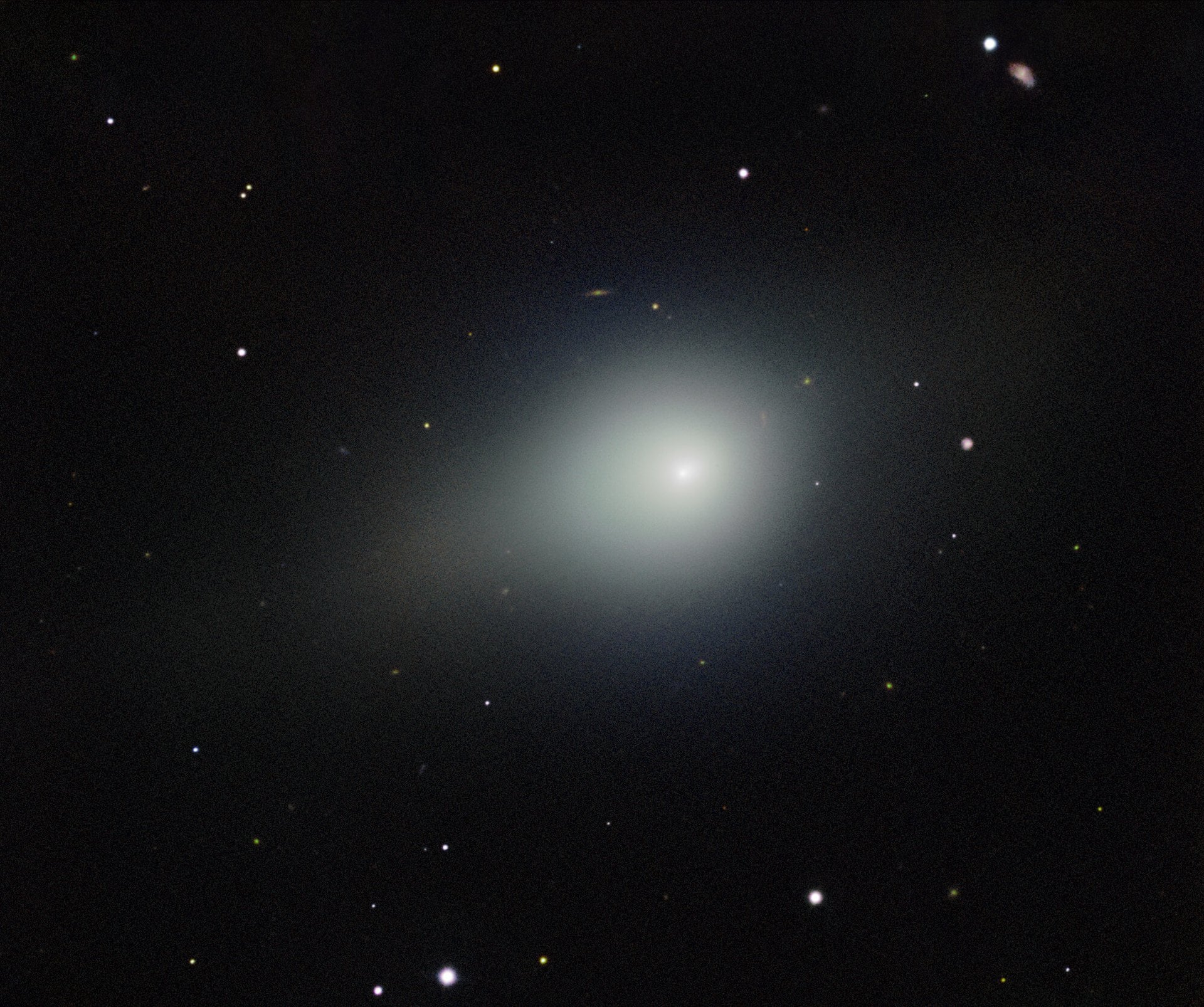
Spectroscopy was not the only tool brought to bear on 3I/ATLAS. The comet was photographed in colour by the Gemini North telescope on 26 November 2025, an image produced by the International Gemini Observatory, NOIRLab, NSF, AURA and B. Bolin. Supporting analysis has also mapped how the comet's material is distributed, with a figure credited to Lea Ferellec illustrating the differing spatial arrangements of dust, gas and ions within 3I/ATLAS. Together, these views complement the spectroscopic data, showing not just what the comet contains but how it sheds that material into space.
Why This Matters for Future Interstellar Research
With only three interstellar objects detected so far, the sample size available to scientists is tiny, and each new arrival has to be squeezed for everything it can offer before it fades from view. The 3I/ATLAS campaign demonstrates what is achievable when a large telescope is paired with a modern, wide-field spectrograph and precise guiding: a detailed chemical profile of a body born around another star, assembled from a few carefully timed observations of its escaping gases.
That methodology is likely to shape how the next interstellar visitor is handled. If the ratio of dinitrogen to carbon monoxide can reliably indicate formation temperature, then future objects can be quickly classified as inner-system or outer-system products, and their chemistry compared against 3I/ATLAS and one another. Over time, that comparison could reveal whether cold, nitrogen-rich formation environments are typical of planetary systems in general, or whether 3I/ATLAS is an unusual case.
For now, the comet has delivered the first clear evidence that at least one interstellar object coalesced in conditions colder than anything found in the region around our own Sun — and that its parent system had an outer frontier of ice, much like ours does.
Key Findings at a Glance
- 3I/ATLAS is only the third interstellar object ever detected, and it passed by Earth before looping around the Sun.
- The WHT Enhanced Area Velocity Explorer (WEAVE) on the 4.2-metre William Herschel Telescope captured ionised gas as the comet emerged from behind the Sun.
- Five ions were identified simultaneously: dinitrogen, carbon monoxide, carbon dioxide, water and hydrocarbons.
- The dinitrogen-to-carbon-monoxide ratio indicates formation below -240 °C (-400 °F).
- That points to an origin in the distant, icy edge of its home star system, analogous to the Kuiper Belt or Oort Cloud.
- The research was led by Dr. Léa Ferellec of the University of Northumbria and published in the Monthly Notices of the Royal Astronomical Society.
This article is based on reporting by Universe Today. Read the original article.
Originally published on universetoday.com