For decades, astronomers have detected mysterious radio pulses arriving from deep space. Some of the most puzzling come from binary star systems that flash every few minutes—far slower than the rapid-fire ticking of typical pulsars. Now, researchers at Caltech have used supercomputer simulations to show exactly how synchronized pairs of stars generate these long-period cosmic radio bursts.
A Slower Cosmic Pulse
Most radio pulsars are neutron stars spinning at incredible speeds, sweeping beams of radiation across Earth every fraction of a second. But the objects in this new study pulse on a much longer timescale, emitting regular bursts every few minutes. These intense beams are not ordinary radio waves but masers—the radio equivalent of lasers—produced under extreme conditions.
Until now, scientists suspected that these long-period bursts were linked to binary systems featuring a white dwarf and an M-type red dwarf. The two stars orbit each other in a tight gravitational dance, and their synchronized interaction was thought to amplify radio emission. However, the exact physical process behind the maser action remained unclear.

A Cosmic Radio Laser Explained
Masers are naturally occurring amplifiers of microwave or radio radiation. In space, they are often found in regions where energized particles spiral along magnetic field lines and release coherent bursts of energy. The mechanism behind these emissions is known as the electron cyclotron maser instability, or ECMI. When electrons are accelerated in a magnetic field, they emit radiation at a characteristic frequency related to their gyration around the field lines. Under certain conditions, this emission becomes amplified into a powerful, focused beam.
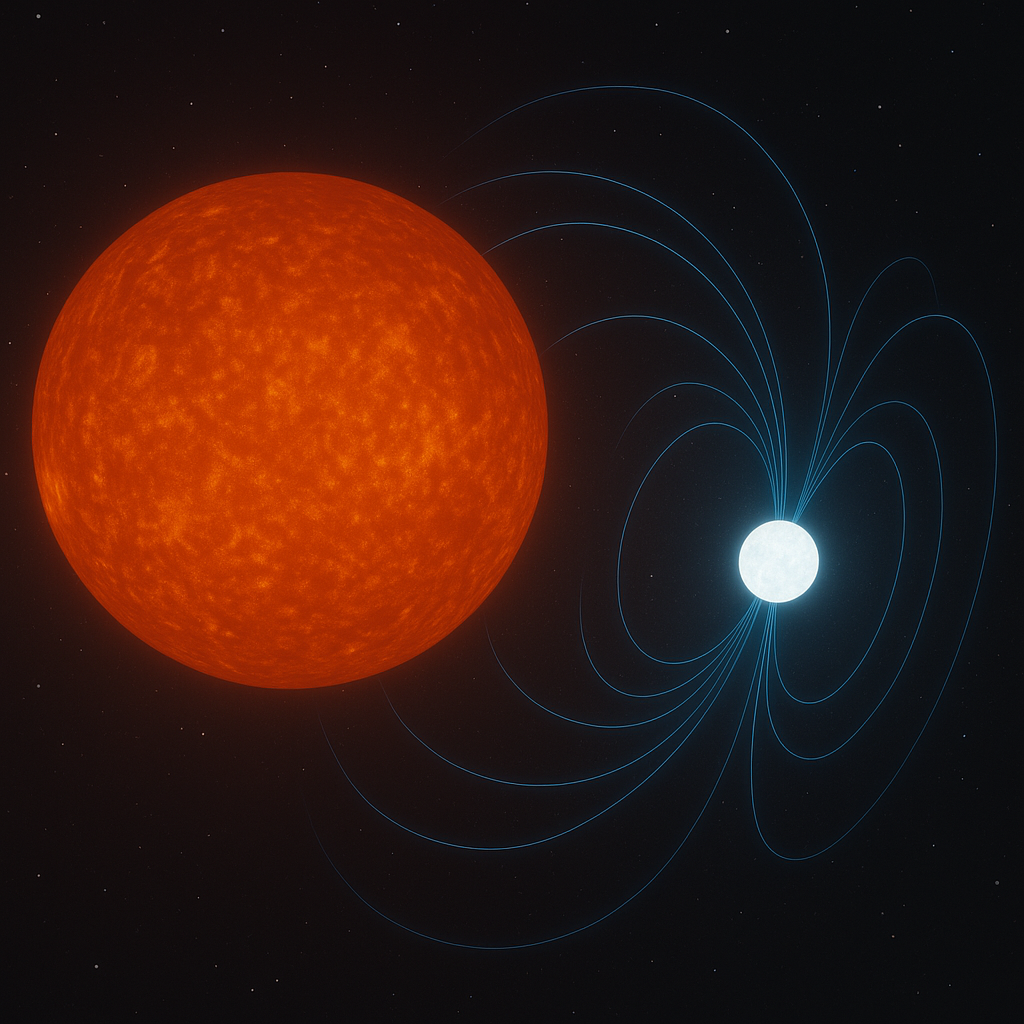
In the newly simulated binary systems, the white dwarf’s magnetic field is the dominant force. It sweeps across the M dwarf as the two stars orbit, driving enormous electric currents through the space between them. These currents energize electrons, and the resulting ECMI produces the long-period radio pulses that have puzzled astronomers. The simulations show that the synchronization of the two stars is critical—each orbit triggers the instability and creates a pulse.
The White Dwarf–M Dwarf Connection
White dwarfs are the dense, compact remnants of Sun-like stars that have exhausted their nuclear fuel. M dwarfs, also called M-type red dwarfs, are among the smallest and coolest main-sequence stars. When paired in a close binary, their magnetic fields interact in dramatic ways.
According to the new research, the white dwarf’s magnetic field lines are far stronger than those from its M dwarf companion, and they play a key role in creating the radio emission. As the M dwarf moves through the white dwarf’s magnetic field, it acts like a conductor moving through a magnetic generator, producing a massive current. This current flows along the magnetic field lines and powers the ECMI.
The result is a coherent radio beam that sweeps across space much like a lighthouse. Each time the binary completes an orbit, the beam points toward Earth, producing a regular pulse. This explains why the observed bursts repeat every few minutes, matching the orbital period of the binary pair.

Simulating the Maser Engine
The study, published in The Astrophysical Journal Letters, was led by Yici Zhong, a Sherman Fairchild Postdoctoral Scholar Research Associate in Theoretical Astrophysics, and Elias R. Most, Assistant Professor of Theoretical Astrophysics and a William H. Hurt Scholar. Both are members of the Theoretical AstroPhysics Including Relativity and Cosmology group and the Walter Burke Institute for Theoretical Physics at Caltech.
Zhong and Most built supercomputer simulations that, for the first time, provided a clear, end-to-end picture of how these binary pairs power the masers they shoot into space. The models tracked the flow of current between the stars and the resulting radio emission, demonstrating that ECMI is indeed responsible for the long-period bursts observed by telescopes.
These findings give astronomers a direct computational framework for understanding radio emission from binary systems containing an interacting white dwarf. Previously, researchers had to rely on indirect inferences and simplified models. The new approach can be used to predict the behavior of similar systems and interpret future observations.
A Familiar Pattern: Jupiter and Io
Interestingly, the radio pulses from white dwarf–M dwarf binaries bear a strong resemblance to planetary radio emissions observed in the Jupiter system. Astronomers first noticed those bursts in 1955 and spent years trying to explain what drove them. In 1969, Caltech scientists Peter Goldreich, Professor Lee A. DuBridge, and Donald Lynden-Bell solved part of the puzzle. They proposed that a powerful electrical current flows between Jupiter and its innermost Galilean moon, Io, as the moon sweeps through Jupiter’s magnetic field.
According to their theory, the orbital motion of Io generates a million-ampere flow of electric current in the shape of a tube connecting Io to Jupiter’s magnetosphere. That prediction was later confirmed by direct satellite imaging. Other research went on to demonstrate how similar processes could operate in stellar binary systems, but the new simulations provide the most detailed picture yet of how the emission is produced.
What the Simulations Reveal
The simulations offer several key insights into the generation of long-period radio bursts:
- The white dwarf’s magnetic field is the primary driver of the maser emission, not the M dwarf’s.
- Electron cyclotron maser instability occurs naturally in these binary systems when the current flowing between the stars reaches a critical threshold.
- The orbital period of the binary sets the repeat rate of the radio pulses, explaining the observed intervals of a few minutes.
- The radio emission is highly directional, which is why we only detect these bursts when the beam happens to cross Earth.
This work also demonstrates the power of computational astrophysics. With supercomputer simulations, researchers can probe environments too extreme to recreate in a laboratory and study phenomena that unfold over astronomical timescales. The Caltech team’s model can be adapted to other binary configurations, potentially revealing more sources of cosmic masers.
Implications for Future Observations
As upcoming radio observatories scan the sky with greater sensitivity, they are likely to uncover more of these intriguing systems. Long-period radio transients have been an observational mystery for years, and linking them to ECMI in white dwarf–M dwarf binaries offers a coherent explanation that can be tested with future observations.
The new simulations also provide a predictive tool. By modeling the expected radio emission from a known binary system, astronomers can compare observations to theoretical predictions and identify which systems are likely to produce masers. This could help prioritize targets for follow-up observations and lead to the discovery of more of these cosmic radio lasers.
In the broader context, understanding how binary stars generate coherent radio emission sheds light on fundamental plasma physics in extreme environments. It also connects stellar astrophysics with planetary science, as the same processes that create radio bursts in star systems are at work in our own solar system, between Jupiter and its moon Io.
The Caltech study brings scientists a major step closer to unraveling the mystery of these synchronized stellar radio pulses. With the newfound ability to model the maser mechanism in detail, the universe’s radio lasers are no longer so enigmatic—they are simply another consequence of stars moving in lockstep under the influence of powerful magnetic fields.
This article is based on reporting by Universe Today. Read the original article.
Originally published on universetoday.com