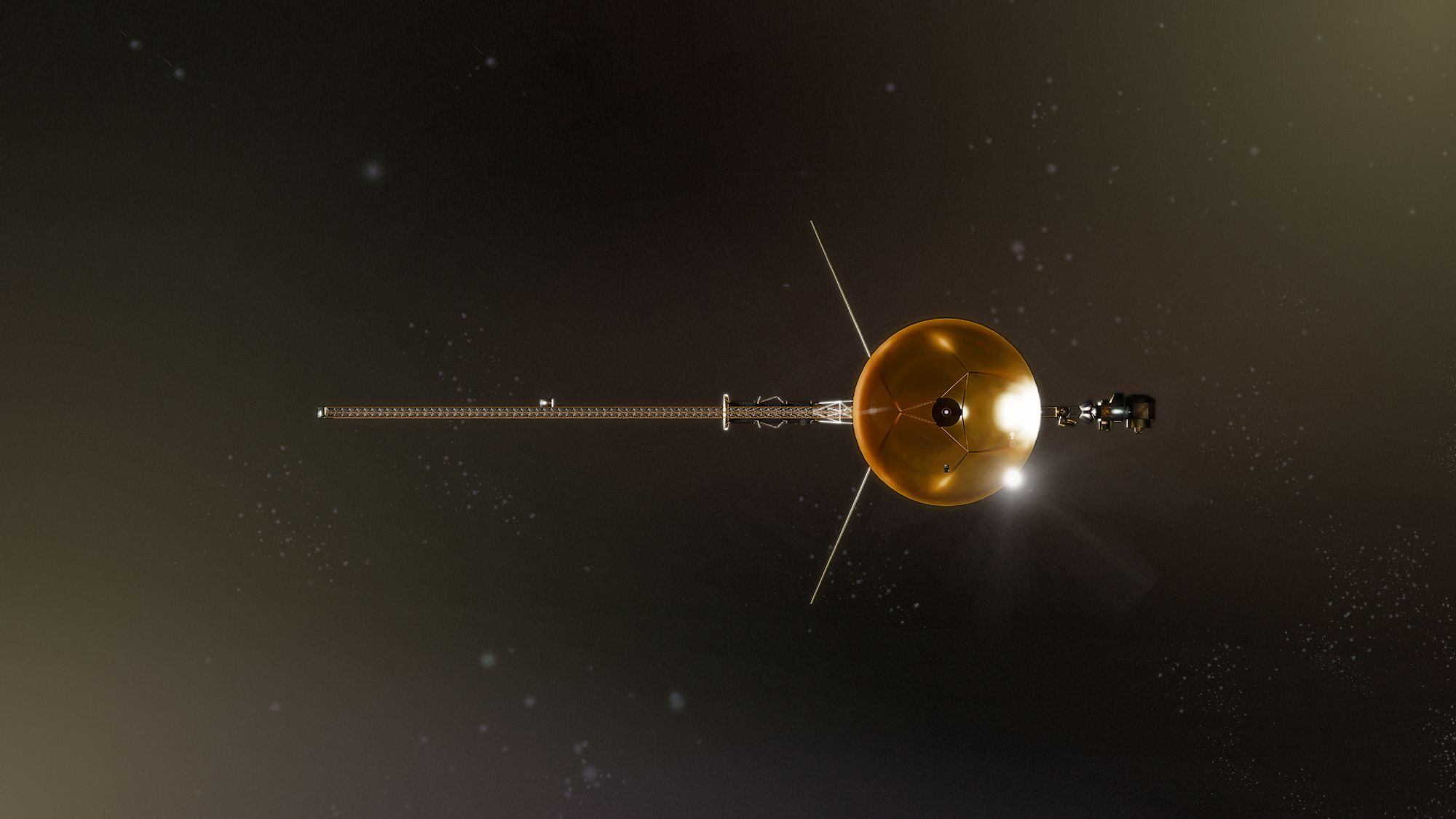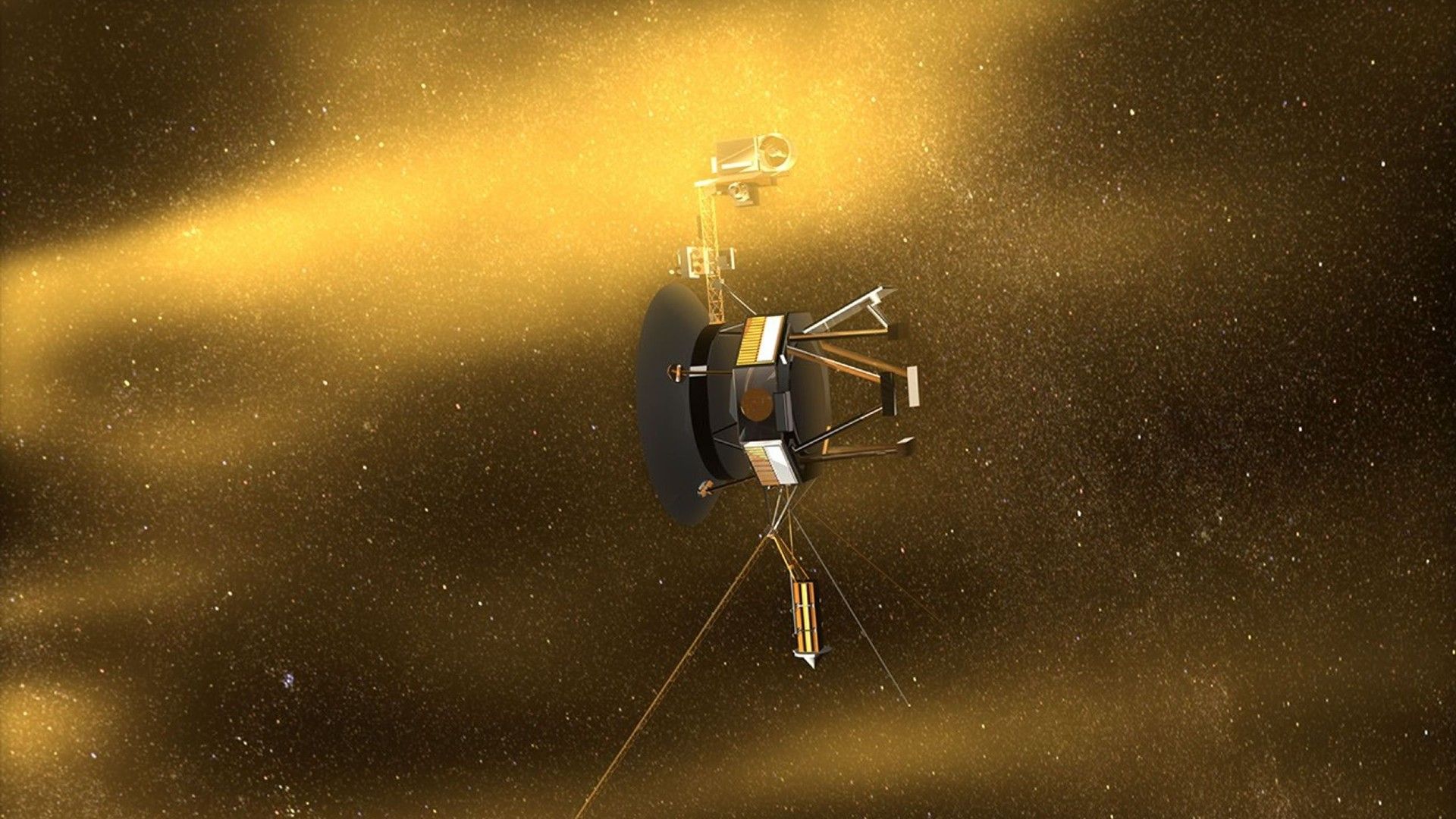
Voyager 1 has reached a distance at which a radio command from Earth takes a full 24 hours to arrive. The milestone, reached on Nov. 18, places NASA’s veteran spacecraft one light-day away from its home planet and underscores both the scale of interstellar space and the persistence of a mission launched in 1977.
The one-way light-time is a simple but powerful measure. A command sent to Voyager 1 travels at the speed of light for an entire day before reaching the probe. Any reply requires another day to return, meaning an exchange cannot happen in anything close to real time. From Earth, the spacecraft is now far enough away that even light needs a day to bridge the gap.
The achievement comes almost 50 years after Voyager 1 and its twin, Voyager 2, began their original tour of the outer solar system. Both missions have long outlived that initial phase, becoming rare active observers of the environment beyond the Sun’s protective bubble of particles.
From planetary flybys to interstellar measurements
Voyager 1 observed Jupiter and Saturn at close range before making a flyby of Titan, Saturn’s large moon, and examining Saturn’s rings. That route sent the spacecraft above the plane of the solar system in the early 1980s and gave it a faster outward trajectory than Voyager 2.
Voyager 2 followed a slower path because it also visited Uranus and Neptune after its encounters with Jupiter and Saturn. It is expected to reach a one-light-day distance in 2035. The difference in their trajectories means the two spacecraft have sampled the solar system’s outer reaches along distinct routes, then carried their instruments into interstellar space on different paths.
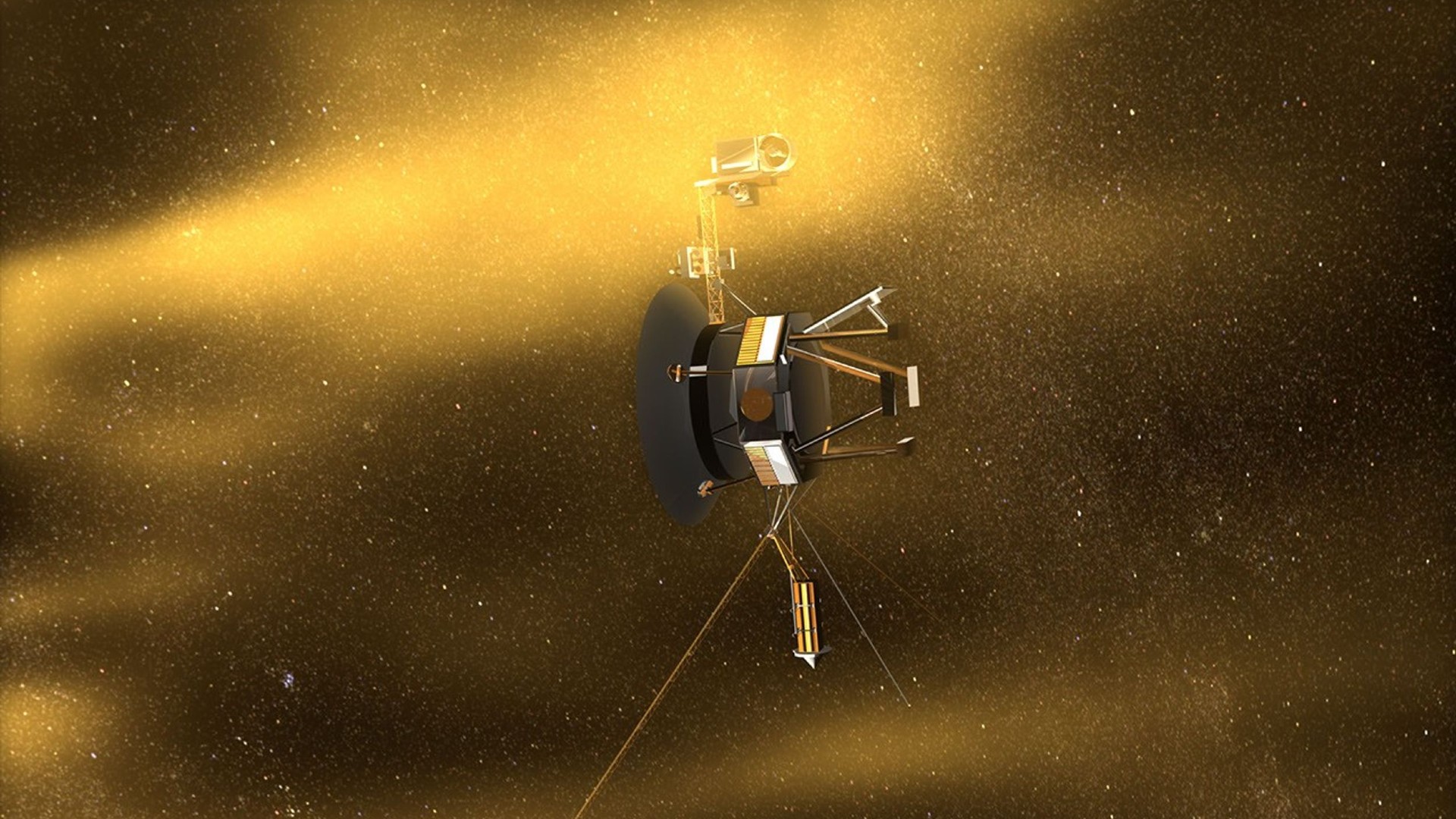
Voyager 1 crossed into interstellar space in August 2012. Voyager 2 followed in November 2018. In this region, the Sun’s constant outward stream of particles has given way to the physics of the space between stars. The boundary is defined by the heliopause, where the solar influence carried by that particle stream meets the interstellar environment.
That setting is why the spacecraft remain scientifically valuable. They are not merely moving farther from Earth; they are continuing direct measurements in a region that is difficult to study from within the heliosphere. Their observations provide a long-running record of conditions outside the Sun’s main particle domain.
What Voyager 1 is still measuring
NASA’s Voyager project manager, Suzanne Dodd, said the current science work includes investigating magnetic-field strength and direction, plasma density, and energetic particles. The mission is also examining how those phenomena change as the spacecraft travels farther from the Sun.
These measurements are especially useful because they come from a moving platform. Conditions in interstellar space are not necessarily static across distance or time. As Voyager 1 proceeds outward, its instruments can track changes in the local magnetic field, the density of plasma, and populations of energetic particles. The mission is also watching for solar effects, including shocks.
The observations add context to the basic milestone of a one-light-day distance. Communication delay is the visible consequence of Voyager’s remoteness, but the mission’s continuing purpose is to make measurements at that remoteness. Every signal received at Earth represents data gathered where the solar system’s outward influence has diminished and interstellar conditions dominate.
A mission shaped by distance and delay
At this range, operations require patience. Ground controllers cannot send a command, immediately inspect its result, and adjust in a single work shift. A one-way command takes a day, while a round-trip exchange takes roughly two days. The spacecraft’s autonomy, durable engineering, and carefully planned operations are therefore central to keeping the mission productive.
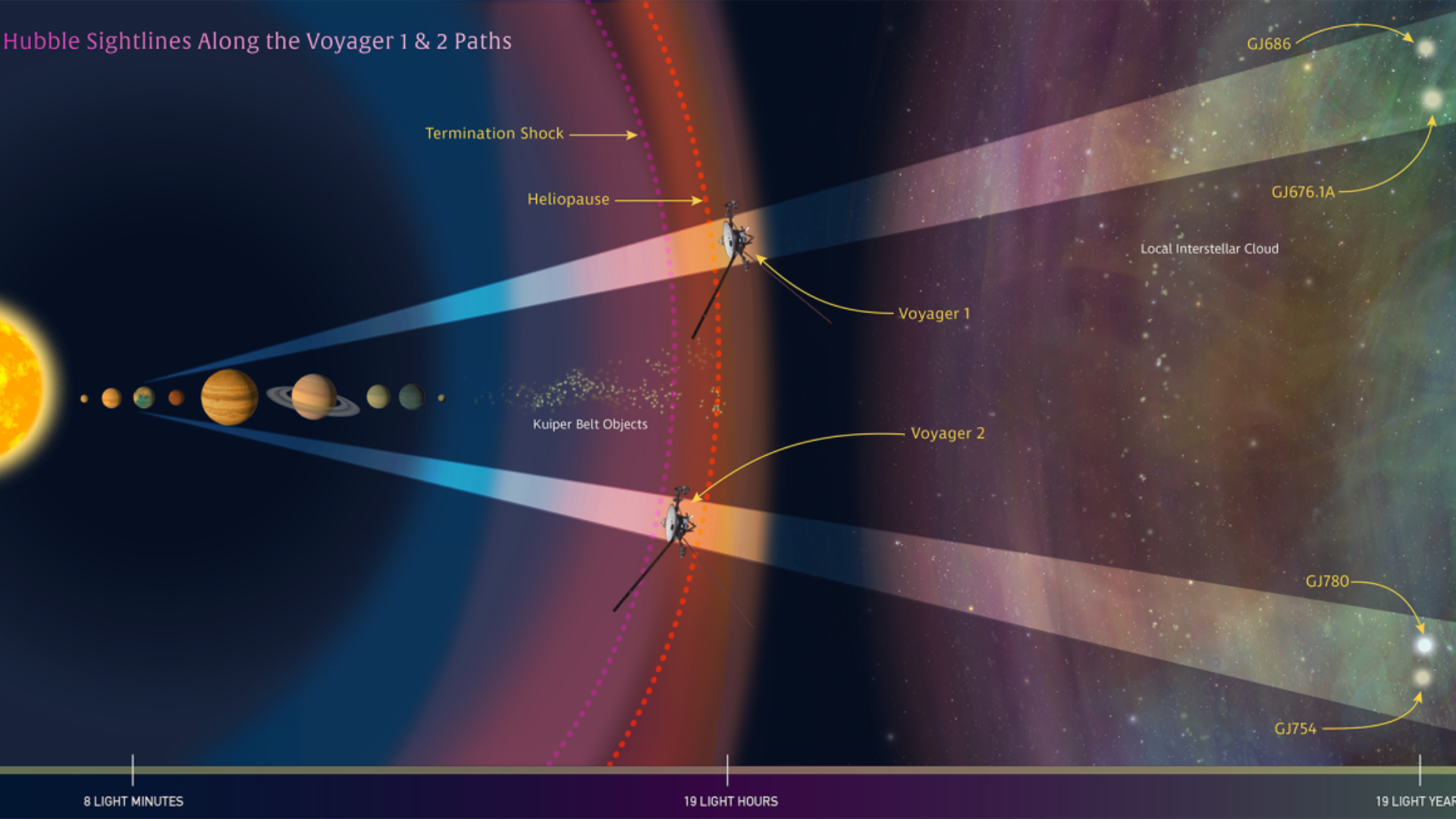
The milestone also gives a concrete scale to Voyager 1’s journey. “One light-day” is not a boundary in space and does not mark arrival at a destination. It is a distance defined by communication: the point at which light, and therefore radio signals, need 24 hours to travel between Earth and the probe. But it vividly demonstrates how far a spacecraft can travel while remaining in contact with its creators.
Voyager 1’s original planetary work is now part of the history of solar-system exploration. Its present role is different. The spacecraft is an interstellar probe, operating in a region where it can study magnetic fields, plasma, and particles beyond the heliopause. The continued stream of information is the mission’s defining achievement at this late stage.

Voyager’s next chapter
NASA expects Voyager 1 to keep working until at least 2027, when the mission reaches its 50th anniversary. Its future beyond that point depends on the practical limits faced by any spacecraft operating far from Earth: the condition of its systems, the ability to continue communicating, and the physics of an environment no human-built vehicle had sampled before the Voyagers.
There is no indication in the milestone itself that the mission’s scientific value has ended. On the contrary, Voyager 1 is continuing measurements as it moves farther out, and Voyager 2 remains on its own route toward the same one-light-day threshold. Together, the pair preserve a long baseline of exploration—from close planetary encounters to the space between stars.
For a spacecraft launched during the 1970s, a 24-hour one-way signal delay is an extraordinary marker of endurance. Voyager 1 has crossed from a mission designed to survey distant worlds into an instrument studying the interstellar environment, still reachable from Earth—just not quickly.
This article is based on reporting by Space.com. Read the original article.
Originally published on space.com