Three nominations moved forward amid a procedural dispute
The Senate Commerce Committee has reported nominations for two NASA posts and one seat on the Federal Communications Commission despite the absence of Democratic members, a move that has intensified an argument over whether the committee had the quorum required to take official action.
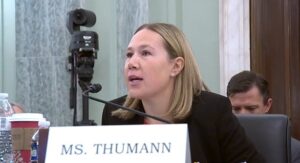
President Trump nominated Joshua Shoemaker to serve as NASA’s chief financial officer and Robert Steinau to become the agency’s inspector general. The committee also advanced Danielle Thumann Severs for a seat on the FCC. The nominees appeared at a November 10 hearing that also included a Department of Transportation nominee.
The NASA nominations were described as noncontroversial. The conflict centered on Thumann Severs, currently senior counsel to FCC Chairman Brendan Carr. Democrats objected to considering her nomination without a Democratic counterpart, a pairing practice that has historically helped preserve the commission’s bipartisan structure.
The quorum question
According to Space Policy Online, committee rules require a quorum for official action and that quorum includes at least one senator from the minority party. No Democrats attended the meeting at which the nominations were approved. Republicans nevertheless proceeded, while Democrats argued that the action should be delayed.
The dispute is more than a technical Senate fight. Confirmation procedures determine how quickly agencies can fill positions that carry responsibility for federal budgets, oversight and communications policy. The nominations must still clear the Senate, but their advancement from committee marks a significant procedural step.
For NASA, the chief financial officer and inspector general roles have distinct functions. The chief financial officer oversees financial management, while an inspector general provides independent oversight. Neither nomination was identified as a major point of partisan contention in the account. Their inclusion in the same committee action, however, placed them inside a broader confrontation over the FCC seat.

Why the FCC seat has drawn opposition
The FCC has five commissioners. Its longstanding political balance has generally been three commissioners from the president’s party and two from the other party. The Senate has often considered a Republican and Democratic nominee together, helping maintain that balance during transitions.
At present, the commission has two Republican members, Carr and Olivia Trusty, and one Democrat, Anna Gomez. Gomez’s term expired in June, but she remains in a holdover capacity allowed under the Communications Act through the end of 2027. Thumann Severs’s confirmation would give Republicans a third commissioner, enough for the FCC to conduct commission business.

Democrats have raised concern that a third Republican could change the agency’s balance further. Their concern is shaped by the Supreme Court’s June 29 decision in Trump v. Slaughter, which the report says held that presidents may remove executive officers of independent agencies without cause. Since its creation in 1934, the FCC had been understood as an independent agency not subject to White House direction.
That legal and political context is central to the current dispute. A commission’s formal party balance, the independence of its members and a president’s removal authority can all affect how the agency approaches rules, enforcement and major policy decisions.
Space policy is part of the FCC’s remit
The FCC is best known for regulating communications, but its decisions also have a direct and growing impact on commercial space activity. Satellite operators need radio-frequency authorizations to communicate with spacecraft. The commission also sets rules related to orbital debris.
As satellite operations have expanded with the growth of megaconstellations, the FCC established a Space Bureau in 2023. That bureau reflects how communications regulation has become part of the operational environment for launch providers, satellite companies, broadband constellations and other space businesses.
Commission composition can therefore matter well beyond traditional telecom policy. Spectrum decisions influence whether satellite systems can communicate reliably. Debris-related rules influence how operators plan missions and end-of-life procedures. A functioning commission is also required to take many formal actions, making the threshold of three commissioners consequential for the pace of decisions.
An institutional test with practical consequences
The committee action leaves several questions unresolved. The Senate must decide whether to confirm the nominees. The procedural argument over the committee’s authority may continue. And the political fight over the FCC’s composition is likely to remain tied to wider concerns about agency independence following the Supreme Court decision.
For the space sector, the immediate story is not a change in a specific satellite rule. It is a governance development involving an agency that assigns frequencies and regulates important aspects of satellite operations. For NASA, the action advances candidates for financial leadership and independent oversight at a time when agency administration remains subject to congressional scrutiny.
The episode also illustrates how federal technology policy can turn on institutional mechanics. A disputed committee vote may appear remote from spacecraft, networks or research programs. Yet the people nominated through that process can shape the agencies that fund, oversee and regulate those systems. As the nominations move to the full Senate, the debate will test both the committee’s procedures and the future balance of the FCC.
This article is based on reporting by spacepolicyonline.com. Read the original article.
Originally published on spacepolicyonline.com