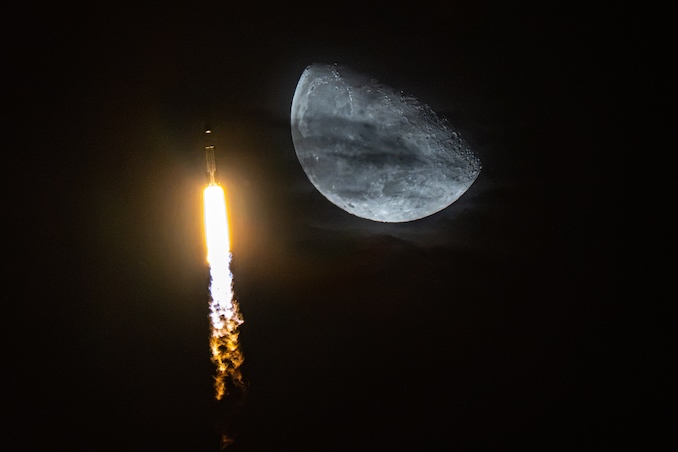
SpaceX’s Falcon Heavy rocket has launched its first mission for the National Reconnaissance Office, marking a new use for the company’s heavy-lift vehicle in US national-security space operations. The classified NROL-97 mission lifted off from Launch Complex 39A at NASA’s Kennedy Space Center in Florida at 11:54 p.m. EDT on October 1.
Because the payload is for the agency responsible for US reconnaissance satellites, little is publicly known about what was carried or the mission’s ultimate destination. What is clear is that the flight gave the National Reconnaissance Office its first use of Falcon Heavy after 22 previous NRO payloads had flown on Falcon 9 rockets.
A heavier option enters NRO launch planning
Falcon Heavy combines three Falcon 9 first stages with an upper stage and payload fairing. Its 27 Merlin 1D engines provide the lift needed for missions that may require more performance than a standard Falcon 9 can offer.
The NROL-97 flight was Falcon Heavy’s 14th mission since the vehicle was introduced in 2018. Its use by the NRO expands SpaceX’s role in launching US intelligence payloads while giving the agency access to a rocket designed for heavier or more demanding missions.
The launch was the first NRO mission procured in 2025 through the competitive National Security Space Launch Phase 3 Lane 2 contract. That detail places the flight within the government’s current approach to buying launch services for national-security missions: selecting providers through a competitive programme intended for the most challenging payload requirements.

Classified payload, visible launch operations
The mission departed on a north-easterly trajectory from Florida’s Space Coast. The NRO did not disclose the payload’s nature, as is typical for its launches. That leaves outside observers unable to assess the satellite or satellites involved, their orbit, or the specific intelligence role they may perform.
While the payload remained secret, several elements of the rocket operation were visible. The Falcon Heavy center core, identified as B1106, was new and was expended during the mission. The two side boosters returned to Earth and landed at Landing Zones 1 and 2 at Cape Canaveral Space Force Station.
The return of those boosters demonstrated the reusable architecture that is central to SpaceX’s launch model. Recovery of the side boosters followed the launch even though the central core was not recovered. Their landings produced sonic booms heard around the region.
Boosters with recent flight history
Both side boosters had flown only a month earlier, when they supported the launch of NASA’s Nancy Grace Roman Space Telescope. Booster B1104 made its second flight on NROL-97, while B1072 made its fourth.
Reuse in this mission is notable because it joined a classified national-security launch to hardware with recent experience on a major NASA science mission. The source also reported that the payload fairing had previously flown on the NROL-95 mission in July, providing another example of recovered hardware being reused for an NRO launch.
Landing Zone 1 was returned to service for NROL-97 after it had been replaced by Landing Zone 40 at Space Launch Complex 40. Landing Zone 40 was used earlier the same day for the return of the booster that launched the Crew 13 mission.
A crowded day for SpaceX
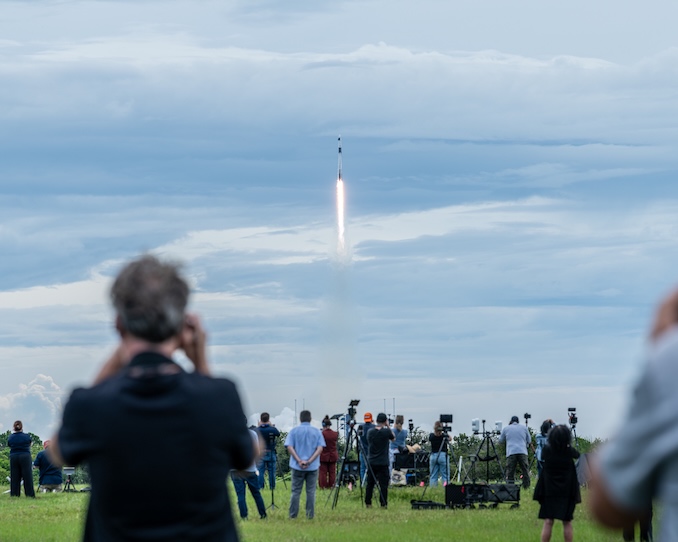
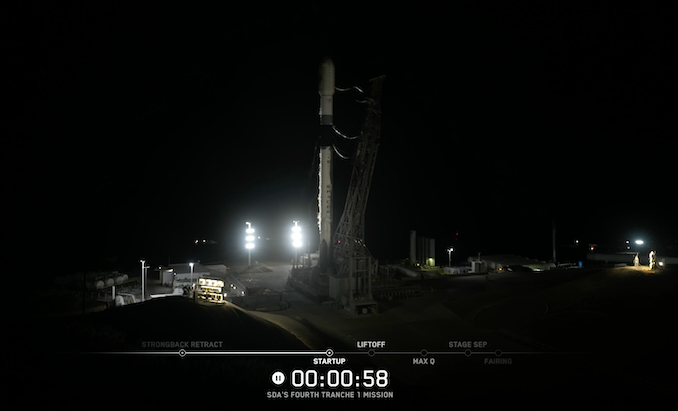
NROL-97 was SpaceX’s third Falcon launch of the day. Before the classified mission, the company launched Crew 13 and also sent 130 payloads into space on the Transporter 13 rideshare mission from Vandenberg Space Force Base in California.
The sequence resulted in four booster landings in a single day, according to the report. It illustrated the operational tempo SpaceX has built around Falcon launches, including human spaceflight, commercial rideshare missions and national-security work.
For the National Reconnaissance Office, the significance is less about the visible booster choreography than about an additional launch option. Falcon Heavy can support missions for which mass, orbital destination or launch-energy needs may differ from those handled by Falcon 9. The agency’s decision to use it for the first time signals that the vehicle now has a place in the NRO’s launch portfolio.
What the first flight signals
The secrecy surrounding NROL-97 means there will be no public technical account of the payload’s purpose. But the launch establishes a clear milestone: the NRO has now used both of SpaceX’s operational Falcon launch configurations for its payloads.
It also shows how reusable launch systems have become intertwined with missions of national-security importance. The flight used a brand-new expendable center core, but paired it with two previously flown side boosters and a previously used fairing. That combination reflects a model in which selected hardware is newly built while other elements are recovered and returned to service.
As the National Security Space Launch programme moves forward, Falcon Heavy’s first NRO mission provides a public indication that heavy-lift reusable launch capability is now available to the US intelligence community, even when the satellite it carries remains out of view.
This article is based on reporting by Spaceflight Now. Read the original article.
Originally published on spaceflightnow.com