A louder gravitational-wave signal may have opened a new route to studying black holes
Black holes are defined by what they hide. The event horizon, the boundary beyond which nothing can escape, blocks any direct view of the physics unfolding at the edge of extreme gravity. That has made the horizon one of the most important and most inaccessible places in modern astrophysics. Now a team of researchers says an unusually powerful gravitational-wave event has provided a way to probe that region indirectly, using information carried in the final moments of a black hole merger.
The result centers on GW250114, a gravitational-wave signal detected by the twin LIGO observatories in the United States. According to the supplied source material, the event was the strongest such signal yet recorded, around three times stronger than the first gravitational-wave detection made a decade earlier. Its intensity gave researchers more data to work with than is usually available when two black holes spiral together and merge.
From that richer signal, the team reports that it isolated a subtle component it calls “direct waves.” Those waves, the researchers argue, contain information from the region immediately beside the event horizon during the instant before the two black holes fully merged and the final object settled into its new form. The work is reported in Nature, according to the candidate text.
Why this matters
For astronomers, the significance is not that anyone has literally seen through an event horizon. Rather, the claim is that the dynamics just outside that boundary leave measurable signatures in gravitational waves. If those signatures can be extracted reliably, physicists gain a new tool for testing how gravity behaves under the most extreme conditions known.
That matters because black holes are among the hardest places to challenge established theory. Einstein’s general relativity has been extraordinarily successful, but researchers expect that any cracks in current physics are most likely to appear where gravity is strongest and the geometry of spacetime is most distorted. The environment around a merging black hole is one of the clearest natural laboratories for that kind of test.
Using the GW250114 signal, the researchers say they inferred two basic properties of the newly formed black hole: its spin and the strength of gravity at its surface. Those are foundational measurements. If future events allow similar estimates, scientists could begin comparing horizon-scale behavior across many mergers instead of relying only on broader properties such as total mass and orbital dynamics.

How gravitational waves became a tool for horizon-scale physics
Gravitational waves are ripples in spacetime produced by accelerating massive objects. Black hole mergers are one of the strongest sources. As the two bodies spiral inward, they emit a characteristic signal that rises in frequency and amplitude before peaking at merger and fading as the final black hole settles down.
Most of the scientific value in these detections has come from reconstructing the overall merger: the masses of the participants, the timing of the collision, and the properties of the remnant. What makes the new claim notable is that the team says the signal also preserves finer-grained information from very near the event horizon itself.
That is a technically demanding proposition. The closer one gets to the horizon, the harder it is to separate meaningful structure from the violent, rapidly changing background of the merger. Any faint component would normally be drowned out. The exceptional strength of GW250114 appears to have changed that equation by making the signal precise enough for a more detailed analysis.
The candidate text attributes the work to Dr. Ling Sun and PhD student Neil Lu at the Australian National University, working with collaborators in Canada, the United States, and Spain. Their interpretation is that these “direct waves” represent a first practical glimpse of conditions at the horizon during a collision.
What researchers can and cannot claim
The source text frames the result as a first step, and that is the right way to read it. A single detection, even an unusually strong one, does not settle the physics of event horizons. The claim will need to survive scrutiny from the broader gravitational-wave community, including questions about how robustly the extra signal component can be extracted and whether alternative explanations fit the data.
Still, the prospect is important even at this early stage. If repeated, the method could expand the scientific role of observatories such as LIGO beyond detection and classification into precision studies of strong-field gravity. That would mark a meaningful shift for the field. Instead of treating mergers only as dramatic confirmations of relativity, researchers could use them as repeatable experiments on the structure of spacetime near black holes.
The timing also matters. Gravitational-wave astronomy is still a young discipline, and each improvement in sensitivity increases the odds of capturing unusually clean or unusually energetic events. If more signals like GW250114 are detected, analysts may be able to compare results across multiple mergers and build confidence that they are truly measuring horizon-adjacent physics rather than artifacts of a particular dataset.

A broader shift in black hole science
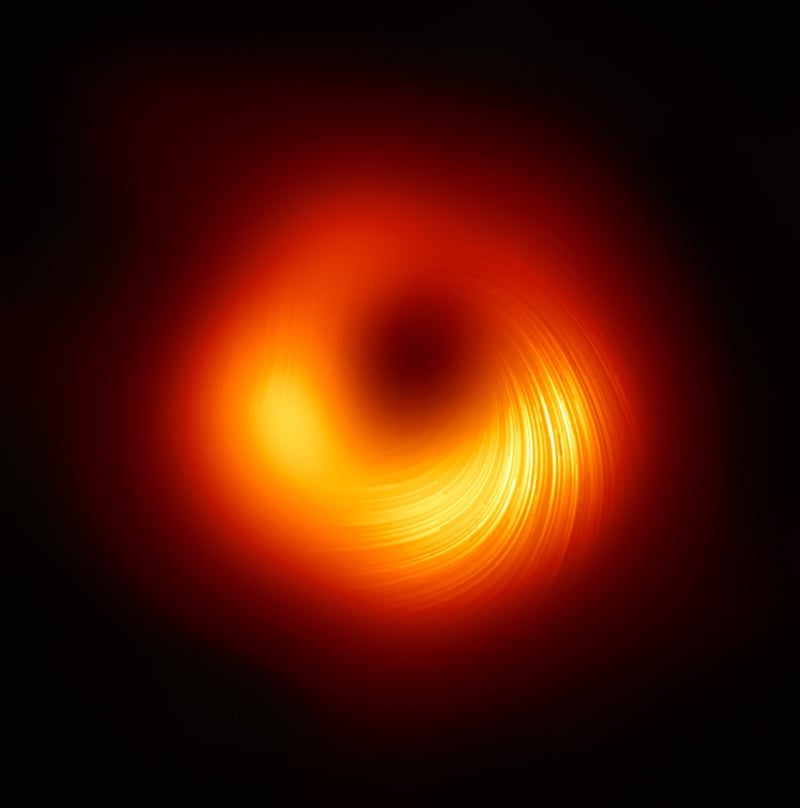
Black hole research has changed rapidly in recent years. The Event Horizon Telescope produced landmark images of the shadow of the supermassive black hole in M87, while gravitational-wave observatories have turned invisible mergers into detectable events. These approaches are complementary. Imaging reveals the structure of matter and light near supermassive black holes under particular conditions, while gravitational-wave measurements capture the dynamics of compact objects in collision.
The new analysis points toward a deeper integration of those efforts. If researchers can connect horizon-scale theory, electromagnetic observations, and gravitational-wave signals, black holes may become less mysterious not because they stop hiding information, but because the universe offers more indirect ways to read what happens around them.
For now, the main achievement is methodological. The reported extraction of direct waves from GW250114 suggests that even the most hidden regions of a merger may leave detectable imprints. Whether that becomes a standard tool of black hole physics will depend on future detections, independent validation, and continued improvements in both observatories and analysis techniques.
But if the result holds, it would mark an important transition. The event horizon would remain a one-way boundary, yet not a total scientific dead end. Researchers may not be able to see inside it, but they may be getting better at listening right up against it.
This article is based on reporting by Universe Today. Read the original article.
Originally published on universetoday.com