A new payload milestone for Ariane 6
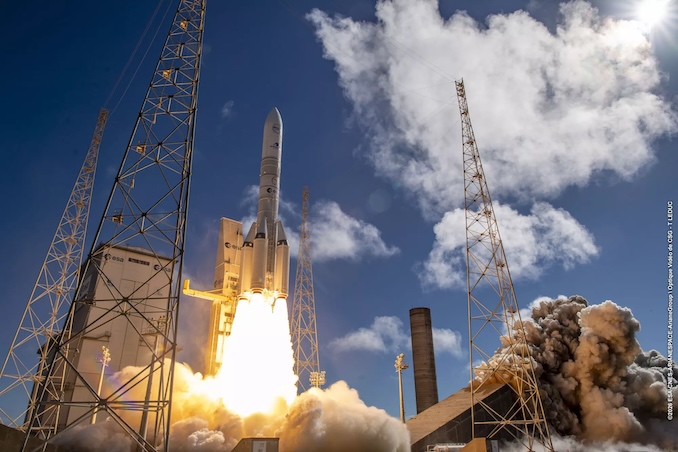
Arianespace has launched its heaviest payload to date, sending 36 Amazon Leo broadband satellites into low Earth orbit on the Leo Europe 03 mission. The flight, carried out by an Ariane 64 rocket from Europe’s Spaceport in French Guiana, also marked the debut of an upgraded solid rocket booster configuration that increases the launcher’s performance.
The company confirmed deployment of all 36 satellites after liftoff, making the mission a technical and commercial milestone at the same time. For Arianespace, it demonstrated that the Ariane 6 family can carry a larger batch of Amazon spacecraft than before. For Amazon, it advanced a major multilaunch campaign to build out its Leo broadband constellation.
The mission was designated VA269 by Arianespace and Leo Europe 03, or LE-03, by Amazon. It was the third of 18 Ariane 6 flights booked by Amazon for constellation deployment, following earlier successful launches in February and April.
What changed on this flight
The most important hardware change on LE-03 was the use of the upgraded P160C solid rocket boosters. Previous Amazon Leo missions flown by Arianespace had used the Ariane 64 configuration with four P120C boosters. On this launch, the Ariane 64 flew for the first time with four P160C boosters instead.
According to the supplied source text, each P160C booster is about a meter longer than the P120C design and carries roughly 156 tons of solid propellant. That is about 14 tons more propellant per booster than the earlier version, and the additional capacity translates into a quoted 10 to 15 percent increase in launcher performance.
Thrust rises as well. The P160C boosters can each produce 3,800 kilonewtons at liftoff, compared with 3,700 kilonewtons for the P120C. Those incremental gains matter because constellation deployment missions are a straightforward test of launch economics: the more satellites a rocket can carry per flight, the more efficiently an operator can build out a network.
On that measure, LE-03 represented a real step forward. Arianespace said this version of the Ariane 64 can carry 36 Amazon Leo satellites, four more than previously possible. That increase may seem modest, but scaled across a long launch campaign it can have meaningful effects on schedule flexibility and deployment efficiency.

Arianespace’s biggest commercial relationship right now
During a prelaunch briefing, Arianespace chief executive David Cavaillolès described Amazon as the company’s main and biggest client today and said the relationship went beyond a standard contract. That framing underscores the strategic weight of the Leo program for Europe’s launch provider.
Arianespace serves both institutional and commercial customers, but large constellation work has become especially important as launch companies compete on cadence, reliability and payload performance. Amazon’s 18-flight booking gives Arianespace a sustained role in one of the largest satellite deployment efforts currently underway.
The LE-03 mission also shows how much launch providers now benefit from repeat business with the same customer. Instead of treating each launch as a standalone event, Arianespace is learning from each successive mission and using that experience to refine the vehicle. Cavaillolès said the company is already looking at further improvements and wants to keep increasing launcher performance and the number of satellites it can carry per flight.
That statement is notable because it places Ariane 6 in an iterative improvement cycle rather than a fixed configuration mindset. The booster upgrade on LE-03 is one example of that process in action.
The mission profile and result
Liftoff took place at 9:21 a.m. local time in Kourou, corresponding to 8:21 a.m. EDT and 1221 UTC. From there, the Ariane 64 carried the 36 broadband satellites toward low Earth orbit. Arianespace later confirmed that all spacecraft had been deployed.
The source text emphasizes the mission’s significance in two ways. First, it was the largest and heaviest payload ever launched by an Ariane vehicle. Second, it was the first time the four-booster Ariane 64 flew with the P160C configuration. Those details make LE-03 more than another routine constellation mission. It was a test of upgraded hardware under operational conditions with a high-profile commercial payload.
Successful deployment does not by itself answer every long-term question about launch cadence or the full economics of the Leo program, but it does remove immediate doubt around this upgraded configuration’s first major assignment. In launch operations, a clean first use of new hardware matters because it strengthens confidence not only for the next mission, but also for the provider’s ability to keep introducing incremental performance gains without disrupting reliability.
Why this matters for Europe’s launch sector
Europe’s launch industry has been under pressure to restore autonomous access to space while also proving it can remain competitive in a market increasingly shaped by mega-constellations, high launch tempo and aggressive performance expectations. LE-03 does not resolve all of those strategic pressures, but it offers evidence that Ariane 6 can evolve quickly enough to stay relevant in the commercial deployment market.
The mission also highlights how launcher improvements can be tightly linked to customer demand. Amazon needs repeated, efficient missions to populate its broadband network. Arianespace needs large anchor contracts and visible successes to build momentum around Ariane 6. The booster upgrade sits at the intersection of those two needs.
There is a broader competitive implication as well. Launch systems are increasingly judged not just by whether they reach orbit, but by how flexibly they can adapt to customer requirements over a sequence of flights. By flying a heavier payload with improved boosters and delivering every satellite on board, Arianespace has added a useful data point in its favor.
For now, the immediate takeaway is simple. LE-03 expanded what Ariane 64 can carry, advanced Amazon’s constellation rollout and gave Arianespace a clean demonstration of a more capable booster set. In a launch market where marginal gains can change deployment timelines and customer confidence, that is a meaningful result.
This article is based on reporting by Spaceflight Now. Read the original article.
Originally published on spaceflightnow.com