New clues point to a violent remake of Neptune’s inner system
A new study is sharpening one of the Solar System’s long-running origin stories: how Neptune ended up with a giant moon unlike its other companions, plus a set of inner moons and dusty rings that look like leftovers from a much messier past. Using observations from the James Webb Space Telescope, researchers conclude that several of Neptune’s small inner moons and its rings likely formed from the interiors of larger worlds that were torn apart after Triton was captured.
The work focuses on three inner moons, Proteus, Larissa and Galatea, along with the rings orbiting Neptune. According to the source material, the findings were published in Science Advances and were led by researchers at the California Institute of Technology. The central question is what Neptune’s original moon system looked like before Triton arrived and disrupted it.
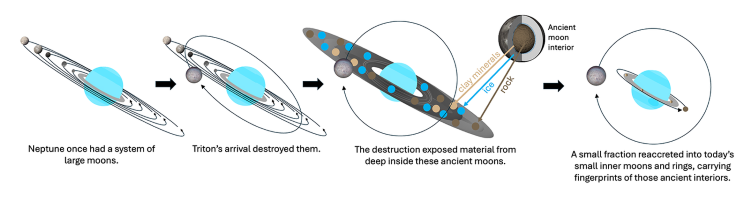
Triton is the key to the mystery because it dominates Neptune’s moon system by mass. The source text says Neptune has 16 known moons and that Triton accounts for more than 99.5% of the total mass of all of them. That imbalance has long supported the idea that Triton did not form where it is now. Instead, scientists have hypothesized that it was captured from the Kuiper Belt, then passed through an elongated orbit that destabilized and reworked Neptune’s earlier moons.
Webb data revealed a surprising absence
To investigate what survived that upheaval, the research team used the Near-Infrared Spectrograph, or NIRSpec, on Webb. What they found was notable not only for what was present, but for what was missing. The source report says all three moons studied, as well as the rings, do not show water ice.
That is unexpected in the outer Solar System, where low temperatures make water ice a common and often dominant surface material. The absence suggested that these bodies may not simply be small primordial objects that formed in place and remained largely unchanged. Instead, the result pointed to a different origin.
The team also found another compositional clue. Larissa, Galatea and the rings were identified as containing water-rich clay minerals with magnesium. Those materials further supported the idea that the present moons and rings came from a more complex parent body or bodies, rather than representing intact small worlds that had existed in their current state since formation.
From larger moons to rubble to new moons
The conclusion presented in the source text is dramatic. The researchers argue that the rings and the three inner moons originated as the interiors of larger moons, and possibly a dwarf planet, that were ripped apart when Triton was captured by Neptune. The debris then reassembled through accretion, eventually producing the rings and the smaller moons seen today.
That scenario recasts Neptune’s inner system as a second-generation structure. Rather than preserving a neat record of original formation, it may instead preserve the aftermath of destruction. In that picture, Triton’s arrival was not just an addition to Neptune’s family of moons. It was the event that reordered the entire system.
Proteus appears to add another layer of detail. The source material says Proteus did not show the same magnesium-bearing, water-rich clay minerals seen in Larissa, Galatea and the rings. The team therefore concluded that Proteus likely formed from a different part of the debris disk. Even within the same broad reconstruction scenario, that implies the debris was not chemically uniform.
Why Neptune matters beyond Neptune
The importance of the result goes beyond one planet’s rings. Giant-planet systems across the outer Solar System carry evidence of migration, capture, collision and reassembly. Neptune is especially interesting because Triton is so anomalous: large, likely captured, and dynamically disruptive. If the new interpretation is correct, Neptune offers a natural laboratory for understanding how satellite systems can be erased and rebuilt.
That matters for comparative planetology. If captured bodies can destroy preexisting moons and seed new generations of smaller satellites, then the arrangement visible today around a planet may reflect later violence rather than original architecture. The study described in the source report therefore contributes to a broader question in planetary science: when scientists look at a moon system, are they seeing a preserved fossil of formation or the debris-shaped result of later events?
The use of Webb is also significant. Neptune is distant and difficult to study in detail, but high-quality infrared observations can uncover compositional information that reshapes long-standing models. In this case, the spectral signatures, and especially the lack of expected water ice, appear to have pushed the interpretation away from a simple in-place origin.
There is still room for follow-up work, particularly in reconstructing the exact nature of the larger bodies that were destroyed and in testing how a debris disk around Neptune would have evolved after Triton’s capture. But the new analysis gives researchers a more specific narrative than the generic idea that “Triton caused chaos.” It identifies likely products of that chaos and ties them to observable composition.
For Neptune, the result is a picture of creative destruction. Larger icy worlds may have been broken apart, their interiors exposed, and their remnants redistributed into rings and modest inner moons. Triton, long treated as the outsider that rewrote the system, remains central to the story. What is changing is the level of detail: Neptune’s present rings, Larissa, Galatea and probably parts of Proteus may not just coexist with the memory of that event. They may be the memory, condensed into debris that survived long enough to build something new.
This article is based on reporting by Universe Today. Read the original article.
Originally published on universetoday.com