Charon’s surface may preserve a record of a dramatically faster past
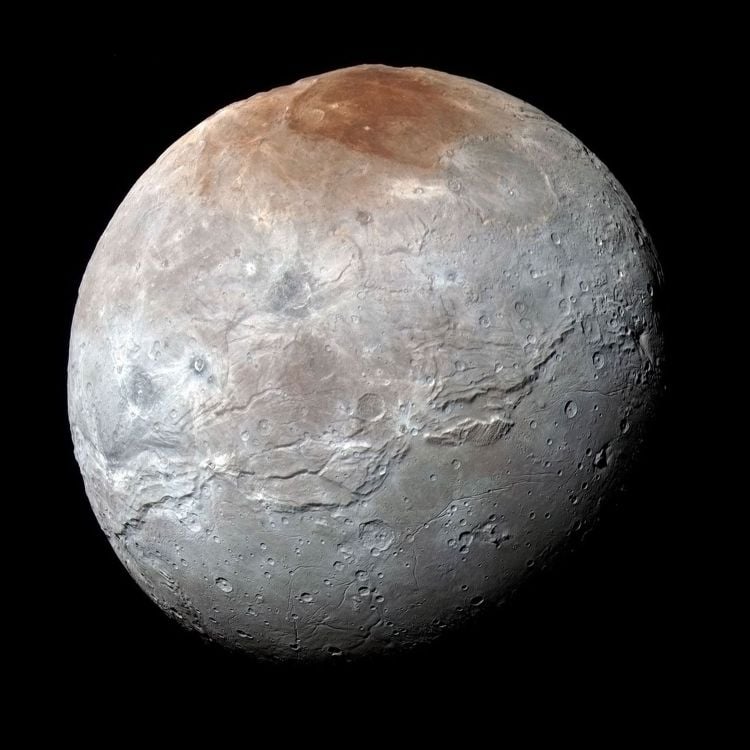
Pluto’s moon Charon has long stood apart from the rest of the solar system’s better-studied icy worlds. It is unusually large relative to the body it orbits, and it has only been seen up close once, during NASA’s New Horizons flyby in July 2015. Even so, the data returned during that brief encounter continue to support new attempts to reconstruct how distant moons form, cool, fracture, and settle into the states seen today.
A new study highlighted by Universe Today argues that Charon’s rugged terrain and fault patterns are consistent with a moon that once rotated far more quickly than it does now. Using computer models to test ideas about Charon’s early evolution, researchers from the University of California, Los Angeles found that the moon may have started with a rotation period of about 14.3 hours. Today, Charon rotates once every roughly 6.4 days, or 153.3 hours. That implies an early spin more than 10 times faster than its current one.
The result matters because it offers a physical explanation for some of Charon’s most distinctive geology. It also gives planetary scientists a relatively clean case study for how icy moons in the outer solar system may change over time as internal structure, surface stresses, and orbital dynamics interact.
Why Charon is a useful test case
Many icy moons bear scars from repeated resurfacing, heavy internal heating, or more complex geologic histories that can obscure early events. Charon appears comparatively less altered, making it valuable for testing longstanding ideas about how frozen worlds evolve. Its size also makes it unusual. According to the supplied source, Charon is about half of Pluto’s diameter and roughly one-eighth of its mass, making it the largest moon relative to its parent body in the solar system.
That relationship has encouraged scientists to look closely at whether Charon’s present-day landscape still reflects conditions from its earliest epochs. One prominent idea, proposed decades ago, is that the moon’s network of equatorial faults formed as Charon slowed from a faster original spin. As the rotation rate changed, stresses would have built up in the crust, helping shape fractures and regional differences across the surface.
The new modeling work was designed in part to test that despinning hypothesis against the actual geologic patterns seen in spacecraft imagery.

Modeling a moon in transition
The study focused on simulating Charon’s early structure and rotational history. The researchers examined how variables such as shell thickness and spin rate could have influenced later surface features. One of the key regions in the analysis was Oz Terra, a northern hemisphere province marked by mountainous, fractured terrain. It contrasts sharply with Vulcan Planitia in the south, which is much smoother.
That north-south contrast has been one of the moon’s biggest puzzles. If both terrains formed under similar conditions, their differences would be harder to explain. But if Charon underwent major early mechanical change as it spun down, then crustal stresses could help account for why one region appears so broken and elevated while another looks far more subdued.
The models described in the source suggest Charon may once have had an ice shell around 30 to 36 kilometers thick. Combined with a fast initial spin, that shell structure would have shaped how stresses accumulated and were released across the surface as the moon despun. In that picture, Charon’s landscape is not just a record of impacts and freezing, but also a record of rotational change.
The timing is also important. The researchers noted that this despinning likely occurred before any cryovolcanism that may have modified parts of the moon later. That sequencing would make the faulted and mountainous terrains especially valuable as markers of an older chapter in Charon’s history.
What the findings could mean beyond Pluto
The importance of the work extends beyond a single moon. Charon is being used, according to the supplied report, as a testbed for understanding other icy moons in the outer solar system. If its terrain can be tied convincingly to early spin-down and shell properties, similar modeling approaches could help interpret worlds whose histories are more complicated or whose observations are less complete.
That does not mean every icy moon followed Charon’s path. Conditions vary widely from system to system, especially when factors such as tidal heating, orbital resonance, and interior oceans are involved. But Charon’s relative simplicity can help researchers separate first-order processes from later overprinting.
There is also a practical scientific value in wringing more insight out of New Horizons data. Missions to the outer solar system are rare, expensive, and slow to arrive. A single flyby can become the foundation for years or decades of reinterpretation as modeling improves. In Charon’s case, the moon’s brief moment in close view is still producing fresh constraints on its origin and evolution more than a decade later.
The new result does not close the case on Charon’s history. It is a modeling-based reconstruction, not a direct measurement of ancient rotation. But it strengthens a specific, long-debated idea by showing that a fast-spinning early Charon is consistent with the moon’s observed fault patterns and geologic asymmetry.
That makes the moon more than a companion to Pluto. It becomes a preserved laboratory for understanding how icy crusts respond when a world’s spin, structure, and thermal history are all changing at once.
Why this story matters
- The study ties visible surface features on Charon to a specific early physical state rather than treating them as isolated landforms.
- It suggests rotational evolution may be a major driver of icy moon geology, alongside impacts and internal activity.
- It shows how archived spacecraft observations can still yield new discoveries when paired with improved models.
For planetary science, that combination is significant. A moon visited once for a matter of hours is still helping researchers probe processes that may have shaped multiple frozen worlds at the edge of the solar system.
This article is based on reporting by Universe Today. Read the original article.
Originally published on universetoday.com