A quasar’s influence appears to stretch much farther than expected
Astronomers studying the quasar H1821+643 report that the object’s winds can push energy far beyond the borders of its host galaxy, reaching into the larger environment around it. The result adds weight to a long-running idea in astronomy: supermassive black holes do not only consume matter, they can also reshape the regions around them through powerful outflows.
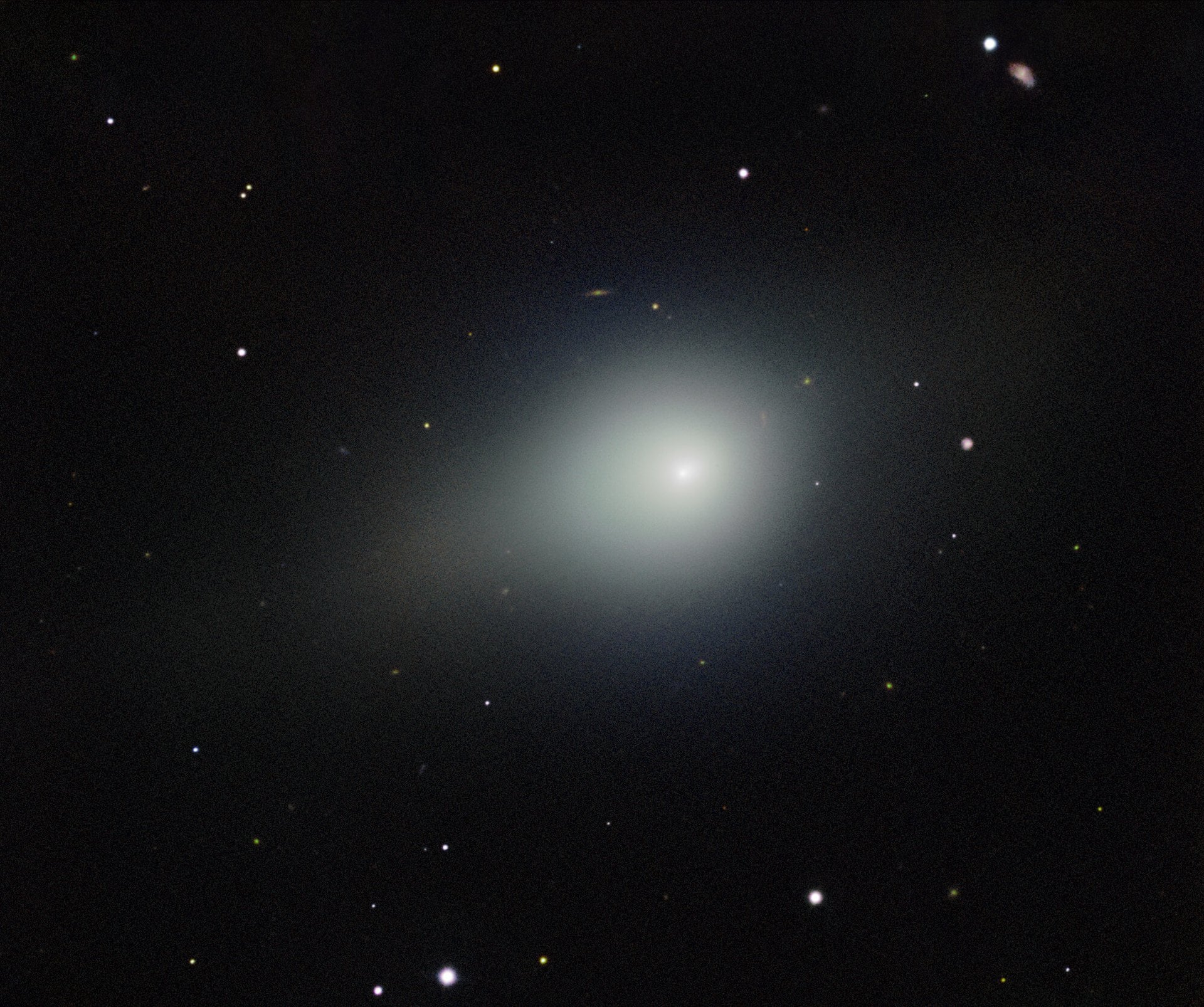
H1821+643 sits about 3.4 billion light-years from Earth in the direction of Draco. Like other quasars, it is powered by an intensely active supermassive black hole. As material falls inward, the system also drives energetic winds outward. In this case, researchers from Tohoku University, Tokyo Metropolitan University, and Kanazawa University found that the effect is not confined to the galaxy itself.
According to the source report, the winds appear able to carry energy well beyond the host galaxy and into the surrounding galaxy-group environment. That makes the impact substantially larger than astronomers had previously assumed for this system.
XRISM let researchers track motion in hot gas
The team used the XRISM satellite to examine the hot gas cloud around the quasar. That cloud emits X-rays, giving astronomers a way to probe conditions in a region that cannot be mapped in ordinary visible light. By taking spectra of the gas and tracking ionized iron, the researchers were able to infer how the material was moving.
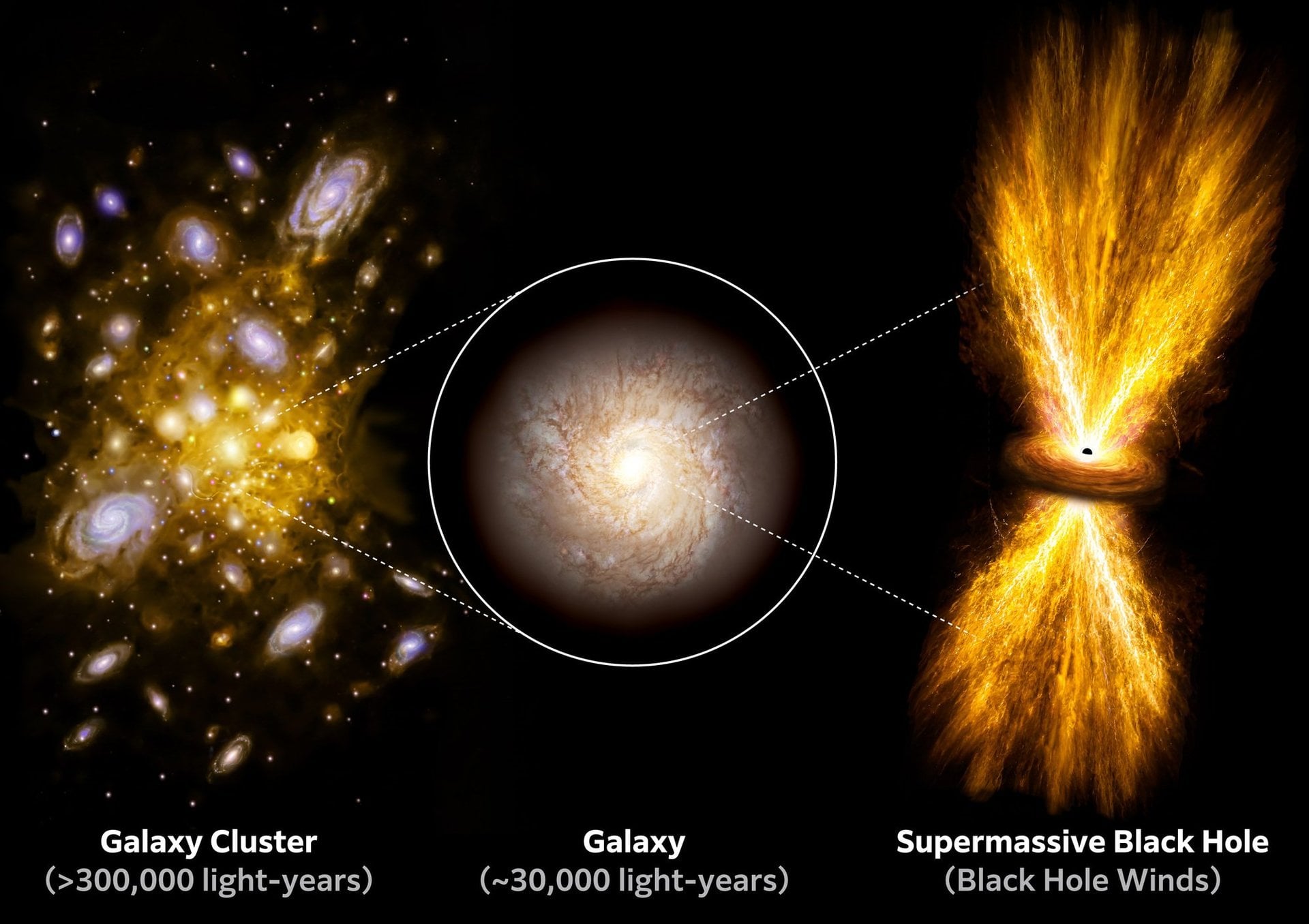
The reported picture is one of violent, large-scale transport of energy. The source text describes a blast driven by the hidden supermassive black hole at the center of the galaxy, with its effects propagating into the surrounding space. The estimated reach extends to roughly 300,000 light-years, far enough to move well beyond the central galaxy and into the broader environment occupied by neighboring galaxies and hot gas.
That scale matters because it shifts the discussion from a black hole affecting only its immediate neighborhood to one affecting a wider structure. If confirmed more broadly in other systems, that kind of feedback could play an important role in how galaxy groups evolve over time.
Black holes are not only sinks of matter
Supermassive black holes are often described in terms of what they swallow, but active systems can also be engines of enormous outward force. The source article quotes Tohoku University researcher Satoshi Yamada saying that black holes are known not only for pulling matter in but also for ejecting gas through powerful winds. In this study, the key finding is that those winds were stronger and more far-reaching than earlier expectations suggested.
That framing is important because the public image of a black hole usually centers on collapse and disappearance. In active galaxies, the opposite process can become just as significant. Gas accelerated away from the center can stir, heat, and redistribute material across vast distances. In practical terms, that means a single compact object can influence whether surrounding gas remains calm, cools efficiently, or becomes too turbulent and energized to behave as it otherwise would.
The source material compares the transported energy to several billion supernova explosions. That does not mean the quasar is literally producing supernovae. Rather, it is a way of conveying the scale of the energy involved. For astronomers, that level of power helps explain why active black holes are treated as central actors in the life cycle of galaxies.
Why this result matters beyond one object
Quasars are among the brightest and most extreme objects in the universe, but they are also valuable as laboratories for understanding galactic evolution. If the energy released by an active supermassive black hole can travel into a surrounding galaxy group, it may affect much more than the central galaxy’s inner gas supply. It could alter the motion and temperature of material across a much broader region.
That is the larger implication of the H1821+643 result. The source report presents the finding as evidence that quasar-driven winds can operate on scales big enough to connect black hole activity with environmental change far outside the galaxy core. In other words, the black hole may be helping shape conditions in the wider structure around it, not merely the galaxy that hosts it.
The observation also highlights the value of high-energy astronomy missions such as XRISM. Because the relevant gas emits in X-rays, a space-based observatory is necessary to capture the signatures researchers need. Tracking ionized iron gave the team a direct way to map motion in a hostile, superheated region that would otherwise remain largely inaccessible.
A reminder of how compact objects can drive oversized consequences
One striking aspect of the report is the mismatch in scale between the black hole and the region it influences. The source text notes that a supermassive black hole is more than 100 million times smaller than the radius of its host galaxy, yet still plays a crucial role in the galaxy’s central region. This study pushes that idea further by indicating the influence can extend beyond the galaxy altogether.
That does not mean every black hole is poised to transform its surroundings in the same way. H1821+643 is an active quasar, an extreme state powered by rapid accretion. But it does reinforce a broader lesson in modern astrophysics: size alone does not determine importance. A compact central engine can dominate the behavior of matter across enormous distances if the energy flow is strong enough.
The source article also uses the finding to illustrate why astronomers pay close attention to our own Milky Way’s central black hole, Sagittarius A*. Earth is not currently in the path of a quasar-like outburst from Sagittarius A*, and the article emphasizes that no such immediate danger exists. Still, the H1821+643 case offers a vivid example of what an awakened supermassive black hole can do to its environment when conditions allow.
For now, the main significance is scientific rather than existential. The H1821+643 observations suggest that black hole feedback may need to be understood on larger spatial scales than previously assumed in at least some systems. If future observations of other quasars show similar behavior, astronomers may gain a clearer picture of how active galactic nuclei help sculpt the structure and thermodynamics of the universe on group-wide scales.
That would make this more than a dramatic story about one distant quasar. It would mark another step toward understanding how the universe’s most compact engines can become some of its most consequential architects.
This article is based on reporting by Universe Today. Read the original article.
Originally published on universetoday.com