Gamma-ray burst afterglow reveals a first at radio wavelengths
Astronomers studying a powerful stellar explosion have captured an unusual signal that could sharpen the scientific picture of how some of the universe’s most extreme outbursts are formed. Using the NSF’s Karl Jansky Very Large Array, researchers detected polarized radio light from the afterglow of a long-duration gamma-ray burst known as GRB 260310A. More importantly, they report that the signal showed evidence of Faraday rotation, marking the first time that phenomenon has been seen in a gamma-ray burst.
The observation traces back to March 10, 2026, when the Fermi telescope gamma-ray burst team reported the event. GRB 260310A was identified as a long-duration burst, the kind associated with the death of a massive star. According to the source material, the explosion occurred inside a dense, highly magnetized cloud of hydrogen gas, an HII region created by the winds of a massive young star.
That environment matters because it appears to have left an imprint on the light escaping the blast. As telescopes around the world turned toward the burst and its afterglow, the Very Large Array detected polarized radio emission from a jet streaming away from the explosion site. The polarization signature did more than confirm the presence of ordered processes in the afterglow. It gave astronomers a new way to read the magnetic environment surrounding the burst.
Why polarized light matters
Polarized light oscillates in a particular direction. In everyday life, people encounter the concept through polarized sunglasses, which filter reflected light. In astrophysics, polarization can reveal physical structure that ordinary brightness measurements cannot. It can carry information about magnetic fields, the geometry of jets, and the material light has crossed on its way to Earth.
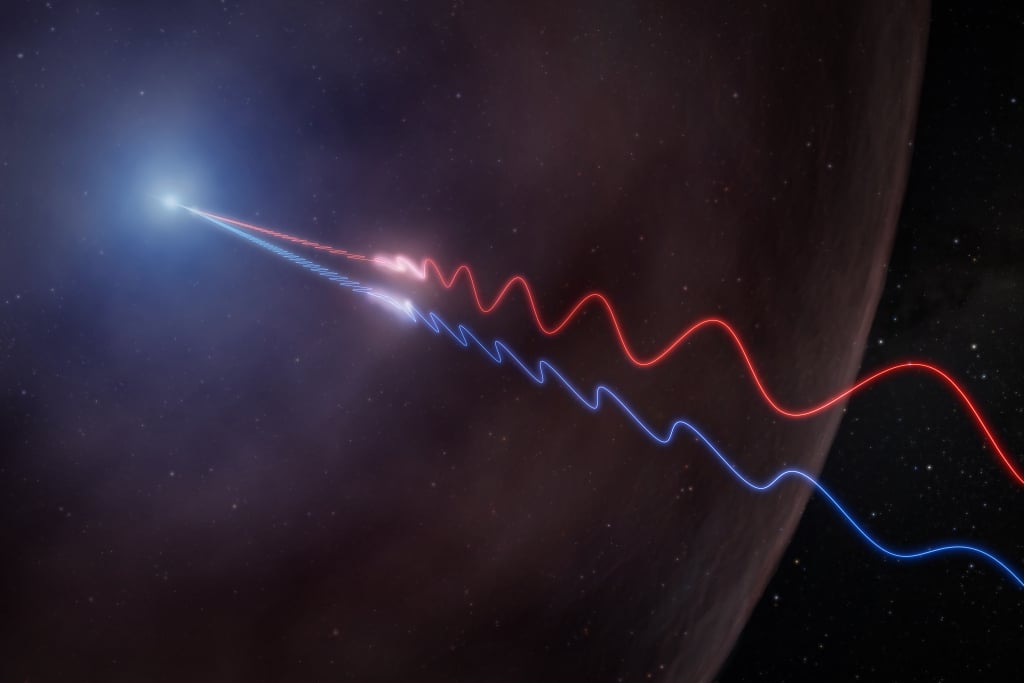
In the case of GRB 260310A, astronomers found that the polarization angle changed across radio wavelengths. That wavelength-dependent twist is the hallmark of Faraday rotation, a process that occurs when polarized light travels through a magnetized plasma. The magnetic field and charged particles in that medium rotate the light’s polarization angle, and the effect grows stronger at longer wavelengths.
This is why the detection is scientifically important. It means the burst was not just observed as a flash and fading afterglow. Researchers were able to use the radio signal itself to probe the magnetized material surrounding the exploded star. The source text describes this as the first time anyone has seen Faraday rotation in a gamma-ray burst, opening a direct observational route to studying the immediate environment of these events.
A burst inside a magnetized stellar bubble
The hydrogen cloud around GRB 260310A was not simply a random pocket of gas. The source describes it as an HII region, a bubble of ionized hydrogen formed by winds from a massive young star. That description fits neatly with the prevailing model for long-duration gamma-ray bursts, which links them to the collapse and explosion of very massive stars.
The new radio evidence strengthens that interpretation. If the burst exploded inside a dense, magnetized HII region, then the progenitor star likely spent its life embedded in an active stellar environment before dying catastrophically. The resulting jet then had to punch through and shine through that magnetized material, allowing astronomers to detect the twisting effect on the radio polarization.
That environmental readout is valuable because gamma-ray bursts are famously intense but fleeting. Scientists often learn about them by reconstructing clues from their afterglows across different wavelengths. In this case, the radio data appears to preserve information not just about the jet itself, but about the local cosmic neighborhood in which the star lived and died.
What Faraday rotation can tell astronomers
Faraday rotation provides a handle on both magnetic-field structure and the magnetized plasma through which the light has traveled. In simple terms, it can help researchers estimate how ordered the magnetic field is, how strong it may be, and how much ionized material lies along the line of sight. For an object as violent and distant as a gamma-ray burst, that is an unusually rich return from a single type of measurement.
The source text says the effect offers clues about the structure and strength of the magnetic field around the burst site, as well as the plasma conditions in the aftermath of the explosion. Those measurements could help refine models of how jets are launched, how they interact with surrounding matter, and what sort of progenitor environments are capable of producing especially powerful bursts.
That last point is significant. Gamma-ray bursts are not all created under identical conditions, and one of the field’s central questions is which stars and surroundings are most likely to generate them. If radio polarization can map the magnetized environments around these events, it could become a new comparative tool across future bursts.
A milestone for multi-observatory follow-up
The detection also highlights the value of rapid follow-up after a burst alert. Once Fermi reported GRB 260310A, astronomers moved quickly to observe it with as many instruments as possible. The Very Large Array’s contribution proved especially important because radio wavelengths preserved the polarization information needed to reveal the Faraday rotation signature.
That kind of coordinated observing campaign is now central to time-domain astronomy, where fleeting events must be captured quickly before they fade. Gamma-ray bursts can change dramatically over hours and days, so collecting data across the spectrum is often the difference between a rough identification and a physically detailed explanation.
For GRB 260310A, the radio observations appear to have turned a dramatic transient into a more diagnostic event. Rather than only confirming that a massive star exploded and launched a jet, researchers can now infer more about the magnetic bubble surrounding the blast. The source material says the full data set from the event should help scientists better understand exactly what kinds of stars and environments can produce powerful gamma-ray bursts.
What comes next
One observation does not settle the broader theory of gamma-ray bursts, but it can redefine what astronomers look for in the next one. If Faraday rotation can be detected again, radio polarization studies may become a much more important part of standard burst follow-up. Each future case could add another environmental map, helping researchers build a clearer picture of how the most massive stars end their lives.
For now, GRB 260310A stands out as a technical and scientific milestone. The burst provided not only a glimpse of a collapsing star’s violent death, but also a way to measure the magnetized cocoon around it. In a field where the brightest events often disappear almost as quickly as they arrive, that is a rare kind of lasting signal.
This article is based on reporting by Universe Today. Read the original article.

Originally published on universetoday.com