Nysa’s shape may be stranger than astronomers expected
Asteroid (44) Nysa has been observed for more than a century, but until now researchers still lacked a clear view of its true shape. New observations described by Universe Today point to a far more unusual object than a simple elongated rock. Using high-resolution ground-based imaging, an international team led by Kate Minker at Lowell Observatory found evidence that Nysa could be composed of three lobes joined together, potentially making it the first known “contact trinary.”
The work relies on images captured with SHARK-VIS on the Large Binocular Telescope in Arizona and SPHERE/ZIMPOL on the Very Large Telescope in Chile. Both systems use adaptive optics to counter atmospheric distortion, allowing astronomers to recover far sharper detail than ordinary ground-based observations. According to the report, the resulting images approach spacecraft-like quality despite being taken from Earth.
That improvement matters because Nysa has long resisted easy classification. It is one of the brightest and largest E-type asteroids in the main belt, a class associated with enstatite-rich surfaces. Earlier observations suggested it might be elongated or even consist of two joined components, but the evidence remained inconclusive. The new images appear to sharpen that debate by showing two prominent valleys wrapping around the asteroid’s circumference.
Why scientists think Nysa could be three bodies fused together
The team interprets those valleys as neck-like junctions, the narrow regions where once-separate bodies may have settled against one another. In that reading, Nysa is not merely irregular. It is a single object made from three distinct lobes that came together gently enough to remain intact rather than shatter on impact.
That would place Nysa in rare company while also extending a known pattern in small-body evolution. Astronomers have already identified contact binaries elsewhere in the Solar System, including comet 67P/Churyumov-Gerasimenko and the Kuiper Belt object Arrokoth. Those worlds are commonly described as two pieces that merged at relatively low speed. A three-lobed version would be new.
The significance is not just taxonomic. If Nysa is a contact trinary, it would provide another example of how small bodies can assemble through gentle accretion rather than catastrophic collision. That has implications for understanding the physical conditions in the early Solar System, when many minor bodies were still forming, migrating, and colliding. A structure built from three lobes suggests a more complex assembly history than a standard rubble pile or a body fractured by later impacts.
Researchers are not presenting that interpretation as settled fact. The report notes that the team leaves open another possibility: Nysa could be a single object so deeply indented and battered that it only appears to be tripartite. That alternative would still be unusual, because no known asteroid is said to resemble it closely. Either way, the observations move Nysa out of the category of vaguely odd asteroid and into that of a physically distinctive target worthy of sustained follow-up.
A small moon could help resolve the mystery
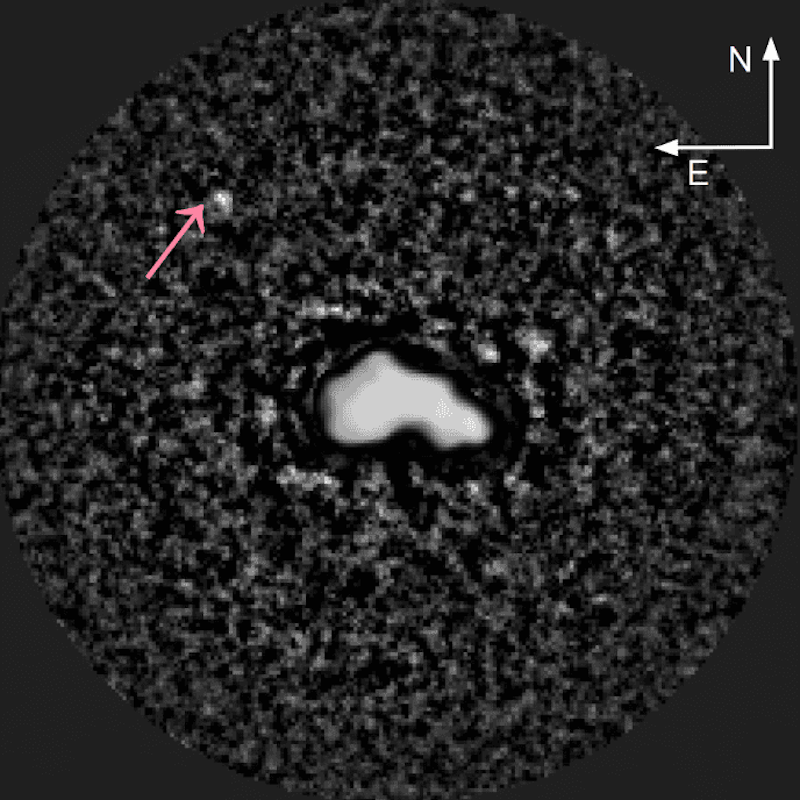
The study also reports the detection of a tiny satellite, designated S/2026 (44) 1. Researchers extracted it from the asteroid’s glare using high-contrast imaging techniques adapted from exoplanet searches. The object is estimated to be about a kilometer across and orbits at least tens of kilometers from Nysa.
That moon may become central to confirming what Nysa actually is. Small satellites give astronomers a way to measure the mass of the primary body by tracing the orbital period and distance of the companion. Once the orbit is nailed down, scientists can derive Nysa’s mass more directly than from brightness or shape estimates alone. Combined with the improved imagery, that could help determine density, internal structure, and whether the asteroid behaves more like a compact monolith or a loosely assembled aggregate.
Those measurements would also test the three-lobe interpretation. A contact-trinary structure may imply a certain balance of density and mechanical cohesion. If the moon-based mass calculation points to a very low-density body, that could strengthen the case for a gently assembled object with significant porosity. If the numbers come out differently, astronomers may have to revisit whether the apparent necks are truly merger boundaries or just topographic depressions.
In practical terms, the moon gives researchers a second line of evidence. The images suggest an extraordinary shape; orbital dynamics can help determine whether the extraordinary explanation is physically plausible.
Why this result matters beyond one asteroid
Planetary science often advances by finding exceptions that force better models. Nysa may be exactly that kind of exception. Main-belt asteroids are usually discussed in broad classes defined by composition, orbit, and general shape, but objects like this reveal how much diversity can exist within those categories. A bright E-type asteroid that may be assembled from three lobes and accompanied by a small moon is not just another catalog entry. It is a test case for how minor planets grow, merge, survive, and evolve.
The finding also highlights how rapidly Earth-based observing power is improving. Spacecraft still provide the most definitive close-up views, but adaptive optics and advanced image processing are narrowing the gap. The report’s description of near-spacecraft-quality images from major observatories is notable in its own right. It suggests that some structural questions once thought to require a dedicated mission can now at least be framed, and sometimes partially answered, from the ground.
That is especially important for bodies like Nysa that are scientifically interesting but not necessarily at the top of any mission queue. Better telescope-based characterization lets astronomers identify which objects deserve deeper study before agencies commit to the cost and time of a spacecraft encounter.
For now, Nysa remains a candidate for a first-of-its-kind classification rather than a confirmed one. But the combination of unusually sharp images and the detection of a moon has materially changed the discussion. After decades of uncertainty, astronomers are no longer just speculating that Nysa is strange. They now have specific physical features to test, a formation scenario to evaluate, and orbital data that could turn an intriguing idea into a durable result.
This article is based on reporting by Universe Today. Read the original article.
Originally published on universetoday.com