A 25-year-old stellar mystery is starting to clear
When V445 Puppis erupted in late 2000, astronomers immediately knew they were looking at something unusual. The blast showed no hydrogen, the element that normally powers a classical nova. Then, almost as soon as it appeared, the system obscured itself behind a dense veil of dust, hiding the central source and turning a rare event into a long-running astrophysical mystery.
Now that dust has thinned enough for researchers to reconstruct what happened. According to the source material, John Mills of the University of Warwick combined infrared observations from the Very Large Telescope, Hubble imaging, two decades of spectroscopy from the Southern African Large Telescope, and photometry from NASA's TESS mission to reveal the binary system at the heart of V445 Puppis. The result identifies the object as a white dwarf drawing material from a helium star, finally explaining how the eruption could occur without hydrogen.
The finding matters because V445 Puppis remains the only confirmed helium nova in the Milky Way. That makes it more than an oddity. It is a rare laboratory for testing how mass transfer, thermonuclear ignition, and binary evolution behave when helium, rather than hydrogen, drives the event.
Why V445 Puppis stood apart from the start
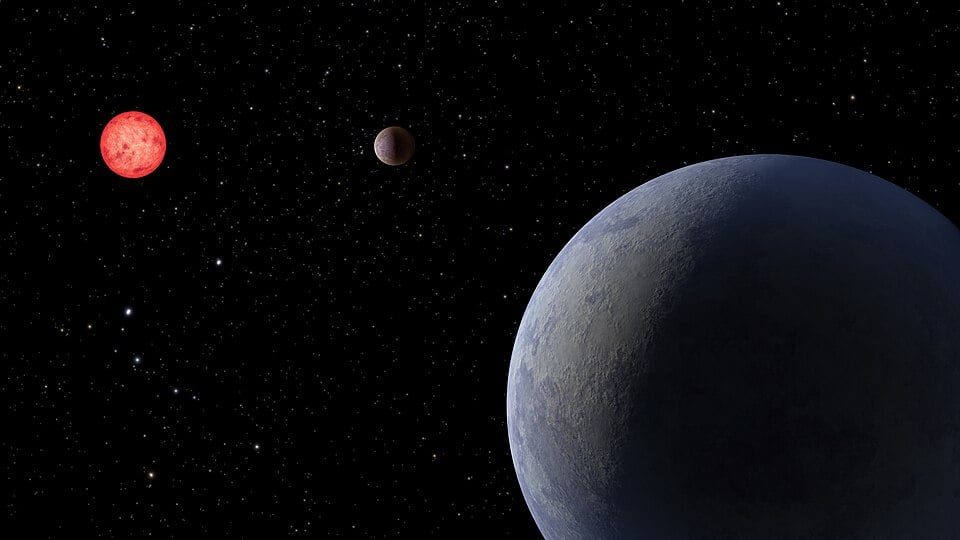
In an ordinary nova, a white dwarf orbits a companion star and pulls hydrogen-rich gas from it over time. That material accumulates on the white dwarf's surface until pressure and temperature become high enough to trigger a runaway thermonuclear flash. The explosion is dramatic, but the white dwarf usually survives, allowing the cycle to repeat if accretion continues.
V445 Puppis followed the same broad script with one decisive difference: the fuel was helium. The source text says the companion is a helium star, a star that has been stripped of its outer hydrogen envelope, most likely by the same white dwarf that is now accreting from it. Such stars are exceptionally rare. The article describes them as numbering perhaps only a few thousand among the hundreds of billions of stars in the galaxy.
That rarity helps explain why helium novae are so seldom observed. It also raises the stakes of every new constraint astronomers can place on this system. When there is only one confirmed example in the Milky Way, the details of its orbit, debris, composition, and post-eruption behavior become unusually important.
Dust hid the evidence, but not forever
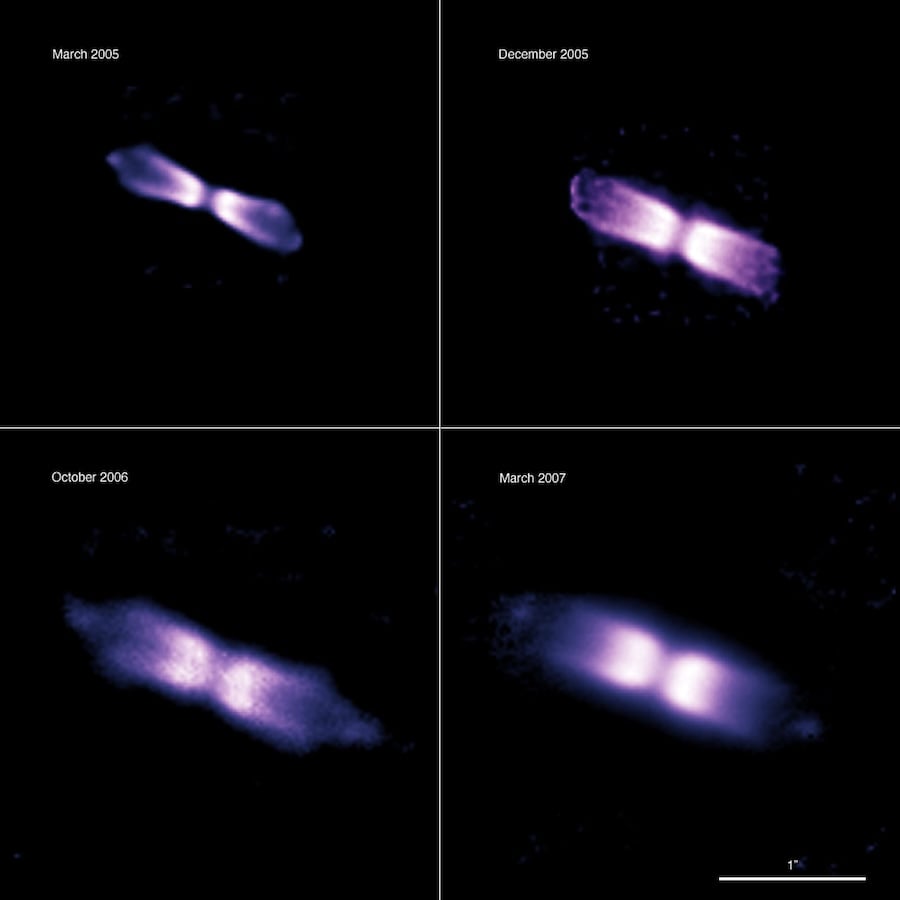
The 2000 eruption did not just announce a rare kind of nova. It also created the conditions that made the system difficult to study. The outburst launched a bipolar shell extending more than a trillion kilometers and produced a thick dust disc that obscured the central binary for roughly a quarter century. For years, astronomers could watch the debris expand while remaining unable to see the engine that created it.
That geometry now appears central to the story. The source describes a pinched-waist structure in the expanding shell, with the dust disc at the center responsible for hiding the system. As the debris gradually cleared, enough light escaped for a multi-instrument reconstruction of the binary to become possible.
This is a useful reminder of how astronomical mysteries are often solved. Not by a single snapshot, but by persistence across decades and wavelengths. Infrared data can penetrate dust better than visible light. Spectroscopy tracks motion and composition. Space-based photometry adds timing information. Hubble and large ground telescopes bring spatial detail. In V445 Puppis, that long observational baseline appears to have been decisive.
A rare binary with a surprising orbital period
The recovered picture of the system contains at least two notable results. First, the stars orbit each other every 3.7 days, which the source text says is roughly twice as long as astronomers had assumed. Revised orbital timing changes how researchers model the binary, including how material is transferred and how quickly conditions for future eruptions may rebuild.
Second, accretion has apparently already resumed. In other words, the white dwarf has started stealing material again from its helium-star companion. That suggests the 2000 event did not end the system's story. It reset it. The binary remains active, and that makes V445 Puppis relevant not only as a postmortem case but as an evolving object to monitor for future changes.
The outflow also includes embedded clumps of gas, possibly oxygen-rich, moving at up to 12 million kilometers per hour. Mills suspects these knots were launched after the main outburst, according to the source material, and nothing like them has been seen in any other nova. If confirmed, they would add another layer of peculiarity to a system already standing alone in the galactic record.
Why helium novae matter beyond one strange star
Helium novae are interesting in their own right, but V445 Puppis may also bear on a much larger question: how some white dwarfs evolve toward catastrophic explosion. The source text links this line of inquiry to Type Ia supernovae, the stellar explosions that have served as cosmological yardsticks and helped reveal the accelerating expansion of the universe.
The article does not claim that V445 Puppis is destined to become a Type Ia supernova, and that distinction matters. What it does suggest is that the system may illuminate a pathway by which white dwarfs gain and process material under unusual conditions. Understanding that pathway could improve models of which binaries remain recurrent novae, which shed too much mass to grow, and which might eventually approach the threshold for a far more destructive event.
That is the scientific value of rare systems. They pressure-test existing categories. A hydrogen-free nova forces astronomers to ask whether their standard frameworks are broad enough, and whether seemingly exotic binaries might help explain better-known cosmic phenomena.
What comes next
V445 Puppis is no longer completely hidden, but it is not a solved case in every respect. Questions remain about the composition of the high-speed clumps, the exact sequence of the outflow, and how the system's resumed accretion will evolve. Continued monitoring will matter, especially because this object has already shown that it can alter its own visibility for decades.
Still, the central mystery has narrowed sharply. Astronomers now appear to have identified the binary responsible for the Milky Way's only confirmed helium nova: a white dwarf feeding on a stripped helium star in a 3.7-day orbit. After 25 years of indirect clues, that is a substantial advance. Sometimes in astronomy, the breakthrough is not discovering a new object. It is finally seeing the one that has been there all along.
- V445 Puppis erupted in 2000 without hydrogen, making it the Milky Way's only confirmed helium nova.
- Researchers used VLT, Hubble, SALT, and TESS data to identify the hidden binary system.
- The system consists of a white dwarf accreting material from a rare helium star.
- The stars orbit every 3.7 days, and accretion has already started again after the eruption.
This article is based on reporting by Universe Today. Read the original article.
Originally published on universetoday.com