NASA highlights a twilight sky event with an eclipse on the horizon
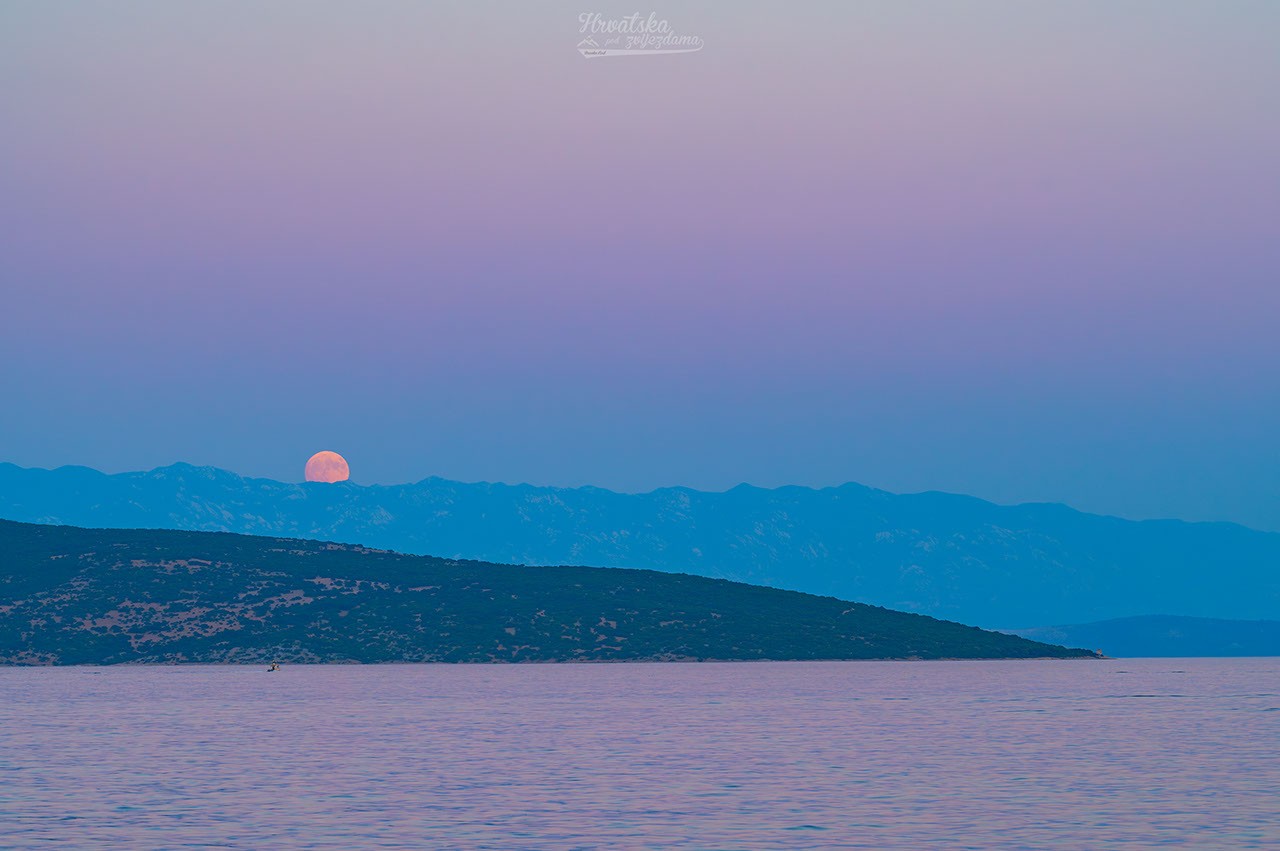
NASA’s Astronomy Picture of the Day for August 1 centered on a visually rich but scientifically familiar alignment: a full Buck Moon rising as the Sun set, with Earth’s shadow and the Belt of Venus visible across the eastern sky. The image, captured on July 28 from Krk Island on Croatia’s Adriatic coast, was presented not just as a scenic moment, but as a reminder that a more consequential sky event is close behind.
In the APOD text, NASA notes that the New Moon of August 12 will cast its shadow on Earth during a “much anticipated total solar eclipse.” The pairing of those two ideas, a moonrise scene that reveals how Earth’s shadow appears at dusk and an approaching eclipse in which the Moon’s shadow falls across Earth, gives the feature unusual timing. It is both an explanation of everyday sky optics and a quiet countdown to a major celestial event.
What the APOD image shows
The photograph captures several layers of the twilight sky at once. The full Buck Moon is shown rising above distant mountains. At nearly the same time, because a full moon rises as the Sun sets, Earth’s shadow appears to rise along the opposite horizon as a diffuse gray band.
Above that gray band is the pinkish strip known as the Belt of Venus. NASA describes it as an antitwilight arch produced by backscattered sunlight. The result is a stacked horizon scene: mountains below, Earth’s shadow above them, the Belt of Venus above that, and the full Moon entering the frame as the evening light fades.
It is the kind of image that works on two levels. For casual viewers, it is a dramatic landscape photograph. For skywatchers, it is a precise demonstration of geometry in the Earth-Moon-Sun system. The scene is not rare, but it is easy to miss unless conditions are clear and the horizon is open.
Why the Buck Moon matters in this context
NASA describes the Buck Moon as the traditional name for the full moon of July. In this case, the July 28 capture is being used to frame a transition between lunar phases and to point ahead to the next New Moon.
That shift matters because eclipses depend on alignment. A full moon is the phase opposite a new moon: during a full moon, Earth sits roughly between the Sun and Moon from the observer’s perspective, while during a new moon the Moon lies between Earth and the Sun. Most new moons pass without an eclipse because the alignment is not exact enough, but when the geometry is right, the Moon can project its shadow onto Earth.
The APOD text does not go beyond that basic setup, but it does make the essential connection clear. The same celestial mechanics that make the full Moon rise as the Sun sets also set the stage for the August 12 eclipse at the next new moon.
Earth’s shadow and the Belt of Venus
One of the more useful aspects of the APOD feature is that it calls attention to two atmospheric effects that many people have seen without naming. Earth’s shadow appears as a broad, dim band opposite the setting Sun. Above it, the Belt of Venus forms a pink or rosy glow.
NASA explains the Belt of Venus as a band of backscattered sunlight. In practice, this is one of the easiest large-scale atmospheric light effects to spot under the right conditions, especially from elevated areas or shorelines with a clean eastern horizon. The contrast becomes more obvious when the Sun is just below the western horizon and the eastern sky has not yet darkened completely.
The APOD image uses those layers to give shape to an abstraction. People often hear that Earth has a visible shadow in the sky, but photographs like this one make that idea legible. The gray band is not metaphorical; it is the planet’s shadow projected into the atmosphere as the geometry of sunset unfolds.
That visual framing also helps explain why eclipses remain compelling even in an era of constant astronomical imagery. They are not detached spectacles. They emerge from the same orbital relationships visible in ordinary twilight, moonrise, and sunset. A dramatic eclipse is, in a sense, the most exacting version of patterns that are already on display almost every clear evening.
Attention turns to August 12
The final line of NASA’s description shifts the focus decisively from the July 28 moonrise to the future event: the New Moon of August 12 “will cast its own shadow on planet Earth” during a total solar eclipse. That sentence is brief, but it changes the APOD from a standalone image explanation into an eclipse preview.
For observers planning ahead, the phrasing underscores the mechanism that defines a total solar eclipse. It is not Earth’s shadow this time, but the Moon’s. During totality, that shadow crosses part of Earth’s surface, briefly turning day into twilight for those in its path.
NASA’s APOD entry does not provide route details or viewing guidance, so its emphasis is atmospheric and conceptual rather than logistical. Even so, the mention of a “much anticipated” eclipse signals the level of interest surrounding the event. Total solar eclipses are uncommon at any given location, and anticipation tends to build well before the date because weather, travel, and path access all matter to observers.
A simple image with a broader lesson
The strength of this APOD entry is that it uses a calm, familiar scene to point toward a headline sky event without overstating either one. The Buck Moon over the Adriatic is not presented as an extraordinary discovery. Instead, it is offered as a well-timed lesson in celestial rhythm.
That makes it effective editorially. The image shows how the atmosphere records solar geometry, how lunar phase defines what appears on the horizon, and how one phase leads directly to the next. The coming eclipse is the dramatic payoff, but the educational value lies in the continuity between the two moments.
For readers who follow space and astronomy, the takeaway is clear. The August 12 total solar eclipse is approaching, and the sky has already begun to preview the mechanics behind it. In NASA’s framing, a full moonrise, Earth’s shadow, and the Belt of Venus are not separate curiosities. They are parts of the same visual system, one that is about to produce one of the year’s most anticipated celestial events.
This article is based on reporting by science.nasa.gov. Read the original article.
Originally published on science.nasa.gov