Another Starlink mission pushes SpaceX deeper into a record 2026 cadence
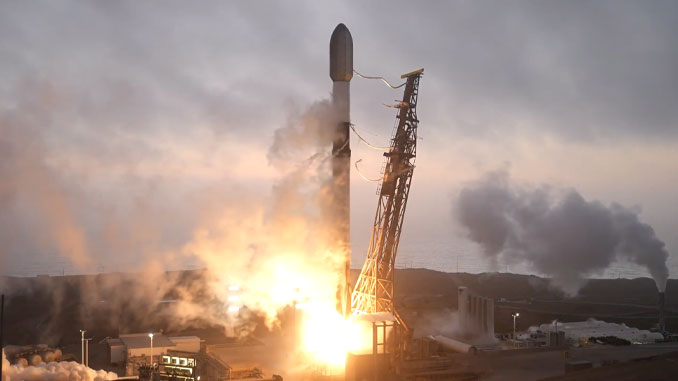
SpaceX launched 24 more Starlink satellites on July 31 from Vandenberg Space Force Base in California, extending the company’s unusually high launch tempo in 2026. The Falcon 9 lifted off from Space Launch Complex 4 East at 8:08 p.m. PDT, or 0308 UTC on August 1, carrying a batch of Starlink V2 Mini satellites bound for low Earth orbit.
The mission, identified as Starlink 17-52, had been delayed several times from an original target date of Monday, July 27. SpaceX did not disclose a reason for those delays, which has become a familiar pattern for many of the company’s routine Starlink flights. Even with the slip, the launch added another successful mission to a year that is already notable for its volume.
According to the source text, the 24-satellite stack deployed from the upper stage about an hour after launch. That deployment adds to a constellation that SpaceX says now exceeds 10,800 Starlink satellites in orbit. The scale of that figure helps explain why the company’s launch manifest is so heavily dominated by its own broadband missions: Starlink expansion depends on a constant flow of replenishment, capacity growth, and orbital maintenance.
The flight also showcased SpaceX’s booster reuse model
As with most current Falcon 9 missions, the rocket’s first stage was a major part of the story. This launch used booster B1081, and the source says it marked the vehicle’s 26th flight. That number is striking because it illustrates how far SpaceX has pushed the reuse model from a technical demonstration into a routine operating practice.
B1081 has supported a wide mix of missions. The source lists previous flights that include NASA’s Crew-7 mission in August 2023, the CRS-29 cargo mission in November 2023, NASA’s PACE in February 2024, Transporter-10, ESA’s EarthCARE, NROL-186, Transporter-13, NASA’s TRACERS, NROL-48, and COSMO-SkyMED Second Generation FM3 in January 2026. In other words, the same booster has now been used across commercial, civil, and national-security launch work before returning yet again for a Starlink mission.
A little more than eight minutes after liftoff, B1081 landed on the droneship Of Course I Still Love You in the Pacific Ocean. The source says this was the 214th landing on that vessel and the 643rd orbital booster landing overall for SpaceX. Those recovery totals are more than symbolic milestones. They represent the operational backbone of the company’s launch economics and cadence.
Starlink remains the main engine of launch frequency
The July 31 mission was not a headline-grabbing planetary probe or a human spaceflight launch. It was a Starlink deployment, and that is precisely why it matters. SpaceX’s most consequential change to the space industry has arguably not been any single marquee mission, but the industrialization of launch through repeatable, high-frequency flights like this one.
The source text says this was the 90th Falcon rocket launch of 2026 so far, including one Falcon Heavy. It also says this was the 69th batch of Starlink V2 Mini Optimized satellites launched to orbit this year. Those figures show the scale of vertical integration at work. SpaceX is not simply selling launch services to outside customers; it is using its launch system to build and continuously expand its own global communications infrastructure.
That strategy creates a feedback loop. More reusable boosters can support more launches. More launches can expand Starlink faster. A larger constellation can strengthen the business case for still more launches. Each individual mission may look routine, but together they form an industrial system that no other launch provider has matched at similar scale.
Why a “routine” launch still matters
Starlink missions can appear repetitive, especially compared with deep-space exploration or crewed flights. Yet the routine nature of these launches is exactly what makes them significant. A launch sector that once treated frequent access to orbit as exceptional is increasingly being reshaped by an operator that treats it as normal.
The latest mission also shows how SpaceX is using California alongside Florida to maintain tempo. Vandenberg launches are especially useful for certain orbital trajectories, and regular operations from the West Coast help distribute demand across infrastructure, personnel, and pads. That matters when a company is trying to sustain dozens upon dozens of missions in a single year.
The satellite payload itself is also part of a continuing technical evolution. This batch consisted of V2 Mini satellites, a smaller form factor than full next-generation spacecraft but one still intended to expand network performance and capacity. The source text does not provide performance details for this specific batch, so the clearest takeaway is logistical rather than technical: SpaceX is steadily feeding a very large, still-growing constellation.

A launch that reflects a broader shift in space operations
By itself, Starlink 17-52 is one more successful Falcon 9 mission with a familiar profile: launch, stage separation, booster landing, satellite deployment. In aggregate, however, it reflects a broader transformation in orbital operations. SpaceX has turned what used to be rare achievements into standardized processes repeated across the calendar year.
The company’s ability to fly a 26-times-used booster, land it again, and continue adding to a constellation of more than 10,800 satellites illustrates a mature operational model rather than a one-off accomplishment. The fact that this happened on the company’s 90th Falcon launch of the year only reinforces that point.
There is no dramatic anomaly in this mission and no announced breakthrough beyond the mission’s success. But that is the story. SpaceX’s present edge lies in making orbital launch, satellite deployment, and booster recovery look ordinary. The July 31 Starlink mission was another demonstration that the company’s most disruptive capability may now be consistency at scale.
This article is based on reporting by Spaceflight Now. Read the original article.
Originally published on spaceflightnow.com