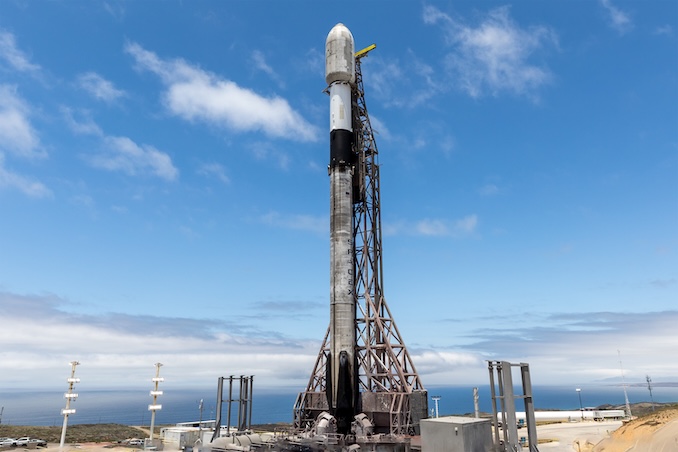
Another launch for a fast-growing spy satellite architecture
SpaceX is preparing to launch NROL-179, a National Reconnaissance Office mission that will add more spacecraft to the agency’s growing constellation of intelligence-gathering satellites in low Earth orbit. The mission is scheduled to lift off from Space Launch Complex 4 East at Vandenberg Space Force Base during a 35-minute launch window opening on June 19 at 1:40 a.m. PDT, or 0840 UTC.
According to the source text, this will be the third launch this year supporting the NRO’s proliferated architecture constellation and the 14th overall for that low Earth orbit network. The total number of satellites on this specific mission has not been disclosed.
Even with many details withheld, the launch is a useful marker of how the U.S. intelligence community is changing its space infrastructure. Instead of relying only on smaller numbers of highly specialized satellites, the NRO has described a plan for a much larger distributed fleet intended to improve resilience and coverage.
What the NRO says it is building
The NRO said it envisions having hundreds of small satellites on orbit as part of this proliferated architecture. The purpose, according to the source text, is to provide greater revisit rates, increased coverage, and to eliminate single points of failure.
Those goals are important because they describe the operational logic behind the system. Greater revisit rates mean targets on Earth can be observed more frequently. Increased coverage expands the amount of territory or activity the network can monitor. Eliminating single points of failure means the architecture is designed so that the loss or degradation of one satellite does not cripple the broader mission.
That is a different model from legacy national security satellite systems that often concentrated capability into a smaller number of expensive platforms. A proliferated network can be replenished more often, can distribute functions across many spacecraft, and can make the overall system harder to disrupt.
The agency has not disclosed the intended final size of the constellation or many of the network’s broader design details. Even so, its public description suggests a deliberate shift toward a more redundant and continuously refreshed orbital layer.

What kinds of satellites are involved
The source text says the satellites on NROL-179 are believed to be Starshield spacecraft, a government variant of SpaceX’s Starlink system, although neither the NRO nor SpaceX has confirmed that on the record. That means the reported link is still an informed attribution rather than a formally stated mission detail.
What the NRO has confirmed is the mix of mission areas contributing to the proliferated architecture. In its prelaunch material, the agency said GEOINT’s contribution includes electro-optical, radar, and relay satellites. It also said the relay satellites enable inter-satellite optical communications and serve as a key component of both the NRO’s resilient communications architecture and the Department of War’s upcoming Space-Data Network.
Those details help explain why this architecture matters. Electro-optical satellites support image collection in visible or near-visible bands. Radar satellites can image through cloud cover and at times of day when optical systems are limited. Relay spacecraft and optical crosslinks turn the constellation into more than a collection of isolated sensors by allowing data to move across the network quickly and with less dependence on vulnerable ground pathways.
In other words, the NRO is not only adding more eyes in orbit. It is building a connected sensing and communications layer that could support faster intelligence delivery and more durable operations.
The launch vehicle and recovery plan
SpaceX plans to use Falcon 9 first-stage booster B1103 for the mission. According to the source text, this will be the booster’s third flight after launching Starlink 17-35 and 17-42 in April and May. Fewer than eight minutes after liftoff, the booster is expected to return to California for a landing at Landing Zone 4.
If successful, that would mark the 35th landing at that site and the 626th booster landing for SpaceX overall. Those figures underline how reusable launch operations have become routine support infrastructure for national security missions that once depended on far more limited and expensive cadence.
The launch itself therefore sits at the intersection of two trends. One is the NRO’s move toward proliferated constellations. The other is SpaceX’s sustained ability to launch and recover hardware at a tempo that makes those constellations more practical to build and maintain.

Why NROL-179 matters
NROL-179 is not a headline-grabbing deep-space mission, and many of its payload specifics remain classified. But it still represents a meaningful shift in military and intelligence space strategy. The emphasis is on scale, redundancy, networking, and frequent deployment rather than singular exquisite spacecraft.
That model could reshape how intelligence is collected and moved in conflict or crisis. A large low Earth orbit network can refresh coverage faster, distribute risk, and better support data transport between satellites. The NRO’s own description of relay satellites and optical communications suggests that connectivity is now as important as raw sensor performance.
For SpaceX, the mission also reinforces its role as the primary launch provider for this expanding national security architecture. For the NRO, each additional launch helps turn an abstract plan for hundreds of small satellites into an operational system with growing density in orbit.
With NROL-179, the U.S. is continuing to build a surveillance and communications layer designed for persistence and resilience. The specific payload count may be undisclosed, but the strategic direction is increasingly clear.
This article is based on reporting by Spaceflight Now. Read the original article.
Originally published on spaceflightnow.com