A New Piece of Space Self-Sufficiency
Long-duration missions beyond low Earth orbit force mission planners into a hard constraint: resupply is slow, limited, or impossible. That reality has already driven years of work on in-situ resource utilization, from producing oxygen and water to growing food and recycling waste. A team led by researchers at the University of California San Diego is now pushing that same logic into another critical area of mission support: medicine.
According to research highlighted this week, the group has developed a method that could allow astronauts to use plants as small pharmaceutical factories, producing and repeatedly harvesting useful compounds during a mission instead of carrying every dose from Earth. For expeditions to the Moon, Mars, or other distant destinations, that kind of capability could become more than a convenience. It could be part of the baseline infrastructure that makes crews medically resilient when supply chains no longer exist.
The work centers on a plant virus known as cowpea mosaic virus, or CPMV. Researchers have studied CPMV for years because of its ability to stimulate immune responses, including in cancer-related applications. In preclinical studies in mice and clinical studies in canine cancer patients, the source text says CPMV has shown effectiveness against tumors. The new advance is less about discovering the molecule itself and more about finding a practical way to produce and recover it in space-compatible conditions.
Why Medicine Is a Space Logistics Problem
Medicine is easy to underestimate in space architecture because it occupies little mass compared with fuel, habitat systems, or food. But pharmaceuticals create a different kind of challenge. They can degrade over time, may require varied formulations, and are difficult to stock in unlimited amounts for every scenario a crew might face. The farther a mission travels from Earth, the more valuable it becomes to manufacture at least some treatments on demand.
That problem grows sharper as agencies and private operators plan for missions lasting months or years. Deep-space crews will need to manage routine illness, inflammation, injury, and possibly more specialized conditions without immediate evacuation. A small, renewable production platform that uses living plants could reduce storage burdens and provide fresh biologic material when needed.
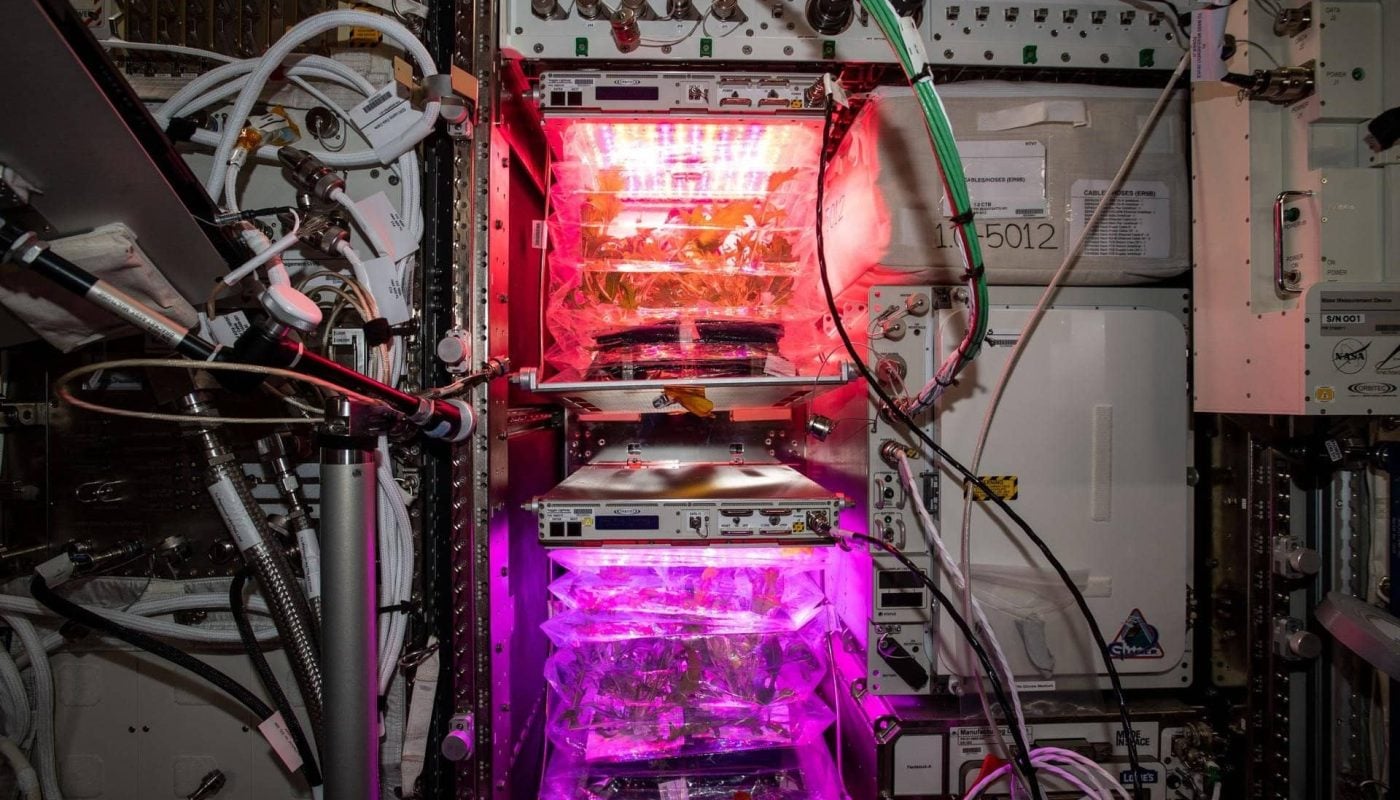
Plants already fit naturally into long-range space concepts. They can help cycle carbon dioxide into oxygen, contribute food or protein, and support psychological well-being in closed habitats. The UC San Diego work suggests they may also serve as a manufacturing layer, adding therapeutic output to the same biological systems already expected to support life support and habitation.
How the Method Works
The team used Nicotiana benthamiana and black-eyed pea plants to manufacture CPMV. Traditionally, extracting material from such plants involves removing leaves and grinding them up, a process that destroys plant tissue and creates waste. That is a poor match for space operations, where every input is limited and every waste stream matters.
The researchers instead describe a simplified approach that allows pharmaceuticals to be grown and repeatedly harvested without destroying the entire plant and without generating large amounts of waste. That is the core operational breakthrough. In a spacecraft or off-world habitat, repeat harvestability matters just as much as biological yield. A process that preserves the production organism can turn a one-time consumable into a continuing asset.
The source text frames this explicitly around microgravity. That matters because processes that work in terrestrial greenhouses do not automatically translate to orbital or deep-space environments. Fluids behave differently, handling steps become more complex, and crew time is scarce. Methods that reduce manual processing and avoid bulky equipment are more likely to survive contact with actual mission design.
The work was published June 5 in npj Science of Plants, and it involved an interdisciplinary collaboration across several UC San Diego engineering, materials, and cancer research centers. That mix of expertise reflects the broader significance of the project. It sits at the intersection of space systems engineering, plant science, and biomanufacturing rather than belonging to only one field.
Why CPMV Matters
CPMV is an unusual candidate because it is a plant virus being explored for human and veterinary therapeutic use, particularly for its immune-stimulating properties. That makes it a useful demonstration platform for a broader idea: biologically active medicines do not necessarily need to be shipped as finished, static products. Some may be made from living systems as needed.
If the concept scales, future space biomanufacturing could expand beyond one virus or one treatment category. The near-term value is proof that a lightweight plant-based production system can fit within the logic of mission self-reliance. The longer-term implication is a diversified onboard pharmacy built not from shelves of prepacked drugs, but from a set of renewable biological processes.
- Plants could serve multiple mission roles at once, including air support, food production, and therapeutic manufacturing.
- Repeated harvesting reduces waste and preserves limited biological resources.
- On-demand production could help crews manage long missions where resupply is impractical.
From Space Use to Earth Applications
The research also points back toward Earth. A low-cost pharmaceutical production method based on plants could be relevant in remote regions, austere medical settings, or places where conventional manufacturing and cold-chain distribution are difficult. Space research often gains public legitimacy when it produces terrestrial benefits, and this project has a clear pathway to that argument.
Even so, the immediate importance of the work is strategic rather than commercial. It addresses a real constraint in human spaceflight: exploration architectures cannot rely indefinitely on Earth-based abundance. If missions are going to become truly durable, they need ways to make essential materials in place, including medical ones.
This UC San Diego effort does not mean astronauts are about to run a full pharmacy greenhouse on the way to Mars. But it does mark a meaningful shift in how mission medicine is being imagined. Instead of treating pharmaceuticals purely as cargo, researchers are beginning to treat them as something crews may one day grow, recover, and renew as part of the habitat itself.
That is a notable step toward a more self-sustaining model of exploration, and one that becomes more important every time human spaceflight moves farther from home.
This article is based on reporting by Universe Today. Read the original article.
Originally published on universetoday.com