Phobos remains one of planetary science’s oldest unresolved puzzles
Mars has two small moons, but it is Phobos, the larger and closer of the pair, that continues to provoke one of planetary science’s most persistent arguments: where did it come from? A new research effort highlighted by Universe Today argues that the answer may depend less on the moon’s surface appearance than on its hidden interior. By focusing on Phobos’ internal structure and on subtle geophysical signatures associated with its giant Stickney Crater, researchers are trying to distinguish between two rival origin stories that have shaped the debate for decades.
One theory says Phobos formed from debris blasted into orbit after a giant impact struck Mars. In that scenario, fragments coalesced into a disk and eventually produced Phobos and Deimos. The competing theory says the moons were once asteroids that were later captured by Mars’ gravity. Both ideas have some observational support, and neither has been decisively confirmed.
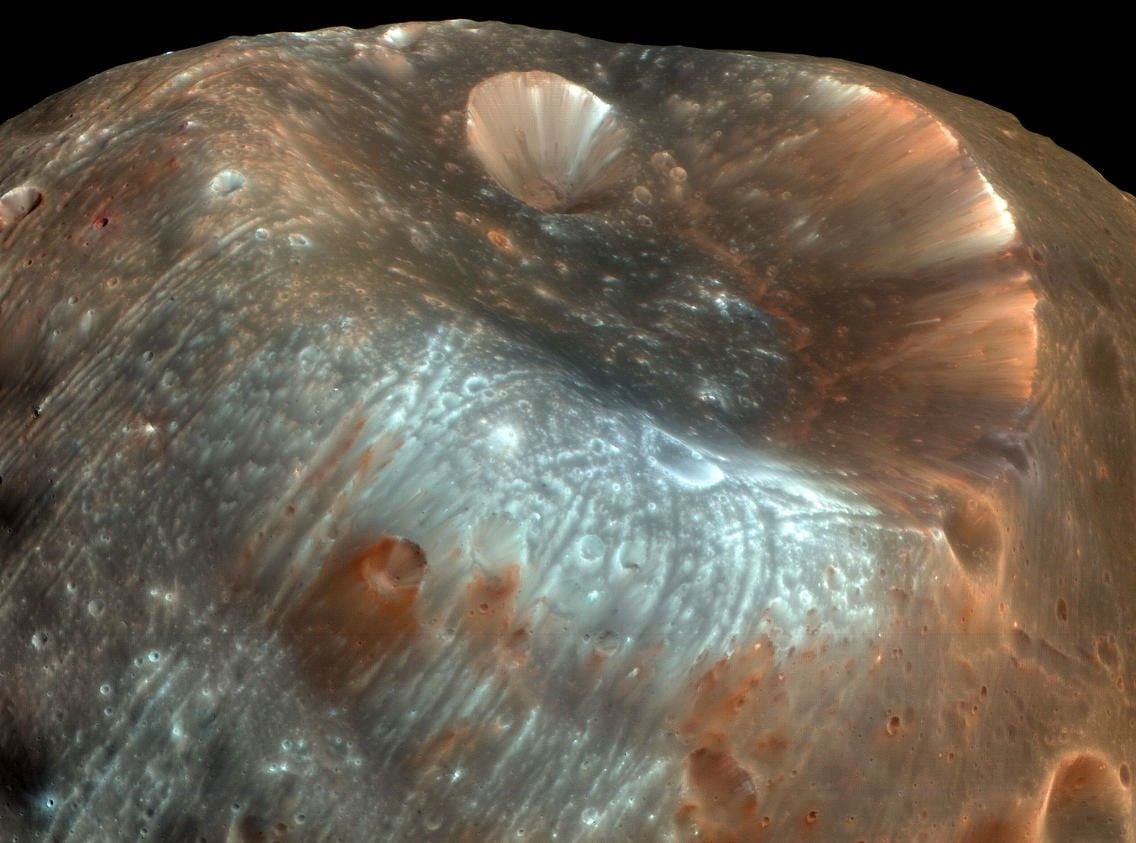
That uncertainty is why the timing and structure of Stickney Crater matter. The crater is the largest impact feature on Phobos, and researchers increasingly view it as a key archive of the moon’s history. In the modeling described by Universe Today, the crater may preserve clues about whether Phobos formed in a giant-impact environment or entered Mars orbit as a captured body.
Stickney Crater could separate the two main theories
The new work was presented at the European Geosciences Union general assembly in Vienna and draws on a 2026 paper in Monthly Notices of the Royal Astronomical Society by Benjamin Haser and Thomas Andert. The researchers examine slight variations in what they describe as Phobos’ geophysical observables, especially around Stickney. Their premise is that the impact event that formed the crater may have created a localized zone of denser material, leaving behind a gravitational signature that can still be measured.
If that densified zone exists and can be mapped in sufficient detail, it may help constrain the age and history of the crater-forming event. According to the reporting, the giant-impact hypothesis would place the Stickney-forming event at about 4.2 billion years ago. Under the asteroid-capture hypothesis, the event could be much younger, around 2.6 billion years old. That difference is large enough to make Stickney a meaningful discriminator between the two models.
The research therefore shifts the question from a broad debate over appearance and orbital history to a more targeted geophysical problem: what does Phobos’ interior actually look like, and does it preserve evidence of a specific formation pathway?
Phobos is small, irregular, and likely more complex than it looks
Phobos has often been described as asteroid-like because of its size and shape. It is irregular rather than spherical, with a mean diameter of just 22.2 kilometers, and it circles Mars in only 7 hours and 39 minutes. Those characteristics make the capture theory intuitively appealing. Yet the new analysis underscores that the moon may be more structurally complex than a simple chunk of rock drifting in orbit.
Current estimates, as cited by Universe Today, suggest a porous interior and even the possibility of water ice content. That matters because porosity, density variations, and internal layering can preserve evidence about how a body formed and evolved. A rubble-pile asteroid captured by Mars might display a different internal pattern from an object assembled from debris generated in a major impact on the planet itself.
Haser, a doctoral student at Germany’s Universität der Bundeswehr München, told Universe Today that Phobos is not just an ordinary rock in orbit. That framing is important. The moon’s scientific value is not simply that it is nearby or visually distinctive, but that it may record early Solar System processes and the impact history of Mars in a form still accessible to measurement.
For researchers, the obstacle is that Phobos’ interior remains largely inferred rather than observed directly. Surface images can reveal craters, grooves, and overall shape, but they do not settle what lies underneath. That is where gravity mapping becomes central.
Why gravity mapping has become the critical method
The researchers argue that determining Phobos’ gravitational field is a fundamental step toward understanding its interior and origin. A precise gravity map can reveal whether mass is evenly distributed or whether buried anomalies exist, such as a densified region associated with the Stickney impact. These measurements are especially useful for bodies that are too small and irregular for simple geophysical assumptions.
In practical terms, gravity mapping would help answer several connected questions:
- How porous is the moon overall?
- Is there evidence of a concentrated mass anomaly near Stickney?
- Are internal density patterns more consistent with reaccreted debris or a captured asteroid body?
- Could the moon contain volatile material such as water ice in meaningful amounts?
Each answer would tighten constraints on the origin models. None would stand entirely alone, but together they could move the debate from plausible narratives to measurable physical structure.
Japan’s MMX mission may provide the decisive evidence
The timing of this research is closely linked to Japan’s Martian Moons Exploration mission, or MMX, which Universe Today notes is due for launch in late 2026. MMX is expected to investigate Phobos in far greater detail and should be well positioned to test ideas emerging from current modeling work.
That makes the present study strategically important even before new spacecraft data arrives. It helps define what measurements matter most, where anomalies may be worth targeting, and how mission teams might interpret the results. Instead of approaching Phobos with only a general interest in its composition and history, researchers can now focus more specifically on the gravitational and structural consequences of the Stickney event.
The broader payoff extends beyond one moon. Understanding Phobos would clarify not only Martian system history but also how small bodies form, evolve, and interact with planets. If Phobos is captured, it would strengthen one class of moon-formation pathway. If it formed from impact debris, it would reinforce the importance of giant collisions in shaping planetary satellite systems.
For now, the central fact is that one of Mars’ smallest companions is carrying an outsized scientific burden. Phobos may look like a battered fragment, but its interior could hold evidence from some of the earliest and most violent chapters in the history of the Solar System. With MMX approaching and gravity-focused models sharpening the questions, the case of Phobos is moving from speculation toward testable structure.
This article is based on reporting by Universe Today. Read the original article.
Originally published on universetoday.com