Roman reaches the Space Coast
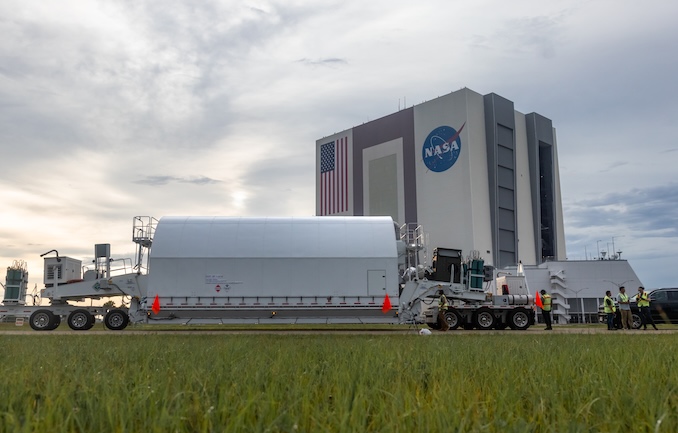
NASA’s Nancy Grace Roman Space Telescope has arrived in Florida, clearing a visible and important milestone on the way to launch. The observatory reached NASA’s Kennedy Space Center aboard the agency’s Pegasus barge on June 22, where it will now begin the final phase of prelaunch work before liftoff on a SpaceX Falcon Heavy rocket.
The arrival shifts Roman from factory and transport operations into hands-on launch-site processing. According to the source report, the spacecraft was carried inside a protective transport container nicknamed the “Chariot,” then moved toward Kennedy’s Payload Hazardous Servicing Facility after disembarking. There, teams are expected to spend about 70 days on checkout work, fueling, and encapsulation inside the rocket’s payload fairing.
NASA’s current target is launch no earlier than August 30, a move up from an earlier September window. That schedule change matters because it suggests the program has preserved enough margin to accelerate final integration without slipping into a later slot, even as launch traffic at Cape Canaveral remains busy.
A major observatory enters its final stretch
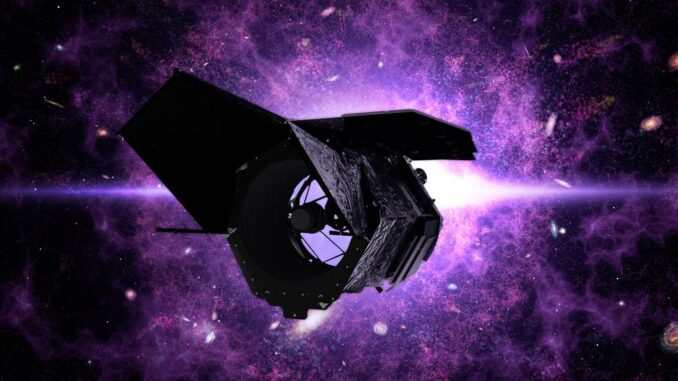
Roman is not being treated as a routine spacecraft delivery. The source describes it as NASA’s “next great observatory,” language that reflects the mission’s status inside the agency’s science portfolio. The telescope carries a reported cost of $4.3 billion and is positioned as a major follow-on to the lineage of flagship space astronomy missions.
The name also carries institutional weight. Roman is named for Nancy Grace Roman, NASA’s first Chief of Astronomy. In comments cited by the source, program executive Lucas Paganini connected the mission directly to her role in shaping the agency’s space-based astronomy strategy, calling her a foundational figure in making Hubble possible. That framing is more than ceremonial. It places the mission within NASA’s long arc of building orbital observatories to answer questions that cannot be resolved from the ground.
For mission teams, arrival in Florida is the point where abstract readiness gives way to a tightly choreographed campaign. Every major observatory faces this phase: transport risk gives way to fueling risk, contamination controls tighten, and launch-vehicle integration becomes the dominant concern. The countdown is still measured in weeks, but the margin for avoidable disruption narrows considerably.
Transport was successful, but not effortless
The trip south was completed safely, though not without complications. The source report says the observatory had to remain below 74 degrees Fahrenheit during transit. Engineers traveled with both a primary and a redundant cooling unit, but those systems were reportedly not sufficient once the barge moved into warmer conditions farther south.
Mechanical engineer Neil Patel, who accompanied the observatory, said the team had to stop and add rental cooling units on an emergency basis. Those supplemental systems then maintained the required temperature. The episode is a reminder that moving a high-value spacecraft is not just a matter of physical protection from shock and vibration. Thermal control remains a mission-critical requirement even before launch processing begins.
That temporary fix also shows the kind of contingency handling that large science missions demand. Nothing in the report suggests damage or a change in launch readiness, but the need for additional cooling support illustrates how vulnerable sensitive payloads can be to environmental deviations during overland and maritime transport. In practical terms, the successful response matters almost as much as the initial issue: the mission team encountered a problem, adapted in transit, and delivered the spacecraft within limits.
What happens over the next 70 days
The next stage is less visible than the barge arrival, but it is where launch confidence is built. Kennedy’s prelaunch campaign is expected to include system checkouts, loading propellants, and preparing the observatory for encapsulation inside Falcon Heavy’s payload fairing. Those are standard steps for major NASA payloads, but each one has to be executed under mission-specific procedures and environmental controls.
Fueling is especially consequential because it changes the spacecraft’s handling profile and introduces a different layer of safety operations. Encapsulation marks another transition, after which access becomes more limited and the observatory begins to take on the practical constraints of launch integration. From there, the focus turns to the rocket, the pad schedule, and final combined operations.
The use of Falcon Heavy is also notable. Roman is one of the highest-profile science payloads assigned to the vehicle, underscoring how NASA’s flagship-class science missions increasingly rely on commercial heavy-lift launch services for deep-space and major observatory deployments.
A milestone with strategic significance
Space missions are often discussed in terms of launch dates, but arrivals like this one can carry equal weight inside a program. Reaching Kennedy means the observatory has cleared manufacturing and long-distance transport and is now in the last operational corridor before flight. For NASA, that narrows the remaining unknowns. For the broader space sector, it is another signal that large, high-cost science missions are still moving toward execution despite complex logistics and crowded launch infrastructure.
The mission still has critical work ahead, and “no earlier than August 30” remains just that: an earliest date, not a guarantee. But Roman is now physically where it needs to be, under the teams that will prepare it for flight, and on a clock measured in days rather than program years.
That alone makes this a meaningful development in space science. Roman’s arrival in Florida does not answer the scientific questions the telescope was built to pursue. It does something more immediate: it confirms that one of NASA’s biggest observatories is now entering the final sequence that could soon put it into space.
This article is based on reporting by Spaceflight Now. Read the original article.
Originally published on spaceflightnow.com