A sharper test for one of cosmology’s oldest dark matter ideas
Primordial black holes have long occupied an unusual place in modern astrophysics. Unlike the stellar-mass black holes formed by collapsing stars, these hypothetical objects would date back to the earliest moments after the Big Bang, when dense pockets of matter might have collapsed directly under their own gravity. Because they would not need stars to form, they have repeatedly been proposed as a possible explanation for at least some of the universe’s unseen mass, commonly grouped under the label dark matter.
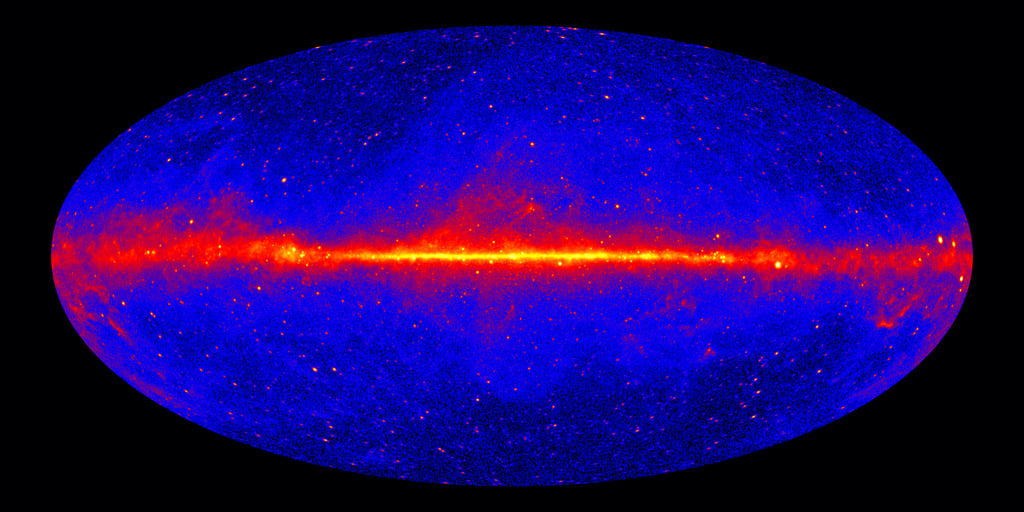
A new preprint highlighted by Universe Today takes aim at one specific slice of that idea: primordial black holes with masses between 10^14 and 10^17 grams, roughly the so-called asteroid-mass range. According to the report, researchers from Oakland University and Rice University modeled how such objects should contribute to the diffuse extragalactic gamma-ray background, the faint all-sky glow of gamma radiation observed beyond the Milky Way. Their conclusion, as summarized in the source text, is that this class of primordial black holes is unlikely to make up a meaningful share of dark matter.
The result matters because primordial black holes remain one of the few dark matter candidates that do not require entirely new particle species. Tightening the limits on where they can hide helps narrow a field that has stayed frustratingly open for decades.
Why small black holes would not stay quiet
The argument depends on a key theoretical insight associated with Stephen Hawking. Black holes are often described as objects from which nothing escapes, but quantum effects imply they are not perfectly black. Smaller black holes should emit thermal radiation, now widely known as Hawking radiation, and lose mass over time. The lighter the black hole, the faster that final evaporation proceeds.
That makes asteroid-mass primordial black holes especially interesting. The source text notes that anything below about 10^14 grams would likely already have evaporated away. But black holes in the 10^14 to 10^17 gram band should still exist while approaching the brighter stages of their life cycle, when their emission becomes stronger. In practical terms, they should not be invisible relics. They should add measurable high-energy light to the sky, especially in gamma rays.
This creates a testable prediction. If enough of these objects are spread across the cosmos to account for a large chunk of dark matter, their cumulative radiation should leave a trace in the extragalactic gamma-ray background. If that trace is absent, the population must be smaller than the dark matter hypothesis would require.
Separating a possible signal from a very crowded sky
That sounds simple in principle, but the gamma-ray sky is crowded. The extragalactic gamma-ray background is not produced by one source. It is an aggregate signal built from many classes of energetic objects and processes, including blazars, radio galaxies, and interactions involving cosmic rays and the infrared background of the universe. Any attempt to isolate primordial black holes therefore depends on modeling and subtracting those established contributors as carefully as possible.
According to the source text, the researchers constructed a model that removes much of that known emission before asking what room remains for primordial black holes. They also developed a Python tool called GammaPBHPlotter to simulate these black holes in greater detail. The model includes Hawking radiation, unstable particle decay, and the gamma rays associated with positrons emitted as the black hole interacts with surrounding particles.
That level of detail is important because weak constraints can disappear when assumptions change. A stronger analysis tries to account for multiple channels through which a real signal would appear. By broadening the modeled emission, the researchers aimed to avoid understating how visible this population should be.
What the study appears to rule out
As described in the source material, the combined modeling suggests asteroid-mass primordial black holes do not fit the observed gamma-ray background well enough to remain a leading dark matter explanation. In other words, if large numbers of these objects were out there, the sky should probably look brighter or differently shaped in gamma rays than it does.
That does not eliminate primordial black holes as a whole. It narrows one mass window. Cosmologists have considered primordial black holes across a far wider range of possible sizes, and different observational methods apply to different bands. Some are constrained through gravitational lensing, some through effects on cosmic structure, and some through high-energy signatures like the one examined here. The significance of this new work lies less in a dramatic one-step disproof than in the steady erosion of viable parameter space.
Dark matter research often advances this way. A single experiment rarely produces a clean universal answer. Instead, candidate by candidate and mass range by mass range, the plausible hiding places become smaller. That is scientifically valuable even when the headline is a limit rather than a discovery.

Why this matters beyond primordial black holes
The study also reflects a broader shift in astrophysics: increasingly, diffuse backgrounds are becoming precision tools rather than vague leftovers. Signals once treated as clutter can be turned into laboratories for testing exotic physics. The extragalactic gamma-ray background is one example. By improving source catalogs and theoretical emission models, researchers can ask sharper questions about what unseen populations might still be contributing.
That has implications beyond primordial black holes. Any hypothetical object or process that injects high-energy photons into the universe can, in principle, be constrained through the same kind of accounting. Better modeling of known sources therefore improves not only conventional astrophysics but also the search for physics beyond the standard picture.
For now, the reported takeaway is narrower but still notable: one longstanding version of the primordial-black-hole dark matter idea appears to be under renewed pressure. If asteroid-mass primordial black holes were expected to hide in the gamma-ray glow, this analysis suggests the glow is giving them away by not leaving enough room for them to be there in the first place.
Because the work is described as a preprint, the findings should still be treated as provisional until peer review is complete. Even so, the logic is straightforward and consequential. The more precisely astronomers can explain the high-energy universe with known populations and processes, the harder it becomes for major dark matter candidates to remain unconstrained. In that sense, a faint gamma-ray background is doing exactly what frontier cosmology needs: turning absence of evidence into a measurable scientific test.
This article is based on reporting by Universe Today. Read the original article.
Originally published on universetoday.com