A quasar from cosmic dawn is behaving like a much later object
Astronomers have detected flickering from a distant quasar seen as it existed only about 850 million years after the Big Bang, making it the earliest flickering quasar identified so far. The object, known as J0439+1634, is offering researchers a rare look at how supermassive black holes were growing in the young universe, and the early readout is unsettling some long-held expectations.
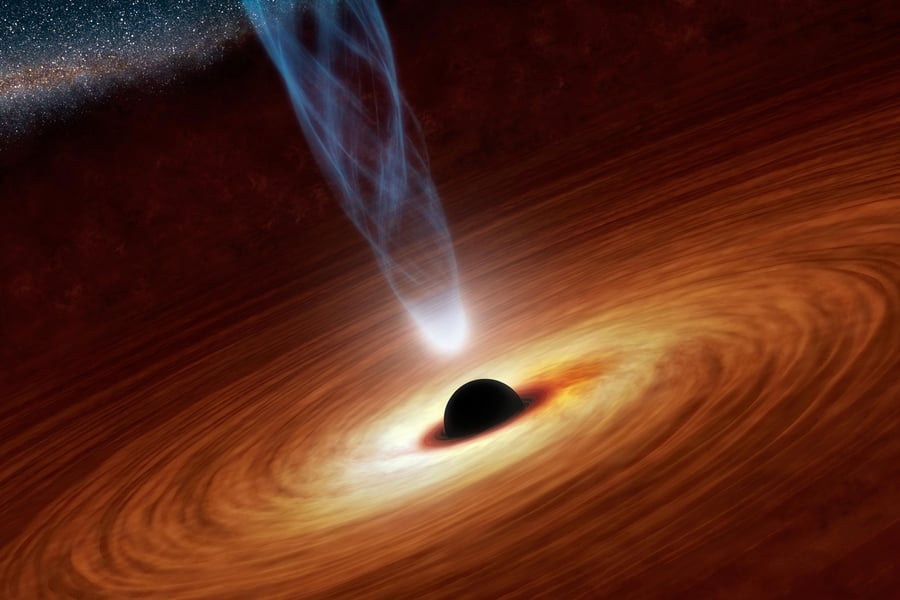
The supplied source text says the quasar’s variable light revealed that the black hole at its center is surrounded by a flat, pancake-like accretion disk. That is the kind of structure astronomers commonly associate with more mature quasars in the later universe. In the earliest eras of cosmic history, researchers had expected black holes to look more chaotic, with puffier and less settled disks shaped by extreme growth and turbulence.
Instead, J0439+1634 appears to have reached an organized state surprisingly quickly. That does not merely add another distant beacon to the quasar catalog. It sharpens the puzzle of how black holes with enormous masses assembled so fast after the universe began.
What astronomers actually saw
The object was detected by astronomers at MIT and other institutions, according to the supplied text. J0439+1634 first appeared in Hubble Space Telescope imagery of a distant galaxy that was being gravitationally lensed by a foreground galaxy. The lensing effect helped bring the quasar into view from across an immense stretch of time, showing it as it looked roughly 12.8 billion years ago.
The researchers found that the quasar flickers. That variability is important because it provides clues about the physical structure of the material spiraling into the black hole. In this case, the changing light implied a relatively thin, flat accretion disk rather than a swollen, highly disturbed one. Gene Leung of MIT’s Kavli Institute for Astrophysics and Space Research, as cited in the source text, said that while many quasars from cosmic dawn have been found, this is the first time astronomers have actually seen one flickering.
That first matters because flickering is not just an interesting signal. It is a diagnostic. It allows researchers to infer the scale and geometry of the feeding zone around the black hole, and therefore to test assumptions about how quickly such systems settle into stable configurations.

Why the disk shape is the real surprise
Quasars are powered by supermassive black holes feeding on surrounding matter. Gas and dust fall inward through an accretion disk, heating up and radiating tremendous energy. In many cases, the process also launches jets of energized material into space. The source text describes J0439+1634 as hosting a black hole with a mass billions of times that of the Sun, exactly the kind of giant object that is difficult to explain so early in cosmic history.
The expectation among astronomers has been that black holes in the early universe should still be in a rougher phase of assembly. If matter is falling in rapidly and the system is still being built under extreme conditions, the disk might be thicker, more disordered, and less settled. A flat disk suggests something different: that the black hole may have already passed through its messiest growth stage before the moment we are able to observe it as a bright quasar.
That interpretation is reinforced by comments in the supplied source text from MIT physicist Anna-Christina Eilers. She says the emerging picture may be that the violent, rapid-growth phases expected for black holes happen very early on, before astronomers catch them in their luminous quasar phase. In other words, by the time a cosmic-dawn quasar becomes visible enough for detailed study, it may already look more structurally mature than theory once implied.
A deeper problem in early-universe astronomy
The finding feeds directly into one of modern astronomy’s most persistent questions: how did supermassive black holes form so quickly? The universe is 13.8 billion years old, and J0439+1634 is being seen at a point only 850 million years into that history. Yet it already hosts a black hole on the scale of billions of solar masses and a disk geometry that resembles later quasars.
That combination is difficult because it compresses two achievements into a short interval. First, the black hole had to gain enormous mass. Second, the surrounding inflow of matter had to organize into a relatively thin disk. If both of those things were already true at that epoch, then either black hole seeds started larger than some models assume, or accretion happened with exceptional efficiency, or the timeline of early black hole evolution needs adjustment.
The supplied source text does not resolve those possibilities, and neither should any responsible rewrite. But it does support a clear conclusion: J0439+1634 makes it harder to imagine that all early quasars were still caught in visibly unruly growth states. At least some may have transitioned into ordered, high-luminosity systems remarkably fast.
Why flickering matters beyond black holes themselves
Quasars are not isolated curiosities. Their central engines can influence the galaxies around them. The energy released as matter falls toward the black hole can affect nearby gas, alter star formation, and shape the broader environment. That means understanding the timing and character of early quasar activity is also part of understanding how young galaxies evolved.
If objects like J0439+1634 became organized and luminous early, their impact on surrounding matter may also have begun earlier or unfolded differently than expected. The source text notes that black hole activity can affect star formation in neighboring regions. That makes the quasar’s flickering more than an astrophysical detail. It is a clue about the pace at which structure emerged in the universe after its earliest epochs.
The discovery also underscores the value of time-domain astronomy, which tracks how objects change rather than only how they look in a single snapshot. A quasar’s brightness variations can expose internal structure that would otherwise remain hidden. In this case, variability turned a distant point of light into evidence bearing on one of cosmology’s central formation problems.
A small signal with large implications
J0439+1634 does not by itself rewrite the history of black hole formation. But it adds a pointed constraint. Any successful model now has to make room for an early-universe quasar that not only existed extraordinarily soon after the Big Bang, but also flickered in a way that implies a surprisingly mature accretion disk.
That is why the discovery stands out. Astronomers are not simply celebrating the remoteness of the object. They are confronting the possibility that the young universe was able to build and stabilize some of its most extreme engines faster than expected. The quasar’s light, delayed across 12.8 billion years, is arriving as a challenge: whatever process built these giants may have been both earlier and more efficient than many models have allowed.
For now, J0439+1634 remains a single but powerful case. Its flicker has opened a new observational window into cosmic dawn and raised the standard for theories of how supermassive black holes emerge. In astronomy, that is often how a major shift begins: not with a complete answer, but with one stubborn object that refuses to behave on schedule.
This article is based on reporting by Universe Today. Read the original article.
Originally published on universetoday.com