NASA’s IXPE may have captured one of quantum physics’ strangest predictions
NASA says a coordinated observing campaign centered on the magnetar 1E 1547-5408 has produced the clearest signal yet for vacuum birefringence, a long-sought effect predicted by quantum electrodynamics roughly 90 years ago. The result, published Aug. 5 in Nature, does not amount to a final verdict on the phenomenon, but it marks a notable step in a field where direct evidence has been elusive.
The claim matters because vacuum birefringence is a counterintuitive idea: in an extreme magnetic field, even empty space should not behave as truly empty. Instead, quantum theory predicts that the vacuum becomes optically active, changing how light propagates through it. Physicists have treated that as a real consequence of the quantum structure of space for decades, but observing it directly has been extraordinarily difficult because the effect becomes measurable only in some of the most extreme environments in the universe.
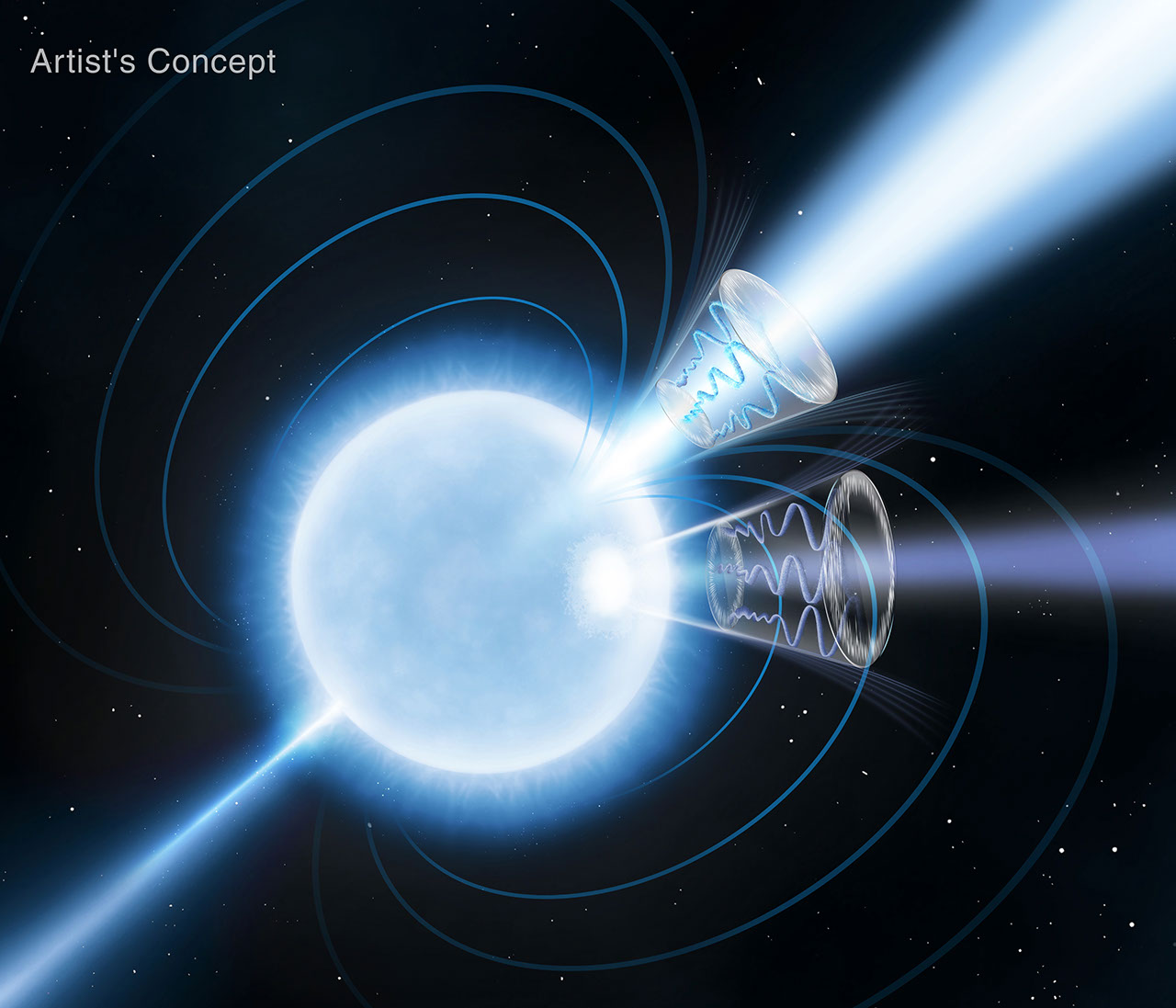
Magnetars offer exactly that kind of environment. These objects are neutron stars, the ultra-dense remnants left behind after massive stars die, but with magnetic fields far beyond those of ordinary neutron stars. NASA describes magnetars as possessing the strongest magnetic fields of any known object in the observable universe. That makes them natural laboratories for testing physics that cannot be recreated on Earth.
A rare target with unusually useful signals
The target in this case, 1E 1547-5408, is a particularly interesting magnetar because it emits both bright radio energy and X-ray light. It spins once about every 2.1 seconds, creating a repeating observational geometry that lets researchers watch how the polarization of its radiation changes as the star rotates. Those changing polarization signatures are central to the new result.
NASA said scientists used more than 140 hours of observations gathered between March and April 2025 with the Imaging X-ray Polarimetry Explorer, or IXPE. The campaign also included NASA’s NICER instrument and Murriyang, CSIRO’s Parkes radio telescope in Australia. According to the agency, this was the first coordinated radio and X-ray polarization measurement of a magnetar.
That coordination matters because polarization carries information about the physical conditions light encounters on its way out of the star’s intense magnetic environment. Instead of measuring only how bright the source is, researchers can ask how aligned the incoming photons are and how that alignment changes over the star’s rotation. In extreme objects, those patterns can reveal whether the surrounding environment is modifying the radiation in a way theory predicts.
NASA said the polarization observed from 1E 1547-5408 was nearly three times greater than what had been seen in similar sources. Just as important, the variations remained smooth and coherent over the magnetar’s rotation period. Together, those traits produced what the agency called the most definitive signal so far for vacuum birefringence.

Why this is more than an astronomy milestone
The result sits at the intersection of astrophysics and fundamental theory. IXPE was designed to measure X-ray polarization, a capability that opens a new window onto high-energy objects such as black holes, pulsars, and magnetars. In this case, that capability is being used not simply to describe a distant star, but to probe how quantum fields behave under extraordinary stress.
Vacuum birefringence emerges from quantum electrodynamics, the framework that describes how light and charged particles interact. In everyday conditions, the effect is vanishingly small. But near a magnetar, where magnetic fields reach extremes far beyond anything humans can generate in the lab, theory predicts the vacuum should act almost like a prism for polarization, changing the way different light orientations travel.
If that interpretation holds up, the implication is not that space is filled with an unknown substance, but that the quantum vacuum itself has measurable structure when exposed to overwhelming fields. That would be a striking confirmation that ideas developed on paper in the early 20th century describe real behavior in nature.
It would also underscore the role of space observatories as tools for fundamental physics. Particle accelerators and laboratory experiments remain essential, but some regimes of nature are available only in the cosmos. Magnetars, with city-scale sizes and stellar-scale mass, provide one of the few places where those regimes can be studied directly.
What scientists still do not know
Even in NASA’s framing, the result is careful rather than absolute. The agency says IXPE “may have proven” the theory and describes the signal as the strongest to date, not the last word. That caution is appropriate. A first-of-its-kind measurement, especially one involving a highly unusual object, still has to be tested against alternative interpretations, modeling assumptions, and future observations.
Researchers are also still working to understand why this magnetar is such a strong and persistent emitter in both radio and X-ray bands. NASA notes that the source is unusual for reasons scientists are still trying to explain. That means the same object that makes the observation possible also introduces complexity: the geometry of the emission regions, the structure of the magnetic field, and the location of the dominant X-ray hot spots all influence how the polarization signal is interpreted.
Still, the practical scientific standard here is not perfection but progress. By combining long-duration observations, multiple instruments, and polarization measurements across wavebands, the team has narrowed the gap between a theoretical prediction and a testable observational signature. In a field where many famous ideas remain difficult to verify, that is real movement.
Why this result stands out now
The announcement arrives at a moment when space-based observatories are increasingly being judged not only by the pictures they return or the catalogs they build, but by the fundamental questions they can answer. IXPE is a relatively specialized mission compared with broad survey telescopes, yet this result shows the value of precision instruments aimed at specific kinds of physics.
For NASA, it is also a reminder that some of the most important discoveries come not from finding a new object, but from measuring a known object in a new way. Magnetars have been studied for years. What changes here is the quality and coordination of the polarization data, which appears to push the evidence into a more compelling regime.
Whether future observations ultimately lock in the conclusion or refine it, the significance of this campaign is already clear. Scientists now have a stronger observational handle on one of quantum theory’s strangest predictions, extracted from a dead star with a magnetic field so extreme that empty space itself may briefly stop acting empty.
Key points
- NASA’s IXPE observed magnetar 1E 1547-5408 for more than 140 hours in 2025.
- The campaign combined X-ray and radio polarization measurements, a first for a magnetar.
- NASA says the data provide the strongest signal yet for vacuum birefringence, a prediction of quantum electrodynamics.
- The result is significant but still framed cautiously as evidence that may confirm a long-standing theory.
This article is based on reporting by science.nasa.gov. Read the original article.
Originally published on science.nasa.gov