PUNCH’s first forecasting test points to a sharper era in space weather prediction
NASA says an early proof-of-concept test from its PUNCH mission has shown a striking improvement in the way scientists may forecast dangerous solar storms. Using continuous imagery from the mission’s four spacecraft, researchers predicted the near-Earth arrival of a coronal mass ejection to within 30 minutes, a level of precision that, if repeated operationally, could materially improve warnings for satellites, astronauts and power systems on Earth.
The result was presented on August 4 at the Committee on Space Research Scientific Meeting and is under review at the journal Space Weather. NASA framed it as an initial demonstration rather than a finalized operational system, but the implications are significant. Forecasting solar storms has long been constrained by a simple problem: scientists could see these eruptions leave the Sun, but they could not track them continuously for most of the trip to Earth.
PUNCH, short for Polarimeter to Unify the Corona and Heliosphere, was built to close that gap. NASA says the mission, launched in 2025, uses four spacecraft in low Earth orbit to make continuous 3D observations of the inner solar system. That broader field of view means researchers can now follow coronal mass ejections much farther than before, nearly all the way to Earth, while collecting a new image every four minutes.
That change in coverage matters because coronal mass ejections are not static objects. They expand, shift speed and change geometry as they move through space. Before PUNCH, scientists could observe them over only about one-fifth of the distance between the Sun and Earth, leaving models to estimate what happened over the rest of the journey. Better data through more of the transit should translate into better arrival-time forecasts and, eventually, better estimates of how severe the effects might be.
Why timing matters
Solar storms are driven by enormous eruptions of magnetized plasma from the Sun. When these eruptions are directed toward Earth, they can disturb the planet’s magnetic environment and create operational risks for modern infrastructure. Utilities, satellite operators and human spaceflight planners all depend on advance warning because even a modest improvement in lead time can change how systems are protected or scheduled.
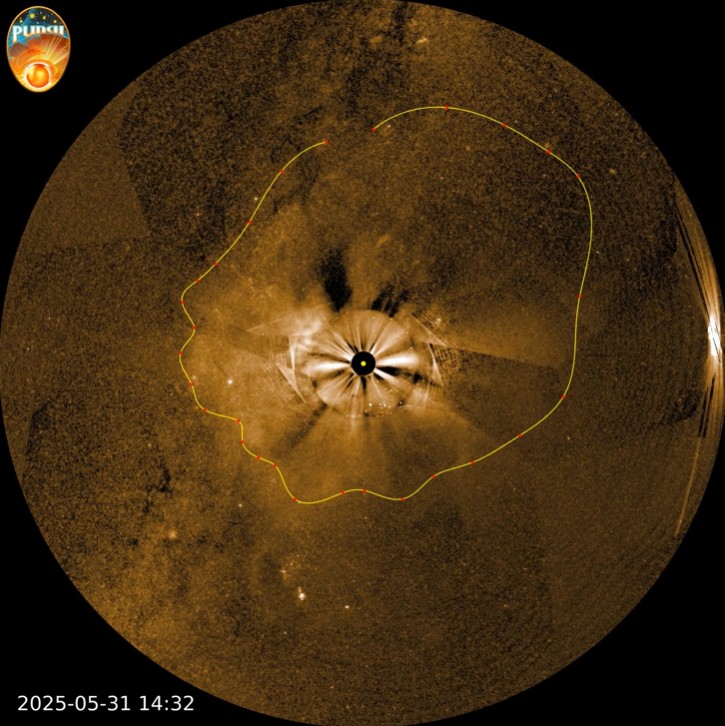
NASA’s test focused on a coronal mass ejection that left the Sun on May 31, 2025. Scientists used the event retrospectively to see whether PUNCH imagery could improve a forecast model. They fed mission images into a computer model that tracked the leading edge of the eruption over time. As the ejection moved through the inner solar system, the model used its observed speed and geometry to estimate when it would reach Earth.
Twelve hours after the eruption left the Sun, the model settled on a final prediction indicating the storm would arrive eight hours later. According to NASA, the actual arrival time ended up within 30 minutes of that forecast. That is the headline result, and it helps explain why mission scientists are describing the test as more than a modest incremental gain.
The mission’s principal investigator, Craig DeForest of Southwest Research Institute, called the outcome a “stunning result” in NASA’s account. Even allowing for the fact that this was a proof-of-concept exercise, the statement captures how unusual it is to see such a sharp improvement in a field where observational blind spots have limited confidence for years.
From partial views to continuous tracking
The value of PUNCH is not just that it collected more images. It is that it changes the geometry of observation. NASA says the mission routinely tracks solar eruptions nearly all the way to Earth, creating an observational bridge between the Sun’s outer atmosphere and the heliosphere through which the storms travel. That offers forecasters a more realistic picture of how a coronal mass ejection evolves after launch, rather than forcing them to infer much of the trip from an early snapshot.
In practical terms, this could make forecasting less dependent on assumptions that become fragile once a storm begins interacting with the surrounding solar wind. A coronal mass ejection that looks straightforward close to the Sun may slow, deform or otherwise change by the time it nears Earth. Continuous tracking gives models more chances to update before impact.
NASA is careful not to oversell the test as a finished forecasting revolution. The reported result was an initial demonstration using one event. It was also a retrospective exercise, not a live operational warning issued in real time. Those distinctions matter. Space weather forecasting systems need repeated validation across many events, especially ones with different structures and propagation conditions, before performance claims can be generalized.
Still, the test establishes a concrete benchmark. It suggests that PUNCH can provide the kind of sustained data stream that forecast models have lacked. If additional cases show similar gains, the mission could help shift the field from broad arrival windows toward more operationally useful timing.
What comes next
The near-term question is whether the result holds up across more storms. Scientists will need to test the method against additional coronal mass ejections and determine how robust the approach is when conditions are less clean than in the first example. Forecast quality is not just about arrival time, but also about the structure and potential impact of the incoming disturbance, so the next phase will likely examine how much more can be inferred from the same data stream.
Even with those caveats, NASA’s announcement signals a meaningful step. Space weather prediction has often been defined by incomplete visibility between the Sun and Earth. PUNCH appears to be addressing that core observational problem directly. An arrival forecast accurate to within 30 minutes will not eliminate solar-storm risk, but it could change how confidently operators act on warnings.
That makes this first test more than a technical milestone for one heliophysics mission. It is an early indication that solar forecasting may be moving from intermittent observation toward near-continuous tracking, which is the kind of shift that can improve both scientific understanding and real-world readiness at the same time.
This article is based on reporting by science.nasa.gov. Read the original article.
Originally published on science.nasa.gov