New modeling challenges the idea of a geologically dead Venus
Venus has long been treated as one of the Solar System’s most hostile and, in a geological sense, most enigmatic worlds. Its surface pressure is crushing, its temperatures are high enough to melt lead, and unlike Earth, it does not appear to be broken into shifting tectonic plates. That last point has helped support a longstanding view that Venus is largely geologically inactive today, a planet whose dramatic surface features mostly belong to a distant past.
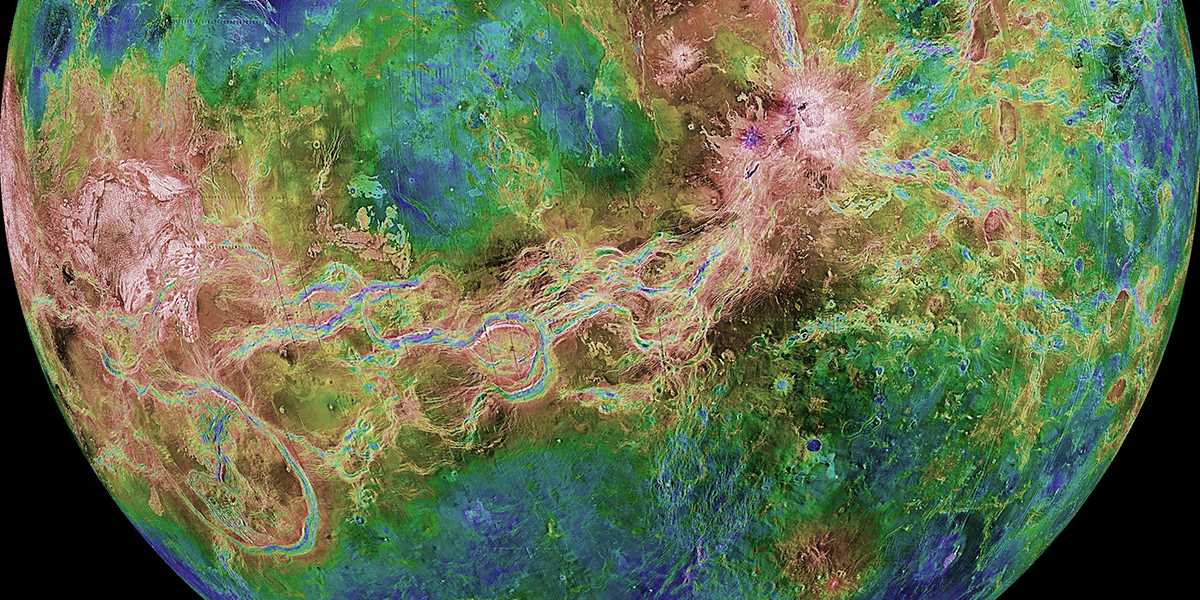
New simulation work highlighted by Universe Today points in another direction. Researchers at ETH Zurich have modeled Venusian rift valleys in high-resolution, three-dimensional detail and found evidence that at least some of these structures may be geologically young. The results strengthen the case that Venus is not a dormant world, but one that may still be internally active, with recent or ongoing geological change.
The work, published in Nature Geoscience according to the report, addresses one of the central questions in planetary science: if Venus lacks Earth-style plate tectonics, how does it release internal heat and reshape its surface over time? Rift valleys appear to be part of the answer.
Why Venus’s rifts matter
Rift valleys form when a planet’s crust is pulled apart. On Earth, such features are associated with tectonic activity and can be seen in major geological structures like the African Rift Valley. On Venus, these lowland features can be enormous, spanning thousands of kilometers. Their size alone has made them impossible to ignore, but their age and significance have been harder to pin down.
What makes the new ETH Zurich work notable is not simply that it identifies rifts as important, but that it uses a more detailed modeling approach to explain how they may have formed and what their current appearance implies. Earlier models relied on simplified material assumptions and were mostly two-dimensional. By moving to high-resolution 3D simulations, the researchers say they were able to reproduce Venusian rift structures more accurately.
That matters because planetary surfaces preserve processes in geometry. The shape of a ridge, basin, or valley can act like a record of how the crust moved, how fast it stretched, and whether those forces are long gone or relatively recent. Better simulation gives scientists a more defensible way to interpret what spacecraft have observed.
Signs of youth in the landscape
The ETH team’s model indicates that broad ridges along the edges of rift valleys, known as rift flanks, form when rifts are geologically young and either still active or only recently inactive. In other words, some of the visible topography on Venus may not be a fossil from a remote chapter of planetary history. It may instead reflect processes that continued into the comparatively recent past.
The report says the simulations suggest some rifts could have formed around 100 million years ago. On planetary timescales, that is recent enough to challenge simple classifications of Venus as geologically dead. It does not mean scientists can yet point to a specific eruption or active fault observed in real time from orbit, but it does narrow the gap between ancient terrain and present-day activity.
The distinction is important. A planet can look static to casual observation and still be dynamically alive beneath the surface. If Venus has young rifts, then its interior has remained capable of deforming the crust and reorganizing surface geology far later than a fully inactive world would.
A different kind of active world
One reason Venus has been so difficult to understand is that it appears to operate by different geological rules than Earth. Earth’s crust is divided into moving plates, and the interactions between those plates create mountains, trenches, earthquakes, and volcanoes. Venus, by contrast, is described in the report as having a single-piece crust rather than a mosaic of constantly shifting plates.
That difference does not necessarily imply inactivity. It may instead mean Venus releases heat and stress through another regime, one that produces regional stretching, large volcanic systems, and broad rift structures without requiring Earth-style plate boundaries. If so, Venus becomes especially important as a comparison world. It would show that rocky planets can remain geologically active even when they lack plate tectonics in the terrestrial sense.
That has implications beyond Venus itself. Planetary scientists use worlds in our own Solar System to build frameworks for interpreting rocky planets elsewhere. Understanding whether and how Venus stays active helps define what “active geology” can mean under very different atmospheric, thermal, and crustal conditions.

Volcanism remains central to the story
The Universe Today report goes further, saying the study supports the view that Venus hosts many active volcanoes. That idea has gained traction in recent years as multiple lines of evidence have challenged the image of a fully dormant planet. Rift valleys fit naturally into that discussion because they represent crustal deformation, the kind of process that can accompany or enable magma movement from below.
Even so, the strongest claim supported directly by the supplied text is that the rifts appear geologically young and consistent with an active interior. That alone is significant. It reframes Venus from a static inferno into a planet where extreme surface conditions coexist with long-lived internal dynamism.
Why the result matters now
Interest in Venus has been resurging because the planet is both familiar and alien. It is similar to Earth in size and rocky composition, yet its atmosphere and surface environment evolved into something radically different. That makes it a powerful natural laboratory for understanding planetary divergence. If Venus is still active, then its present state is not merely the weathered residue of ancient catastrophe. It is the outcome of processes that may still be operating.
The ETH Zurich study, led by Professor Taras Gerya with research conducted by Xi Yang during master’s work under Gerya’s supervision, adds weight to that view by giving scientists a stronger physical explanation for what Venus’s rift valleys mean. Rather than treating these vast structures as relics alone, the new model suggests they may be markers of a planet that has not finished reshaping itself.
For planetary science, that is the real shift. Venus may still be one of the harshest worlds in the Solar System, but harsh does not mean inert. Beneath the crushing atmosphere and furnace-like heat, the planet may remain geologically alive, still stretching, deforming, and perhaps volcanically renewing parts of its surface in ways researchers are only beginning to resolve.
This article is based on reporting by Universe Today. Read the original article.

Originally published on universetoday.com