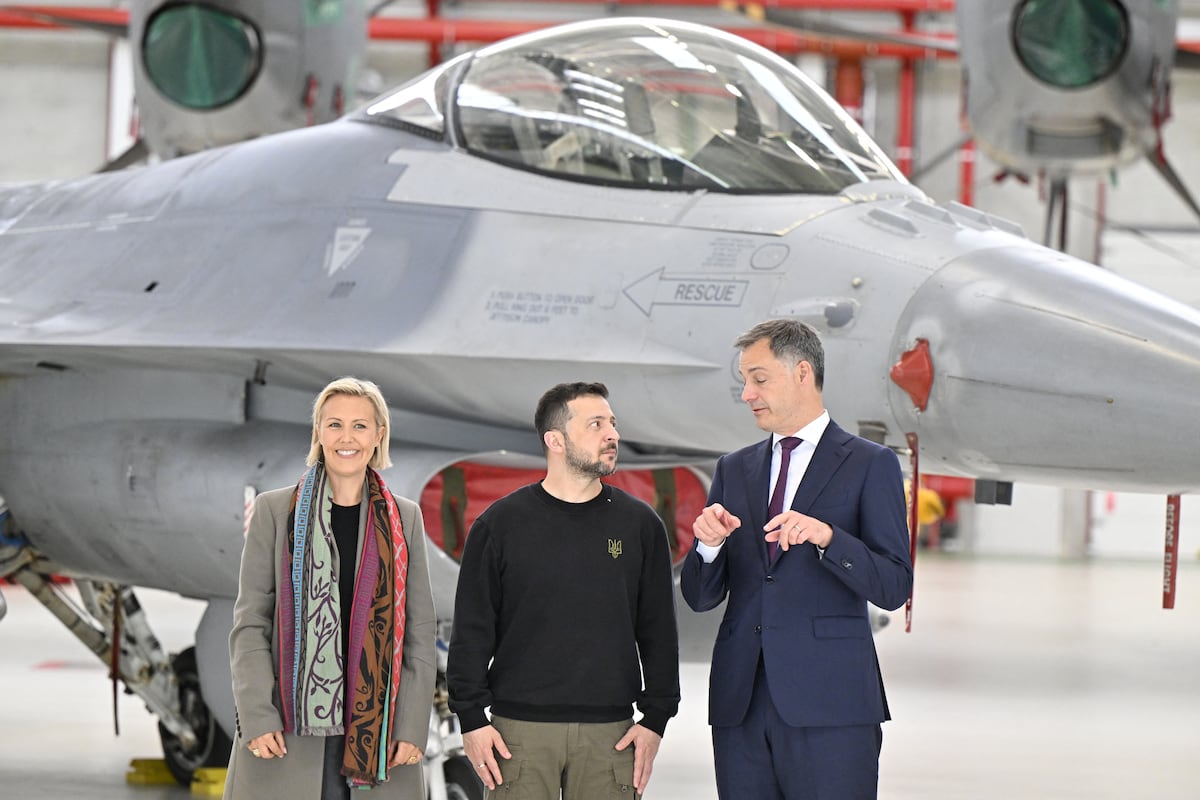
Ukrainian F-16s move from air defense to air combat
Ukraine’s F-16 fleet has achieved its first reported air-to-air kill, according to testimony from Gen. Dan Caine, chairman of the U.S. Joint Chiefs of Staff. Speaking at a Senate Appropriations Committee hearing, Caine said a Ukrainian F-16 recently shot down a Russian fighter jet, describing the event as evidence that Kyiv’s layered air defense network has matured significantly over the past two years.
The statement matters because Ukraine’s F-16s had largely been associated with defensive missions since entering the war. Until now, the aircraft were primarily used to intercept incoming drones and cruise missiles rather than to hunt Russian combat aircraft directly. A successful air-to-air engagement suggests that Ukraine is not only sustaining Western aircraft in combat conditions, but also integrating them into a broader and more ambitious operational picture.
Caine did not identify the Russian aircraft type in his remarks. However, the source material notes that Ukraine’s Air Force announced earlier in July that it had shot down a Russian Su-35 on the eastern front. Russia’s defense ministry had not acknowledged the loss at the time of the report, while some pro-Russian military bloggers on Telegram said a Su-35 had gone down and that the pilot survived after ejecting. Other Russian channels claimed a Patriot air defense battery, rather than an F-16, was responsible.
Why the reported kill stands out
The reported shootdown is notable because it runs against the usual assumptions about the balance between the two aircraft. Ukraine’s F-16s are older A and B models supplied by countries including the Netherlands and Denmark. According to the source text, these are rebuilt airframes dating back to the 1970s and 1980s, making them much closer to earlier generations of F-16s than to the latest variants now in service elsewhere.
By contrast, the Russian Su-35S is described as one of Moscow’s most advanced fighters. The source says its radar can detect fighter-sized targets at substantially longer ranges than the radar fitted to Ukraine’s F-16s. It also cites a range advantage for the Su-35’s longer-reaching air-to-air missiles compared with the AIM-120 missiles Ukraine is known to field.
On paper, that should leave the Russian aircraft with the upper hand in a long-range fight. That is why the reported engagement carries broader meaning beyond a single tactical success. It suggests that pilot skill, mission planning, external cueing, and the wider air-defense architecture can offset at least some hardware disadvantages. In modern air warfare, the decisive factor is often not one aircraft in isolation, but how effectively it is linked into sensors, missile batteries, command networks, and other aircraft.
Caine’s comments leaned in exactly that direction. He framed the incident less as an isolated triumph and more as a sign of Ukraine’s ability to scale domestic defense production and build a layered defensive system. That framing is important because it places the F-16 kill inside a larger story: Ukraine is trying to turn a patchwork of donated systems and local industry into something resilient enough to keep operating under prolonged wartime pressure.
Part of a larger air-defense campaign
The source text says Ukraine’s F-16s have shot down 2,200 of roughly 3,000 Russian drones and missiles intercepted by the aircraft. Even allowing for the fog of war and the difficulty of independently verifying combat claims in real time, the number illustrates the role these jets have already come to play in protecting Ukrainian airspace from stand-off attacks.
That mission has strategic value. Cruise missiles and one-way attack drones are not only battlefield tools; they are also instruments of attrition aimed at cities, power infrastructure, logistics, and public morale. If F-16s can help thin those attacks while also posing a more credible threat to Russian fighters, their value rises beyond symbolism. They become part of a flexible air-defense force that can respond both to incoming strike packages and to enemy aircraft operating near the front.
The reported air-to-air kill also signals a possible evolution in confidence. Introducing a Western fighter into an active war is one challenge. Using it conservatively at first, in missions that emphasize survivability and quick gains, is a rational next step. Expanding from those defensive intercepts into combat against hostile fighters indicates either greater confidence in tactics and integration or a battlefield situation that increasingly demands it.
That does not mean Ukraine suddenly holds air superiority, or that the technical gap between its aircraft and Russia’s front-line fighters has disappeared. The source material points in the opposite direction, underscoring how formidable the Su-35 remains in radar reach and missile range. But combat results do not always track spec sheets. A single successful engagement can reveal weaknesses in doctrine, exposure, situational awareness, or coordination on the opposing side.
What allies and adversaries will watch next
For Ukraine’s Western backers, the event is likely to reinforce the argument that donated systems can deliver meaningful returns even when they are not the newest available models. An older fighter, if sustained and networked well, can still complicate an adversary’s planning and create new risks for hostile air operations. That matters for future training, sustainment, weapons supply, and decisions about what additional capabilities partners may be willing to transfer.
For Russia, even a single confirmed loss to a Ukrainian F-16 would carry operational and political weight. Operationally, it could force more caution in the use of high-end fighters near contested sectors. Politically, it would undercut a long-running assumption that Western-supplied aircraft would be useful mainly for air policing and missile defense rather than direct aerial combat against advanced Russian jets.
The deeper significance is that the war’s air dimension continues to evolve in increments rather than through one dramatic turning point. Ukraine’s F-16s did not arrive as a magic solution, and this reported kill does not change that reality. What it does show is a more capable, better-integrated force than the one that first received the aircraft in 2024. If that trend continues, the practical impact may come less from spectacle and more from steadily raising the cost and uncertainty of Russian air operations.
This article is based on reporting by Defense News. Read the original article.

Originally published on defensenews.com