Ukraine presses for Patriot production as diplomacy returns to the agenda
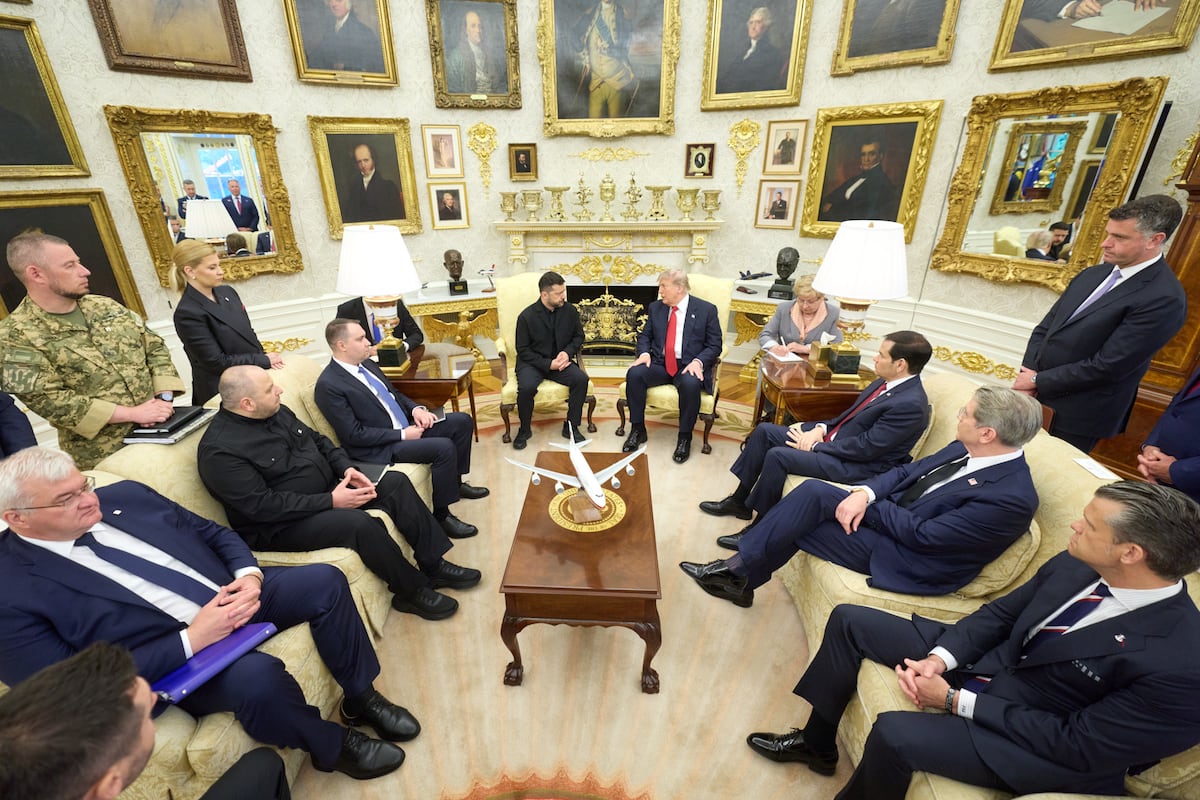
U.S. President Donald Trump and Ukrainian President Volodymyr Zelenskyy used a meeting in Washington on Tuesday to focus on two of the most consequential questions in the war: how Ukraine can strengthen its air defenses against Russian ballistic missile attacks, and whether a stalled diplomatic track with Moscow can be revived. According to remarks cited after the talks, the discussion centered on potential U.S. licensing for Ukraine to produce Patriot missile interceptors and on efforts to restart negotiations aimed at ending the conflict.
The meeting came during a compressed but politically important visit for Zelenskyy. He met Trump privately in the Oval Office, held talks with Finnish President Alexander Stubb, and spoke with U.S. senators on Capitol Hill. The trip also unfolded against a difficult backdrop for Kyiv. While relations with Washington were described as warmer than they had been in recent months, the United States has been sitting on aid for Ukraine, and the death of Senator Lindsey Graham removed one of Kyiv’s strongest advocates in Washington.
That context made the air defense issue especially urgent. Zelenskyy told reporters he had stressed Ukraine’s need for anti-ballistic missile systems and interceptors. He said Ukraine had drones capable of destroying Iranian- and Russian-built drones, but framed ballistic missile defense as the more pressing gap. “The real problem is anti-ballistic systems and anti-ballistic missiles,” he said after meeting senators at the Capitol.
Patriot interceptors remain central to Ukraine’s defense
The Patriot system has become one of the most strategically valuable pieces of Western military support for Ukraine because, as the source notes, it remains the only weapon in Kyiv’s arsenal capable of downing ballistic missiles. That matters more as Russia has intensified air attacks and Ukraine has repeatedly faced shortages of Patriot interceptors. In that setting, the prospect of producing at least some of those interceptors domestically would represent more than a symbolic industrial step. It would point to a possible shift toward longer-term sustainment rather than reliance solely on external resupply.
Zelenskyy said Trump had previously promised at a NATO summit this month to grant Ukraine a license to produce its own Patriot missile interceptors. After Tuesday’s meetings, he said those talks advanced. On Telegram, Zelenskyy described his conversation with Trump as a good meeting and said they had discussed the promise. Later, in an interview on Fox News’ “Hannity,” he said Trump had “accepted that he will give us licenses” to produce the interceptors.
The wording is important. The source does not say a production arrangement has already been finalized or implemented, only that the leaders discussed licenses and that Zelenskyy described Trump as having accepted the idea. Even so, the statement is significant because it suggests Ukraine is pursuing a path that would move beyond direct deliveries and toward local manufacturing under U.S. authorization.
Zelenskyy also said he separately met with officials from Lockheed Martin, identified in the source as the world’s largest weapons maker. That detail underscores how the Ukrainian government is trying to connect political commitments in Washington with defense-industry relationships that could support practical production or supply arrangements.
A renewed diplomatic push, with familiar uncertainty
Alongside the military discussion, Zelenskyy said diplomacy was also part of his agenda. “It is important to step up the diplomatic process,” he said after meeting senators, referring to peace talks with Russia that have stalled while the war enters its fifth year. That remark reflects a familiar pattern in the conflict: diplomatic channels remain active in principle, but they repeatedly struggle to translate into sustained negotiations or concrete breakthroughs.
According to two sources familiar with the talks cited in the report, U.S. envoys Steve Witkoff and Jared Kushner have agreed to visit Ukraine for the first time as part of an effort to restart their mediation work with Russia. The same report says both men have visited Russia and met Russian President Vladimir Putin multiple times since Trump returned to office in January 2025. Zelenskyy said last week he had already spoken with them about the prospects for renewed talks, though no specific date for a visit had been set.
That leaves the diplomatic track in a tentative stage. There is movement, but not yet a timetable or a public framework for negotiations. The discussion nonetheless matters because it shows the White House and Kyiv are trying to pair military support talks with an overt diplomatic channel, rather than treating those as wholly separate tracks.
Why the Washington visit mattered
The political optics of the trip were nearly as important as its formal agenda. Zelenskyy’s visit gave him a chance to reinforce personal and institutional ties in Washington at a moment when U.S. support remains critical but not guaranteed. The source says he attended the funeral of Senator Lindsey Graham, whose death removed one of Ukraine’s most influential backers in the U.S. capital. In practical terms, that means Kyiv is operating with one less advocate inside a political system where internal support can affect the flow of aid, sanctions, and defense cooperation.
Zelenskyy also welcomed new U.S. legislation advancing sweeping Russian energy sanctions. While the report does not detail those measures, his endorsement indicates Ukraine sees them as part of a broader pressure campaign on Moscow, complementing battlefield needs and diplomatic efforts.
Taken together, the meetings suggest Ukraine is pursuing a layered strategy in Washington. One layer is immediate battlefield necessity, especially missile defense. Another is industrial resilience through licensed interceptor production. A third is diplomatic re-engagement, however uncertain. The fact that all three surfaced in a single day of talks signals how tightly they are now linked.
The meeting did not produce a publicly detailed agreement, and many operational questions remain unanswered, including how quickly any licensing arrangement could translate into output and whether renewed talks with Russia can move beyond exploratory contacts. But the themes that emerged were clear. Ukraine wants greater control over the supply of the only system it has for ballistic missile defense, and it wants the United States involved both in that effort and in the next attempt to restart diplomacy.
For now, the most concrete headline is the Patriot discussion. If licensing moves from political acceptance to execution, it could become one of the more consequential developments in Ukraine’s air defense posture. If diplomacy gains traction as well, Tuesday’s meetings may come to be seen as an early marker of a broader shift. At this stage, though, both tracks remain promises in motion rather than settled outcomes.
This article is based on reporting by Defense News. Read the original article.
Originally published on defensenews.com