Marine Corps ends Osprey buy and turns to sustaining the fleet
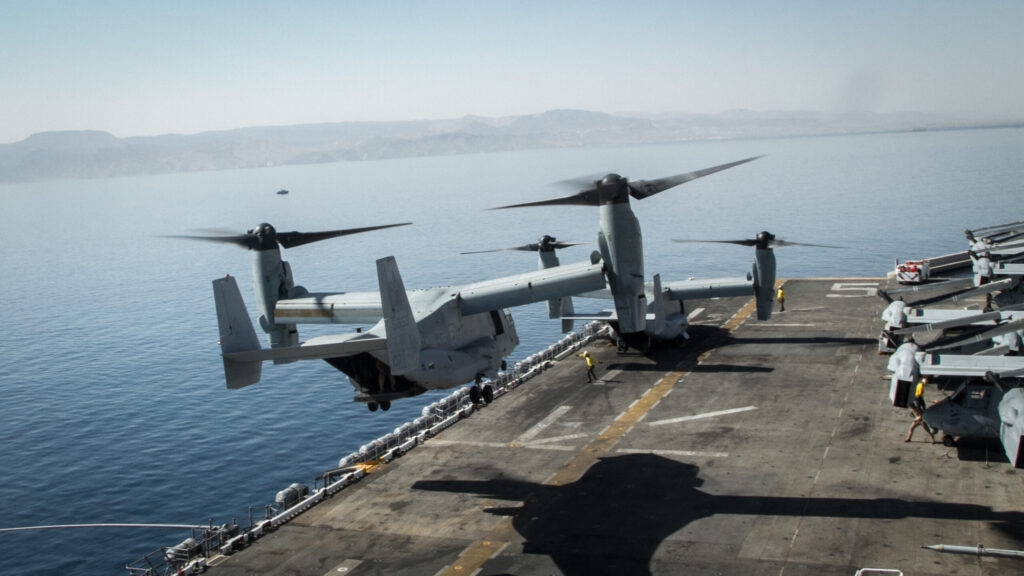
The U.S. Marine Corps has accepted its final MV-22 Osprey, taking delivery of the 359th aircraft in its program of record and bringing a major chapter in Marine aviation procurement to a close. The handoff marks the end of the service’s planned acquisition of the tiltrotor aircraft and begins a new phase centered less on buying airframes and more on keeping them flying safely and effectively for decades.
According to the Marine Corps, the MV-22 fleet reached initial operating capability in 2007 and has since logged more than 686,500 flight hours across 114 operational deployments. Over that span, the aircraft became a defining part of how the service moves personnel, equipment, and supplies between ships and land bases. Its core proposition has always been reach and speed combined with vertical takeoff and landing, a mix designed to support distributed operations in places where conventional fixed-wing aircraft cannot easily operate.
That operational identity was underscored by Lt. Gen. William Swan, the deputy commandant for aviation, who said the aircraft did not simply join the fleet but changed how the Marine Air-Ground Task Force generates combat power. The statement reflects how deeply the Osprey has been integrated into Marine planning. Rather than serving as a niche platform, the MV-22 has become a baseline assumption in how commanders think about moving forces across maritime and littoral environments.
From acquisition milestone to modernization challenge
Completing the program of record does not mean the aircraft has reached a stable end state. The Marine Corps says its focus now shifts to a modernization effort intended to keep the MV-22 operational through 2055. That is a long runway, and it implies a sustained cycle of upgrades, maintenance improvements, and configuration management to support readiness over nearly three more decades.
The service has outlined several priorities for that next phase. Those include improvements to nacelle wiring aimed at reducing maintenance hours, efforts to standardize aircraft configurations across the fleet, and component updates meant to improve safety and sustainability. Taken together, those plans point to a practical reality of mature aircraft fleets: once procurement ends, the harder work often becomes controlling cost, improving reliability, and reducing downtime without disrupting operations.
For the Marine Corps, that work carries unusual weight because the Osprey occupies a specialized role. The aircraft’s ability to take off and land vertically while flying faster and farther than many traditional rotorcraft has made it central to the service’s expeditionary concept. If readiness falters, there is no simple one-for-one substitute waiting in the wings. That makes sustainment decisions strategically important, not merely technical.
A platform with influence and controversy
The Osprey’s record is significant, but it is not uncomplicated. The broader fleet across the U.S. services has suffered several fatal crashes in recent years, and those incidents continue to shape how the aircraft is discussed in public and within defense circles. Breaking Defense notes that a June 2022 crash killed five Marines, and a Marine Corps investigation found that a hard clutch engagement caused the accident. In that event, the clutch temporarily slipped and then reengaged.
That context matters because the transition from procurement to modernization is happening under the shadow of persistent safety scrutiny. An aircraft can be operationally valuable and still face hard questions about maintenance burden, mechanical risk, and aircrew confidence. The Marine Corps appears to be signaling that it understands that balance. Its modernization language does not frame the next phase only as a matter of extending service life; it also emphasizes keeping the aircraft ready, relevant, safe, and sustainable.
Those priorities are especially important for a fleet that is already deeply embedded in force structure. Once a platform becomes foundational to operational planning, safety and reliability are no longer isolated technical concerns. They shape deployment tempo, training confidence, and the wider credibility of future aviation investments.
What this moment says about Marine aviation
The final delivery is also a marker of how Marine procurement is shifting. The era of building out the Osprey inventory is over. The next test is whether the Corps and its industrial base can translate that finished buy into a stable, supportable fleet. That means fewer headlines about new deliveries and more attention to engineering fixes, maintenance efficiency, parts commonality, and the discipline required to keep a large fleet mission-capable.
In practical terms, the Marine Corps now has the full inventory it planned for. The strategic question is what level of performance it can consistently extract from that inventory over time. Modernization efforts such as wiring improvements may sound narrow, but details like those often determine whether a fleet remains available at acceptable cost. Standardizing aircraft configurations can also reduce logistical friction, simplify sustainment, and make training and upgrades more manageable across the force.
The Marine Corps’ stated goal of operating the Osprey through 2055 suggests the aircraft will remain a core enabler well into future force design debates. That gives today’s delivery symbolic importance. It closes out one of the service’s biggest aviation acquisitions while opening a prolonged period in which sustainment quality will matter as much as procurement scale once did.
For the Corps, the final MV-22 is less an ending than a handoff from buyers to maintainers, engineers, and operators. The aircraft has already shaped Marine expeditionary mobility. The next phase will determine whether it can hold that role under the pressures of age, safety demands, and evolving operational requirements.
This article is based on reporting by Breaking Defense. Read the original article.
Originally published on breakingdefense.com