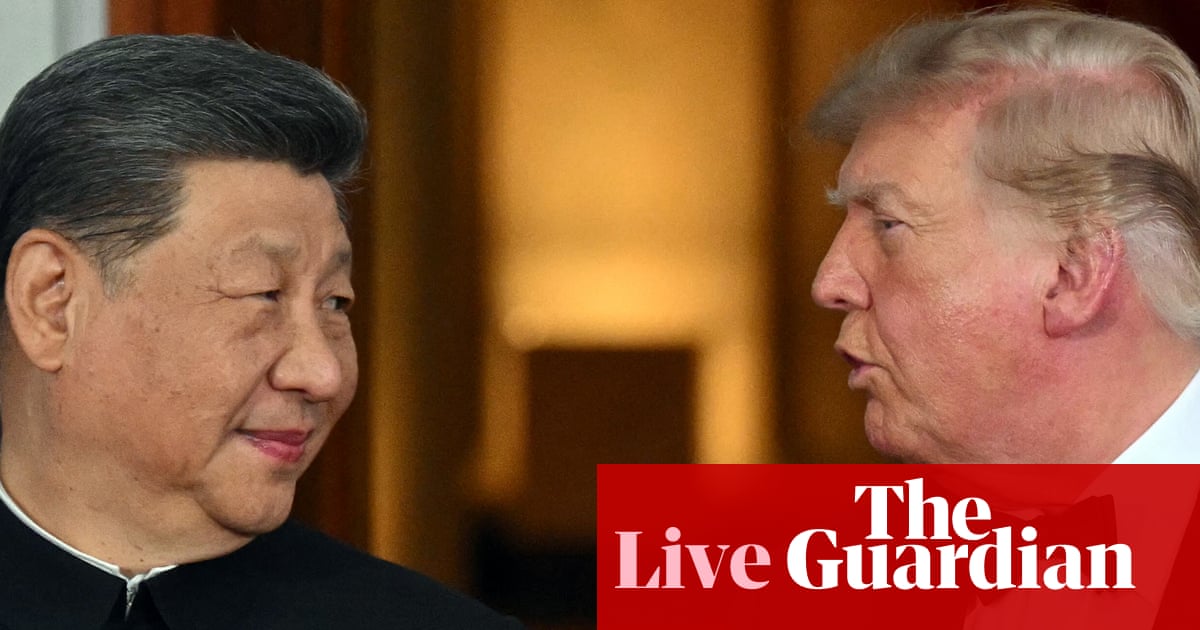
The White House meeting between President Donald Trump and Chinese leader Xi Jinping has produced one of the clearest signals yet of how Washington views Beijing's potential role in the US military campaign against Iran. According to an account relayed to CNBC and reported by The Guardian in a live update, Trump told Xi during yesterday's talks that it would be "unacceptable" for China to assist Iran while American operations against the country continue.
The details surfaced this morning in Central European Summer Time, with the item published at 15.21 CEST and updated shortly afterward. The account is attributed to a US official who spoke to CNBC, and it places the Iran question squarely at the center of a summit that was already being watched closely for signs of how the two powers intend to manage their most contentious disputes.
Perdue Says The Warning Was Not New
Speaking to CNBC, David Perdue, the US ambassador to China, described a message that he said had been conveyed to Beijing well before the leaders sat down together. Perdue indicated that Washington had made its position explicit weeks earlier, telling the Chinese side that any assistance to Iran — whether given directly or indirectly, and whether in the form of intelligence, parts or military equipment — would be entirely unacceptable. He added that Trump repeated that position in person yesterday.
The ambassador's framing matters for how the summit is likely to be read in both capitals. By characterizing the exchange as a reaffirmation rather than a first warning, Perdue presents the White House as consistent and predictable, having laid down a marker privately before restating it at the highest level. That sequencing suggests the administration wants to avoid any suggestion that Beijing was caught off guard by the demand.
What Xi said in return has not been disclosed in the account provided so far. Nor is it clear whether the Chinese delegation offered any assurances, sought clarifications, or raised its own conditions. Those gaps leave the practical effect of the conversation unresolved for now.
Secondary Sanctions Put Beijing In The Spotlight
The Trump-Xi meeting is taking place against the backdrop of a new round of secondary sanctions that Washington is attempting to put in place against Iran. The stated aim of that effort is to cut off Iran's remaining links to the global economy — a goal that inevitably runs through Beijing, given the scale of the economic relationship between China and Iran.
Secondary sanctions work by threatening penalties against third parties, including foreign companies and financial institutions, that continue doing business with a targeted country. Because they extend punishment beyond the sanctioned state itself, they depend heavily on whether major trading partners are willing to comply. That is precisely the vulnerability critics have identified in the current approach.
Why Critics Doubt The Pressure Campaign
According to the account, critics have speculated that the new sanctions plan will prove ineffective unless China gets on board. The reasoning is straightforward: China has long maintained strategic ties to Iran, and those ties give Beijing considerable leverage over whether a pressure campaign can actually isolate Tehran economically.
If the largest and most significant trading partner declines to cooperate, the argument goes, the sanctions may end up reshaping trade routes and intermediaries rather than severing Iran's connections to world markets. That skepticism is not a prediction about what China will do, but a caution about how much a sanctions package can achieve on its own.
The ambassador's remarks, in that light, can be read as an attempt to close that gap by raising the political cost of non-compliance. Rather than relying solely on financial penalties, the administration appears to be pairing them with a direct presidential message delivered face to face — one that frames any form of assistance as a potential breach of expectations between Washington and Beijing.
A Visit That Includes A Stop At The Archives
The summit is not unfolding in a purely bilateral vacuum. Xi is expected to depart Washington, DC, after touring the National Archives, the institution that holds the Declaration of Independence, the Constitution and the Bill of Rights. The itinerary adds a symbolic dimension to a visit otherwise dominated by hard security and economic questions.
For a Chinese leader, a tour of the repository that houses America's founding documents carries obvious ceremonial weight. It places the diplomatic program alongside an encounter with the artifacts of US political origin — a contrast with the closed-door discussions at the White House, where the subject matter is military and economic pressure.
The scheduling also means the visit will be bracketed by two very different kinds of images: the leaders in talks, and the Chinese delegation walking through the vault that protects some of the most closely guarded texts in American history. Both will be part of how the trip is remembered.
Key Points From The Reporting
- Trump told Xi during yesterday's White House talks that Chinese help for Iran would be "unacceptable," according to a US official who spoke to CNBC.
- US ambassador to China David Perdue said Washington had communicated the same message weeks ago, covering direct and indirect help, including intelligence, parts and military equipment.
- Perdue said Trump restated the position clearly during the meeting.
- The talks come as the US seeks to implement a new round of secondary sanctions on Iran aimed at severing its remaining ties to the global economy.
- Critics have argued the sanctions plan will be ineffective unless China participates, citing Beijing's long-standing strategic ties to Iran.
- Xi is expected to leave DC after touring the National Archives, where the Declaration of Independence, the Constitution and the Bill of Rights are held.
What Comes Next
The immediate question is whether the presidential message changes Chinese calculations in any measurable way. Secondary sanctions are ultimately tested in practice — in the decisions of banks, shippers, manufacturers and intermediaries about whether the risk of US penalties outweighs the value of continued dealings with Iran. A warning delivered at a summit can shape those calculations, but it does not settle them.
A second question concerns how the exchange is absorbed into the broader US-China relationship. The Iran issue is now folded into a leader-level conversation that covers a much wider agenda, and the way each side characterizes the discussion afterward may reveal more than the initial account. Public readouts from both governments will be scrutinized for hints about whether the topic was treated as a settled warning or an open dispute.
For now, the record consists of what Perdue said on the network: that the United States has made its position plain for weeks, that Trump repeated it directly to Xi, and that Washington regards any Chinese assistance to Iran as crossing a line. Whether that line holds under the strain of a new sanctions regime — and whether Beijing chooses to test it — is the substance of what follows.
This article is based on reporting by The Guardian. Read the original article.
Originally published on theguardian.com