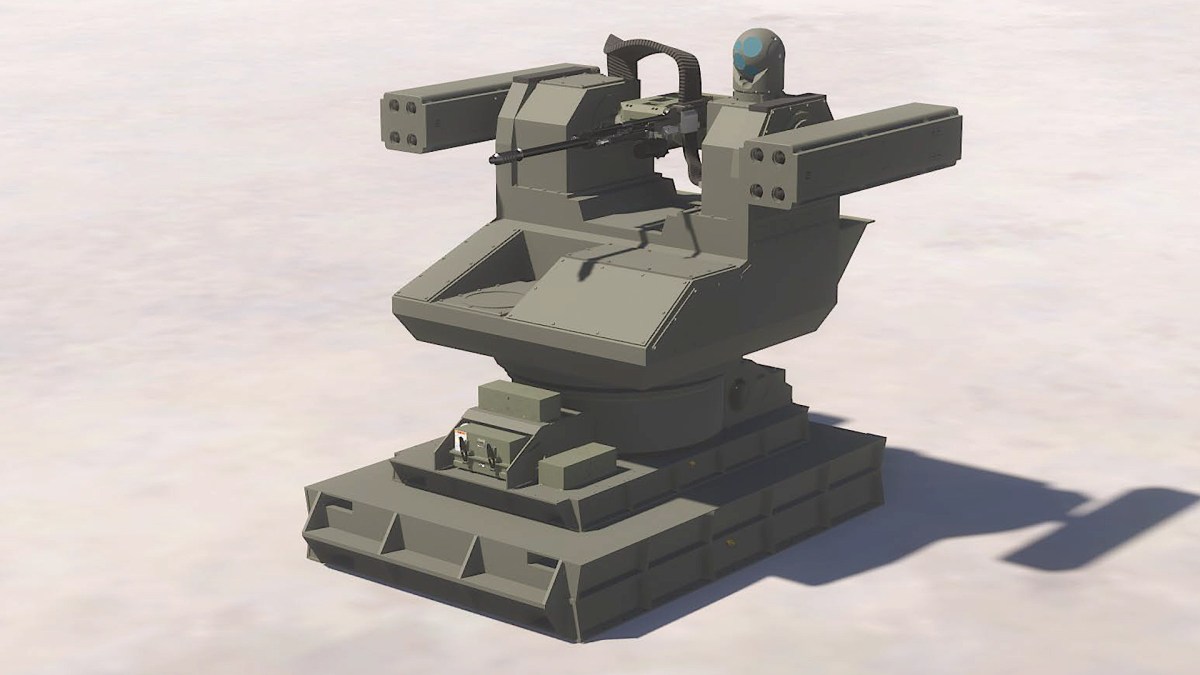
The U.S. Army is aiming to have a new class of palletized short-range air-defense systems in service before the end of 2029, expanding the ways combat units can deploy defenses against aerial threats, including drone swarms. The program, formally called Maneuver-Short Range Air Defense Increment 4, is intended for crewed vehicles, uncrewed vehicles and static sites.
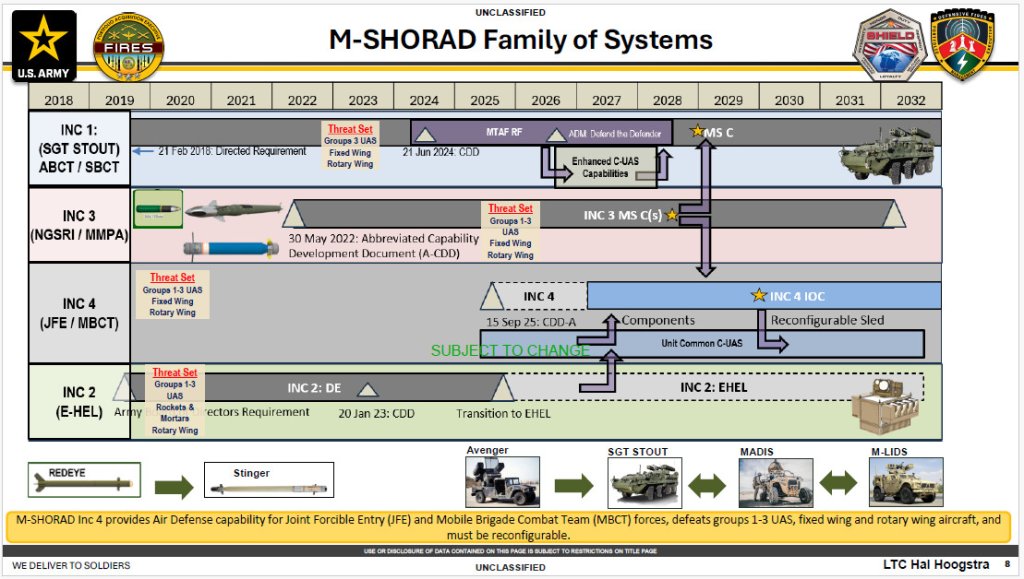
New program details appeared in briefing slides released online after an industry-day event in Huntsville, Alabama. The Army’s target is to reach Initial Operational Capability by the end of calendar year 2029, tightening the focus on a capability it has previously said could be fielded between fiscal years 2027 and 2029.
Air defense designed for flexibility
The Increment 4 concept centers on palletized systems, sometimes described as air-defense “sleds.” Instead of tying a weapon suite permanently to one vehicle type, a palletized approach could allow it to be carried by different crewed or uncrewed platforms, or placed in a stationary defensive position.
That flexibility is a key part of the Army’s stated goal. Units could potentially reposition a point-defense capability as their operational needs change, rather than depending exclusively on dedicated air-defense vehicles. The systems are expected to defend against aerial threats and could also be used against ground targets.
The emphasis reflects the growing prominence of small uncrewed aircraft and drone swarms on modern battlefields. Such threats can force defending units to distribute sensors and interceptors across a wider area while retaining the ability to move with maneuver forces.

How Increment 4 fits the M-SHORAD program
The Army’s broader M-SHORAD effort dates to the late 2010s and has developed through several increments. Each increment addresses a different part of short-range air defense, from mobile missile-and-gun systems to directed-energy weapons and new interceptors.
- Increment 1 produced a Stryker 8×8-based mobile air-defense system now called Sgt. Stout.
- Increment 2 focuses on bringing counter-drone directed-energy weapons into operation, particularly laser-based designs.
- Increment 3 initially centered on the Next Generation Short-Range Interceptor, intended to replace the Stinger missile, and now also includes work on a 30mm airburst round for M914-equipped ground vehicles.
- Increment 4 is focused on the palletized capability intended for mobile and static deployment.
In combination, the increments show the Army pursuing multiple ways to counter low-altitude threats rather than relying on a single vehicle or weapon. Missiles, guns, airburst ammunition and directed energy address different target sets and engagement conditions; a palletized system adds another deployment option.
A 2029 operational target
The Army previously identified a possible fielding window from fiscal year 2027 through fiscal year 2029. The newly released schedules point more specifically to Initial Operational Capability by the close of 2029.
Initial Operational Capability generally marks the point at which a capability can begin serving with operational units, rather than remaining solely in development or test activity. It is not necessarily the same as full-scale deployment across the force, but it is an important milestone for a system intended to fill a gap in combat-unit protection.
The date also indicates that the Army is treating the program as a near-term response to a pressing operational need. Drone threats have become a major concern for land forces because they can be inexpensive, numerous and used for reconnaissance, targeting or attack. A defense that can be mounted where it is needed—or left behind to protect a fixed point—could improve how units allocate limited air-defense assets.
Why palletization matters
Traditional short-range air-defense systems are often built around a particular vehicle, which can simplify integration but also constrains where the system can go. A palletized architecture may offer a different balance: the same defensive package could be employed on suitable platforms or emplaced at a static location.
For maneuver forces, that could create more options for defending formations on the move. For commanders protecting a temporary command post, supply point or other fixed location, it could offer a way to establish point defense without assigning a permanently vehicle-bound system to the task.
The approach also aligns with the Army’s expectation that M-SHORAD Increment 4 will work with both crewed and uncrewed vehicles. The source does not identify a final vehicle configuration or weapon loadout, so those details remain to be determined. What is clear is that the service is seeking a capability that can adapt to several modes of deployment.
Part of a wider counter-drone effort
Increment 4 will not replace the rest of the M-SHORAD family. The program’s other elements cover mobile systems, laser-based counter-drone work, a future interceptor and 30mm airburst ammunition. Together, those efforts suggest an effort to build layered defenses against threats that can vary in range, size, speed and number.
For the Army, the key question over the next three years will be whether industry can deliver a mature, interoperable palletized system on the stated schedule. The 2029 goal sets a concrete benchmark: a new deployable point-defense option meant to give units more capacity and flexibility when aerial threats, especially drone swarms, demand both.
This article is based on reporting by twz.com. Read the original article.

Originally published on twz.com