A concept for extending precision fires
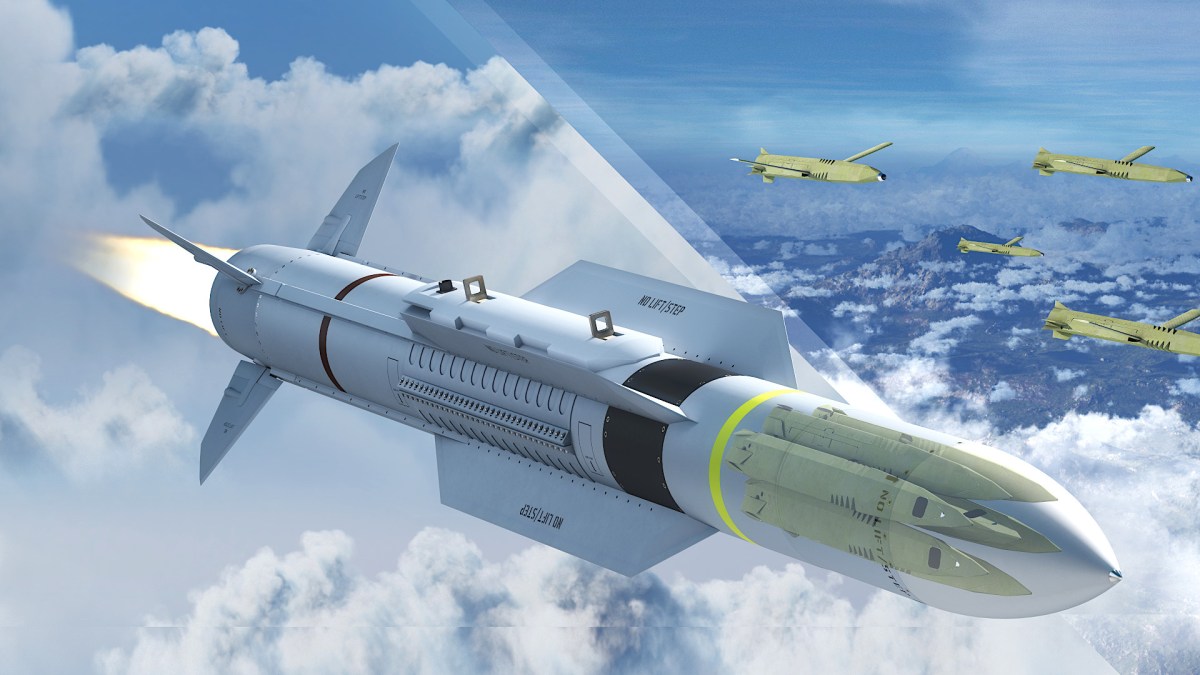
General Atomics is exploring whether a long-range missile could serve as a carrier for several smaller, maneuvering precision munitions. The company has described a concept in which an AIM-174B missile is adapted for a strike role and fitted with seven Vektrex-derived submunitions.
The idea was displayed as a rendering at the Euronaval 2026 exhibition in Paris and was first reported after being seen at General Atomics’ booth. General Atomics Electromagnetic Systems subsequently provided additional detail, saying it is exploring the use of Vektrex-derived maneuvering submunitions from air- and ground-launched missiles to meet emerging requirements for extended-range precision fires.
The proposal remains a concept rather than an announced fielded weapon or acquisition program. Still, it illustrates a possible way to pair the reach of an existing missile with the ability to place multiple guided effects over a target area.
From artillery round to missile payload
Vektrex was first unveiled in 2023 under the name Long Range Maneuvering Projectile. Development has focused initially on an unpowered precision-guided munition that can be fired from standard 155 mm howitzers. It uses pop-out wings after launch, allowing it to glide rather than follow only a conventional ballistic trajectory.

General Atomics has also shown a concept for launching the munition from 5-inch naval guns. Its work to date has been supported by the U.S. Army and the U.S. Navy, according to the source material. The company has described Vektrex as having redundant guidance systems intended to support engagement of static or moving targets.
Putting a derivative of that munition inside a missile would be a substantial change in employment. Instead of firing an artillery projectile directly at a target, a launcher could send a missile toward a distant area and release multiple gliding payloads. The carrier missile would provide the initial range and speed; the smaller munitions would supply the terminal maneuvering element.
The concept is notable because it looks beyond a single warhead delivering one effect at one point. A missile loaded with several submunitions could potentially present defenders with more than one inbound threat after the payload separates. That could create additional demands for sensing, tracking, interception, and target prioritization.

Why the AIM-174B appears in the proposal
The specific rendering uses the AIM-174B, an air-to-air missile derived from the Standard Missile-6 family. General Atomics’ concept would turn it into a strike weapon carrying seven Vektrex-derived munitions. The proposal therefore suggests using the internal volume of a large, long-range missile for a different mission set than its usual air-to-air role.
No performance figures, release method, guidance architecture, warhead details, or operational timelines for the concept were provided in the supplied report. Those omissions matter. A display rendering is not evidence that the weapon has been tested, integrated with a launch platform, or selected by a customer.
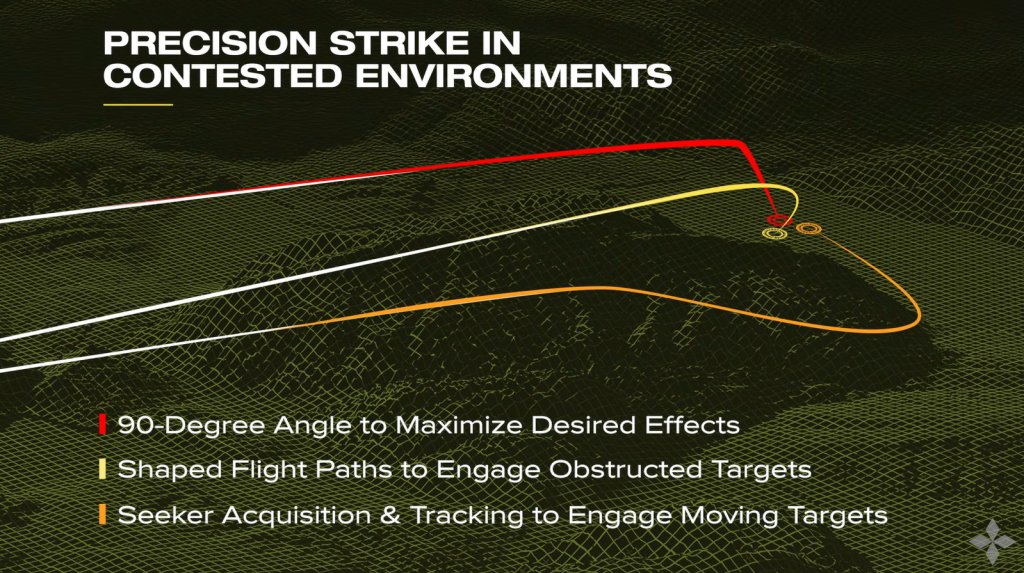
General Atomics did point to its investments in advanced weapons, precision machining, automation, and assembly as a manufacturing basis that could support production once designs qualify and customers commit. That framing makes clear that the work is still tied to future qualification and customer decisions.
A broader design question
The underlying proposition is that existing and future missiles might become delivery systems for several maneuvering munitions, rather than solely carriers for a unitary warhead. Such an approach could offer planners more flexibility in choosing how to distribute effects across a target area, while allowing a weapon to be launched from air or ground platforms.
It could also blur traditional boundaries between artillery, naval fire support, air-launched strike weapons, and missile defense challenges. Vektrex itself began as a precision-fire concept for 155 mm howitzers, with a naval-gun option also shown. The AIM-174B illustration moves the same basic glide-munition idea into a much longer-range missile package.
Whether the approach becomes a real weapon will depend on technical integration, testing, affordability, and military demand. For now, General Atomics has disclosed an exploration effort, not a deployed capability. But the concept points to continuing interest in using compact guided munitions to make long-range fires more adaptable and more difficult for an opponent to counter with a single defensive response.
This article is based on reporting by twz.com. Read the original article.

Originally published on twz.com