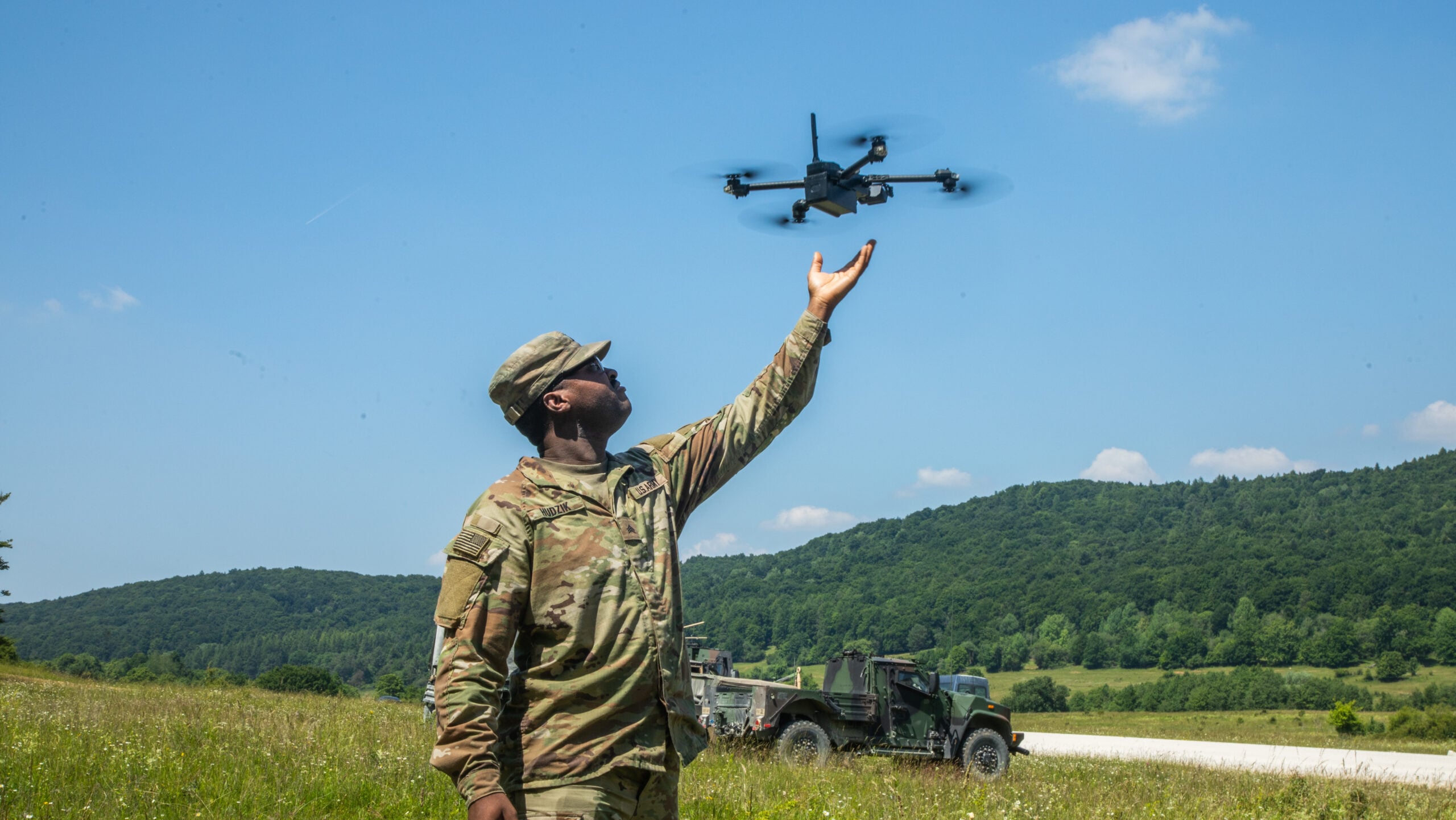
Cheap drones are not necessarily cheap capability
As the U.S. military races to absorb lessons from recent conflicts and expand its use of small unmanned systems, one warning is becoming harder to ignore: buying at scale is not the same thing as buying lasting combat value. An op-ed published by Breaking Defense argues that the Pentagon risks confusing low unit price with low effective cost, especially in a domain where adversaries can develop counters quickly and where technology cycles move faster than traditional acquisition logic expects.
The argument is straightforward but consequential. If the Defense Department buys a very large number of low-cost drones and warehouses them for future use, the apparent savings may prove illusory if enemy countermeasures emerge before much of that inventory is ever deployed. In the example laid out in the piece, purchasing 100,000 drones at $1,000 apiece looks efficient at first glance. But if only 30,000 remain operationally useful before the other 70,000 are neutralized by changing threats, the true cost per useful unit rises sharply.
That is the central claim: the military can no longer assume that lower unit cost automatically translates into better value per dollar when drone obsolescence arrives faster than inventory can be consumed.
An industrial-era buying logic meets a faster innovation cycle
The op-ed places the problem in historical context. For most of the industrial age, mass production rewarded standardization, specialization, synchronization, and certification. Those principles reduced the cost of replicating another tank, truck, bomb, or aircraft once the tooling, process, and workforce were established. That made unit cost a useful proxy for efficiency and helped militaries scale proven hardware.
But the article argues that this logic is no longer sufficient. Manufacturing is entering a different era, one shaped by artificial intelligence, digital engineering, modeling and simulation, and tools that are less tied to a single fixed design. In such an environment, the value of flexibility can rise faster than the value of repetition. If the threat changes rapidly, a cheap system that cannot be adapted may become expensive in strategic terms, while a somewhat costlier system that can evolve may deliver better overall return.
That shift is especially relevant for small drones. They sit at the intersection of software, sensors, radio links, autonomy, and payload integration. Each of those layers can become a target for countermeasures. A drone does not need to be physically destroyed to become ineffective. It can be jammed, spoofed, detected too easily, or simply outclassed by changes in the defensive environment.
Obsolescence becomes a procurement variable
The op-ed’s key contribution is to treat obsolescence not as an unfortunate afterthought but as a cost category that should be planned for up front. In traditional procurement, the assumption often runs the other way: buy in quantity, drive down cost, and rely on scale. The article suggests that for small drones this can backfire, because stockpiling large volumes may lock the department into hardware that ages out tactically long before it wears out physically.
That changes how the Pentagon should think about value. The relevant metric is not simply cost per airframe. It is cost per useful battlefield effect over time. A drone that is inexpensive on paper but quickly neutralized by enemy adaptation may be worse than a more adaptable system with a higher sticker price. In that sense, a warehouse full of obsolete drones is not a reserve of combat power. It is a record of procurement assumptions that did not survive contact with the pace of change.
The warning also cuts against a political and bureaucratic instinct. In periods of urgency, quantity is easy to communicate. Large numbers suggest readiness, industrial momentum, and action. But quantity can mask fragility if the systems being procured are optimized for today’s threat picture with little margin for change.
The case for adaptability over pure volume
Although the supplied text is only part of the full argument, it points toward a broader acquisition principle: in a fast-moving drone market, repeatability alone is not enough. The systems, tools, and processes used to build unmanned platforms may need to support quicker redesign and iterative refresh cycles. That implies a greater role for digital engineering, modularity, and production methods that can absorb change without collapsing cost discipline.
The challenge for defense procurement is that mass and adaptability can pull in different directions. Standardization helps scale, but over-standardization can freeze a design. Certification improves trust, but lengthy certification can slow iteration. Specialization creates efficiency, but excessive specialization can make upgrades cumbersome. The emerging task is not to abandon those industrial principles. It is to rebalance them for a class of systems that may become outdated in months rather than decades.
That does not mean cheap drones are a bad investment. It means cheap drones should not be evaluated in isolation from the rate at which their usefulness may degrade. The article’s argument is not anti-scale; it is anti-complacency. It asks acquisition planners to stop assuming that a low purchase price settles the value question.
Why this matters now
The urgency behind the op-ed comes from how central small drones have become to modern military planning. Conflicts in Ukraine and the Gulf have accelerated interest in low-cost, proliferated systems for surveillance, targeting, strike, and counter-drone operations. That environment creates pressure to buy quickly and buy in volume. The op-ed accepts the need for scale, but insists that scale without a plan for rapid obsolescence can turn into waste.
This is not just a budget issue. It is also a readiness issue. A force that believes it possesses large numbers of viable unmanned systems may discover too late that much of its inventory has lost practical relevance. At that point, the military faces a poor set of options: dispose of the hardware, spend to retrofit it, or deploy systems with sharply reduced battlefield value.
The broader lesson is that drone procurement may need to be treated less like conventional stockpiling and more like a managed technology pipeline. The problem to solve is not simply how to manufacture tens of thousands of units. It is how to maintain useful capability while adversaries are actively learning how to defeat it.
If that premise is right, then the Pentagon’s drone push will succeed or fail on more than production numbers. It will depend on whether acquisition systems can recognize that in this market, the cheapest unit may not be the least expensive capability. The hidden price is obsolescence, and the op-ed argues that defense planners need to budget for it before warehouses start filling up.
This article is based on reporting by Breaking Defense. Read the original article.
Originally published on breakingdefense.com