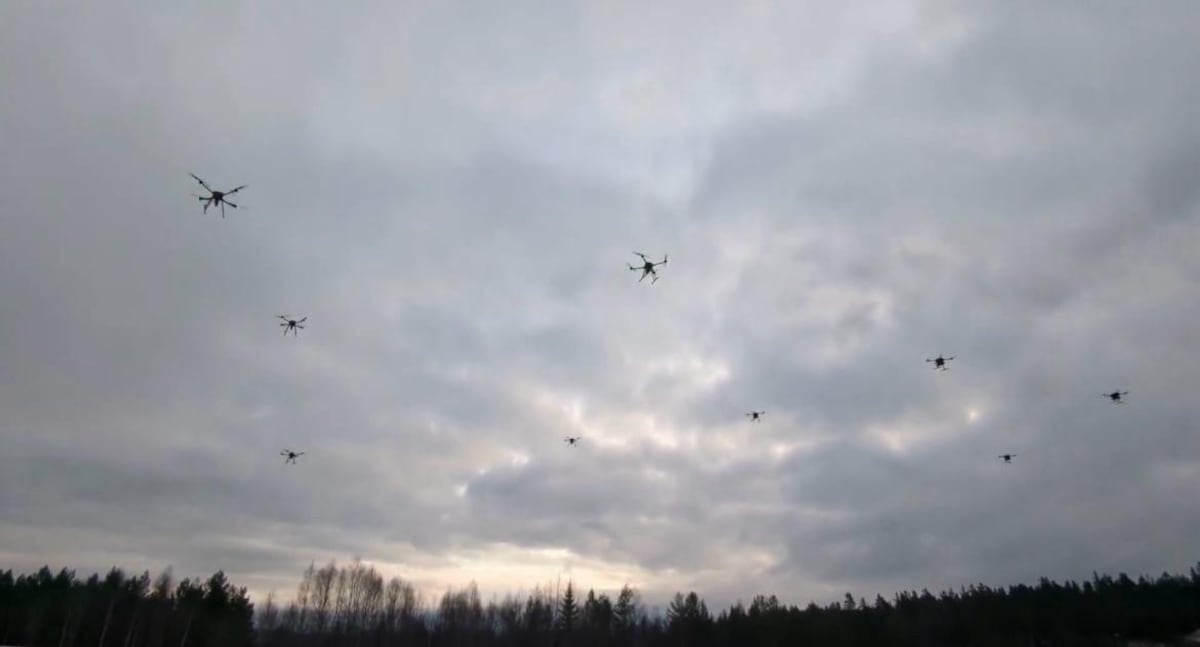
Israel Aerospace Industries introduces a soft-kill system aimed at mass drone threats
Israel Aerospace Industries has unveiled a new air defense system called Hypnosis, positioning it as a response to one of the hardest problems in modern battlefield defense: how to stop large numbers of incoming drones without relying entirely on expensive kinetic interceptors.
According to the company announcement reported by Defense News, Hypnosis is designed to jam and spoof the satellite navigation signals that guide aerial threats. The system consists of an array of mobile stations placed around a defended area. Working together, those stations are intended to disrupt the command-and-control signals of incoming threats and degrade their ability to navigate effectively.
The concept places Hypnosis squarely in the growing category of so-called soft-kill defenses. Rather than physically destroying targets with missiles or guns, soft-kill systems try to confuse, divert, or disable them electronically. That approach has become increasingly important as militaries confront the prospect of drone swarms, where the sheer number of airborne objects can overwhelm traditional defenses.
Why drone swarms are changing air defense economics
Conventional air defense systems were largely built around the idea of engaging a limited number of high-value threats: aircraft, helicopters, cruise missiles, or ballistic missiles. Swarming drones create a different challenge. Even relatively simple and inexpensive uncrewed systems can become dangerous when deployed in large numbers, particularly if they approach from multiple directions or operate with coordinated logic.
That changes the economics of defense. A force may be able to intercept one or two drones with kinetic systems, but a larger saturation attack can quickly consume munitions, strain sensor networks, and raise the odds that at least one warhead gets through. The value proposition of soft-kill tools is that they may be able to affect many incoming threats at once, especially if those threats depend on shared vulnerabilities such as satellite navigation or command links.
IAI is presenting Hypnosis as a system built for precisely that kind of environment. The company said its experience in navigation warfare, or NAVWAR, informed the design. In practical terms, that means using electromagnetic effects to interfere with how drones orient themselves, receive instructions, or maintain confidence in their own positioning.
If successful, that offers a different defensive logic from pure interception. Instead of engaging each drone individually, a defended site could create a zone in which multiple aerial threats lose the navigation and control integrity they need to complete an attack.

What the company says the system does
Based on the supplied report, Hypnosis uses mobile stations deployed around a protected area. Those stations work in unison to send out jamming signals against drone swarms. The stated goal is to disrupt both navigation and command-and-control functions used by incoming aerial threats.
The report describes the system as a soft-kill weapon intended for situations where hard-kill methods would be difficult because of the number of airborne objects involved. That makes it less a replacement for conventional air defense than a complement to it. In a layered architecture, electronic attack can thin out or disorganize an incoming swarm before kinetic systems are used against any remaining threats.
What is not yet public, at least in the supplied material, is equally important. There are no technical performance figures here for range, power, effectiveness against different drone classes, resilience against countermeasures, or operational conditions. There is also no information on whether the system has been deployed operationally or evaluated in combat. At this stage, the significance lies in the capability area IAI is targeting and in the timing of the unveiling.
The timing reflects a wider military shift
The launch comes amid intensified attention to uncrewed warfare across multiple theaters. The report notes heightened tension in the Middle East and an ongoing exchange of missile and drone strikes between Russia and Ukraine. In both contexts, drones have become central not just as tactical tools but as instruments of persistent pressure, reconnaissance, and strike capacity.
At the same time, defense companies around the world are developing systems that allow swarms of drones to attack with increasing autonomy and coordination. That offensive trend naturally produces a defensive race. If attackers can field larger numbers of cheaper aerial systems, defenders need options that do not depend solely on high-cost interceptors or one-shot engagements.
That dynamic is driving renewed interest in electronic warfare, spoofing, and network disruption. A capable soft-kill system can be attractive because it promises scale. In theory, one defensive architecture could affect multiple targets across a zone instead of requiring one interceptor per threat. Whether systems like Hypnosis can deliver that consistently in contested environments will determine how valuable they become.
Still, the basic strategic logic is clear. Swarms are difficult because they saturate and overwhelm traditional air defense networks. Any technology that can reduce that saturation effect, even partially, becomes highly relevant.
What Hypnosis may represent for future layered defense
The unveiling of Hypnosis is best understood as part of a broader move toward layered, mixed-method air defense. Modern protection against drones is unlikely to come from a single solution. Radar and electro-optical sensors must detect threats. Electronic warfare tools may then jam or mislead them. Kinetic systems may still be needed to finish off any platforms that remain dangerous or are hardened against signal disruption.
In that architecture, the appeal of Hypnosis is not that it eliminates the need for interceptors, but that it may help preserve them. If a jammer or spoofing network can neutralize or scatter a portion of a swarm before missiles are launched, defenders may stretch their magazines further and maintain coverage longer under stress.
The mobile-station design also suggests an emphasis on flexible deployment. Instead of a single fixed emitter, a distributed arrangement around a defended area could potentially create broader or more adaptive electronic effects. That may matter for protecting bases, infrastructure, or maneuver formations that face changing threat axes. The supplied source does not provide operating doctrine, but the architecture points toward area defense rather than point defense alone.
For now, Hypnosis remains an unveiled capability rather than a field-proven one in the information provided. Even so, it highlights where military investment is moving. Drone swarms are no longer a theoretical future problem. They are shaping procurement, doctrine, and industrial competition now. Systems that can impose confusion at scale, rather than simply fire at scale, are likely to draw increasing interest from armed forces trying to keep pace with the evolution of aerial threats.
That makes Hypnosis notable even in the absence of published performance data. It is another sign that the contest between autonomous or semi-autonomous mass attack and distributed electronic defense is becoming a defining feature of contemporary air defense planning.
This article is based on reporting by Defense News. Read the original article.
Originally published on defensenews.com