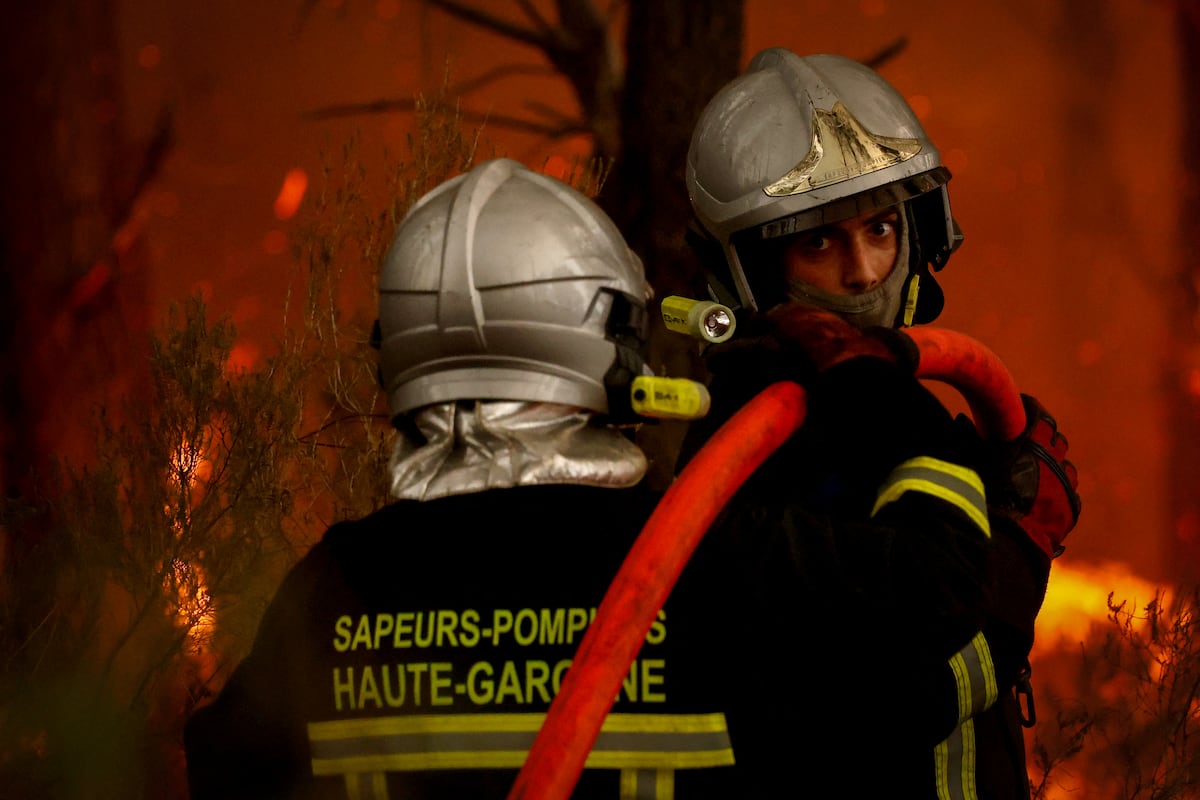
Wildfire pressure is reaching one of France’s most important defense corridors
Large wildfires in southwest France are no longer just an environmental emergency. They are now threatening a concentrated belt of defense and aerospace production west of Bordeaux, forcing evacuations, equipment transfers, and temporary shutdowns at facilities linked to combat aircraft, missile propulsion, and France’s sea-based nuclear deterrent.
Defense News reports that the fires are pressing against a cluster of industrial sites that includes an ArianeGroup facility producing propulsion components for the M51 submarine-launched ballistic missile, Dassault Aviation’s Rafale final assembly operations, and a major Roxel manufacturing site for solid rocket motors used in MBDA missiles. The concentration of sensitive programs in one geographic area gives the wildfire event a significance beyond local disruption. It exposes how climate-driven emergencies can interfere with strategic manufacturing and military readiness even without directly damaging a final weapon system.
The Gironde department has been battling one of the country’s largest wildfires on record. More than 100,000 acres have burned, according to the report, an area described as roughly four times the size of Paris. In recent days the fires moved toward one of France’s densest concentrations of missile, propulsion, combat-aircraft, and military-electronics production, turning a regional disaster into a national security concern.
What is being disrupted
Dassault Aviation said it was moving sensitive equipment from a site nearest the fires to facilities closer to Bordeaux, including a site in Merignac and the local Air Base 106, in coordination with French procurement authorities and local officials. Most workers at the affected sites were staying home in line with directions from authorities, while smaller teams remained in place to handle equipment transfer and help protect facilities.
One site under pressure is Dassault’s Martignas location, identified in the report as the wing assembly plant for the Rafale fighter jet. Satellite data on Tuesday morning showed active fires less than 9 kilometers west of the facility. That distance is uncomfortably close for an industrial site handling high-value equipment and tightly sequenced aerospace production work, even if the flames do not reach the plant itself.
ArianeGroup had evacuated its affected sites, while the French Atomic Energy Commission, or CEA, closed its military nuclear research site near Bordeaux as the fires approached. The article also identifies a Roxel site in the threatened zone. Roxel is a key producer of solid rocket motors used in missile systems made by MBDA, meaning any extended interruption could ripple into munitions supply chains that European governments are already trying to strengthen.
NASA fire-monitoring data cited by Defense News suggested conditions had somewhat improved by 9 a.m. local time on July 28, 2026, with fires and hotspots west of Bordeaux significantly reduced. But that easing came with an explicit warning from authorities: a new wave of hot weather peaking on Wednesday, combined with near-record drought conditions, could cause fire activity to intensify again.
Why this matters beyond Bordeaux
At one level, the story is about business continuity. Aerospace and defense manufacturers routinely prepare for labor strikes, cyberattacks, logistics bottlenecks, and supplier failures. Wildfire disruption is now joining that list as a real operational threat in Europe. The mix of evacuations, remote work, movement restrictions, and on-site protection teams described in the report is effectively a climate-era stress test for defense production.
At another level, the episode matters because of what these facilities represent. The M51 missile supports France’s submarine-based nuclear deterrent. The Rafale is central to French airpower and a major export program. Rocket motor manufacturing underpins broader European missile capacity. When sites tied to all three categories face simultaneous pressure from the same environmental event, the vulnerability is systemic rather than isolated.
The incident also highlights a strategic geography problem. Industrial clustering brings efficiencies: specialized labor pools, supplier proximity, logistics integration, and shared infrastructure. But concentration creates common-mode risk. If multiple defense programs depend on facilities in the same region, then a single fire corridor, power disruption, or evacuation order can affect several parts of the national arsenal at once. That does not mean clustering is a mistake, but it does mean resilience planning has to assume environmental shocks can hit several critical nodes simultaneously.
European governments have spent the past several years talking about scaling defense output, especially missiles and other high-demand systems. Yet volume targets depend on stable industrial throughput. A factory does not need to burn for production to slow; access restrictions, worker displacement, smoke, transport interruptions, and the relocation of sensitive equipment can all impose delays. The report does not quantify schedule effects, but the defensive measures already underway show that disruption is not hypothetical.
Climate risk is becoming a defense-industrial variable
What makes this episode notable is how clearly it connects climate conditions to hard-power infrastructure. The report describes near-record drought and a fresh burst of heat as active risk multipliers. That framing matters because defense discussions often separate environmental instability from force structure and procurement. In practice, the two are increasingly linked. Factories, research sites, depots, and testing locations all sit inside physical landscapes shaped by heat, wind, drought, and fire behavior.
For industry planners, the immediate questions are practical. How quickly can critical tools and materials be relocated? Which work packages can shift between sites? How many employees can remain productive under evacuation or access constraints? What backup arrangements exist with military bases or state agencies? Dassault’s use of Air Base 106 as part of its transfer response suggests that public-private coordination is already a critical element of resilience.
For governments, the broader issue is whether defense-industrial policy now needs to incorporate climate adaptation more explicitly. That can mean hardening facilities, improving firebreaks and vegetation management, expanding redundant production capacity, or reducing geographic concentration for the most sensitive programs. None of those measures are simple or cheap, but neither is a prolonged interruption affecting fighter aircraft, missile motors, and deterrence-related propulsion work at the same time.
What to watch next
- Whether the heat wave expected on Wednesday causes the fires west of Bordeaux to expand again.
- How long evacuations and work-from-home measures remain in effect at Dassault, ArianeGroup, and related sites.
- Whether companies disclose any effect on production schedules for Rafale, missile-motor output, or propulsion components.
- Whether French or European defense planners respond by widening resilience requirements for critical industrial facilities.
The immediate situation remains fluid, but the signal is already clear. A major wildfire has pushed up against one of France’s most strategically important manufacturing zones and forced a defensive response across several cornerstone programs. Even if direct physical damage is avoided, the event is a reminder that climate hazards are becoming an operational factor in defense production, not just a background environmental story.
This article is based on reporting by Defense News. Read the original article.
Originally published on defensenews.com