A stealth robotics startup is betting on simpler automation
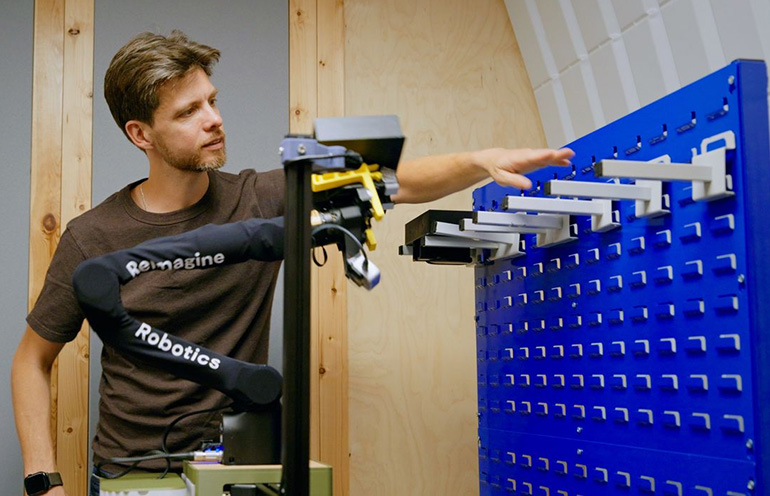
Reimagine Robotics has come out of stealth with a clear argument about what industrial robotics still gets wrong: too much of the burden of automation falls on specialists instead of frontline workers. The London- and Sydney-based startup says its systems are designed so people doing the actual work can show a robot a task, watch it attempt the job, correct it when needed, and then move on to the next bottleneck.
That pitch places the company in a crowded robotics field shaped by two persistent constraints. First, many factories still struggle to automate tasks that change frequently or require adaptation outside tightly scripted workflows. Second, even when robotics hardware is available, deployment can stall because every change in process demands more engineering support than operators can provide themselves. Reimagine’s claim is that both problems can be softened if robots are trained more like new coworkers than like fixed-function machines.
Who is behind the company
The startup was co-founded in April 2025 by Jonathan Scholz, Oleg Sushkov, Akhil Raju, and Misha Denil. Scholz previously founded Google DeepMind’s Applied Robotics team in London and led it for seven years, giving the company immediate credibility in a market that increasingly connects robotics progress with advances in machine learning.
That background matters because Reimagine is not presenting itself as a conventional industrial automation vendor. Its framing is explicitly about AI-enabled learning on the job. Scholz described the company’s approach as allowing a worker to demonstrate a task, correct mistakes, and iteratively shape the robot’s behavior in place. The company refers to that process informally as “monkey-see, monkey-do.”
The concept is familiar in broad terms across robotics research: reduce the amount of hard-coded programming and rely more on demonstration, correction, and adaptation. What distinguishes Reimagine’s message is the insistence that this should happen in operational settings with ordinary staff, not only with robotics engineers.

From programming robots to teaching them
Industrial robots are powerful when tasks are stable, environments are controlled, and engineering teams can spend time refining workflows. But those conditions do not cover every manufacturing problem. Many facilities still handle mixed products, short runs, awkward handoffs, and repetitive physical steps that are too variable for simple automation but too dull or labor-intensive to leave untouched forever.
Reimagine Robotics says its answer is to keep humans central. Rather than removing people from the process, the company says workers identify the bottleneck, teach the robot the task, and correct it until the system becomes useful. That is an important distinction because it shifts the role of labor from operator-of-last-resort to trainer and process owner.
If that model works in practice, it could change the economics of deployment. Every hour not spent waiting for a specialist programmer lowers friction for a customer. More importantly, it makes automation available to plants that may not have deep in-house robotics expertise. The barrier becomes whether a task can be demonstrated and corrected effectively, not whether a site can support a large robotics engineering team.
Early deployments focus on practical factory work
For a company only now emerging from stealth, Reimagine is notable for already pointing to real deployments. According to The Robot Report, one early use case involved advanced manufacturing and electronics disassembly. In a made-to-order plastics business, the company trained robots to tend 3D printers overnight by removing print beds, operating latches, and pressing controls.
That example is revealing because it is not a glamorous robotics demo. It is exactly the sort of repetitive, after-hours workflow that factories would like to automate but often struggle to justify if integration costs are high. The report also said the customer’s own team used the platform to automate additional stages such as washing, curing, and drying. If accurate, that suggests the real value may lie less in a single task than in the ability to extend automation incrementally after the initial deployment.
The company also cited another deployment in which its robots were used in recovering valuable critical materials from used hard drives. That points to a second commercial angle beyond traditional factory throughput: adaptive automation for disassembly, recycling, and materials recovery. Those environments tend to be messier and less standardized than classic production lines, which makes them a useful test for claims about learning-based robotics.

Why the timing matters
Reimagine is entering the market at a moment when industrial AI is being judged less by spectacular demonstrations and more by whether it can survive contact with the factory floor. Companies across robotics have become more willing to promise adaptable systems, natural-language interfaces, or demonstration-based training. Buyers, meanwhile, are looking for evidence that these claims reduce deployment time and produce measurable output.
That is why Reimagine’s emergence from stealth is meaningful even with limited disclosed detail. The startup is not just selling a robot; it is selling a workflow for how automation should spread inside a facility. In that workflow, expertise remains with workers, while the robot becomes easier to repurpose as needs change.
The company’s first phase has been funded through pre-seed backing from Fly Ventures, firstminute capital, and angel investors. For now, the bigger question is execution. Teaching by demonstration sounds attractive, but the operational test will be whether customer teams can actually expand robot duties without running into reliability, safety, or maintenance bottlenecks.
The real test is repeatability
Reimagine Robotics has chosen a compelling message: robots should be trainable by the people who understand the work best. That message aligns with a wider push to make industrial automation less brittle and less dependent on scarce specialists. It also fits the commercial reality that many factories want narrow, immediate wins rather than moonshot reinventions of production.
Still, emerging from stealth is the easy part. The harder task is proving that “learn on the job” can move from a persuasive slogan to a repeatable industrial operating model. If the company can show that customer staff can reliably teach robots new tasks across different sites and workflows, it will have identified a meaningful opening in industrial automation. If not, it risks becoming another robotics startup whose software promise runs ahead of shop-floor reality.
Key points
- Reimagine Robotics says workers can train its robots directly without specialist programmers.
- The company was founded by former Google DeepMind Applied Robotics leaders.
- Early deployments include overnight 3D-printer tending and electronics disassembly work.
- The startup is targeting adaptable automation in manufacturing and materials recovery.
- Its core commercial question is whether robot teaching can scale reliably across sites.
This article is based on reporting by The Robot Report. Read the original article.

Originally published on therobotreport.com