Robot orders post the strongest quarter of 2026 so far
North American companies ordered 10,989 robots valued at $723.5 million during the third quarter of 2026, according to new data from the Association for Advancing Automation.
That represented a 24.8% increase in units and a 26.1% increase in order value compared with the same quarter in 2025. The organization described the period as the strongest quarter of the year so far, pointing to a recovery that reached beyond a single manufacturing segment.
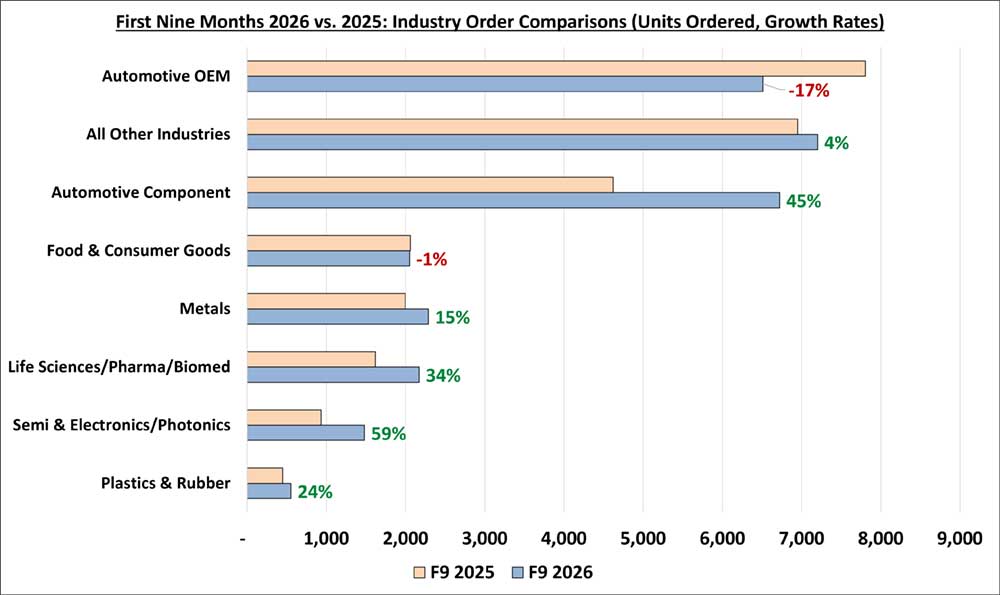
For the first nine months of 2026, companies in North America ordered 28,984 robots worth about $1.89 billion. Those totals were up 9.6% in units and 13.3% in value from the same period a year earlier.
Automotive returns, suppliers accelerate
Automotive remains a consequential market for industrial automation, but the third-quarter data show a more nuanced picture than a simple sector-wide rebound. Automotive original-equipment manufacturers returned to positive year-over-year growth after declining in the first half of the year, with orders rising 7.5% in the quarter.
Automotive component suppliers recorded a much larger increase. Their robot orders climbed 90.4%, continuing a strong pattern seen earlier in 2026. That divergence suggests that automation investment was particularly active among companies producing parts for the vehicle industry, even as automakers themselves recovered more gradually.
There is still an important qualification: through the first nine months of the year, automotive OEM orders remained 17% below their year-earlier level. The third-quarter improvement therefore signals a change in quarterly momentum, not a complete reversal of the weakness seen earlier in 2026.
Growth spreads across electronics, life sciences and materials
The strongest gains were not limited to automotive suppliers. Semiconductor and electronics or photonics industries increased robot orders by 97.6% in units year over year. Plastics and rubber rose 67.7%, life sciences, pharmaceutical and biomedical industries rose 38.7%, and metals increased 37.0%.
The electronics result coincided with growing investment in U.S. semiconductor manufacturing and strong demand for electronics used in artificial intelligence and other applications, according to A3. The data do not establish how much of the increase is directly attributable to AI demand, but they show that automation orders are rising in an industrial segment linked to the expansion of computing infrastructure.
Life-sciences growth likewise fits with continuing investment in domestic pharmaceutical manufacturing and related activities. These sectors often have different production requirements from traditional automotive plants, ranging from precision handling to clean manufacturing environments. Their increased purchases help explain why the quarter’s recovery was broad-based rather than narrowly dependent on vehicle production.
Not every sector rose. Food and consumer-goods robot orders declined 23.7% in units, while the category covering all other industries increased only 0.5%. The mixed results are a reminder that robot demand remains tied to specific investment cycles and production conditions, even during a strong overall quarter.
A more diversified automation market
A3 Executive Vice President Alex Shikany said the notable feature of the quarter was not only the size of the increase but also its distribution across the market. Automotive OEMs resumed growth, while automotive components, semiconductors and electronics, and life sciences posted substantial gains.
That mix matters because it points to a market that is becoming less concentrated in one application area. Automotive has historically been central to industrial robotics in North America, but the third-quarter figures show considerable demand from factories producing electronics, medical and pharmaceutical products, metals and other goods.
Diversification can be important for robot suppliers, systems integrators and manufacturers planning automation investments. A market spread across several sectors may be less vulnerable to a slowdown in any one industry, though the results also show that broadening demand does not guarantee gains for every segment.
Collaborative robots also gain ground
Collaborative robots, also known as cobots or force- and power-limited robots, contributed to the positive quarter. Companies ordered 1,831 cobots valued at $63.8 million, according to A3.
Cobots are often considered for applications where machines operate in closer proximity to people or where production needs can change frequently. The third-quarter figures show that these systems remained a meaningful portion of the market, though the broader order data cover many types of industrial robots and applications.
The value of orders rising slightly faster than units in the overall market may indicate a shift toward higher-value systems, more complex deployments or a different mix of industries. A3’s figures do not break out the precise reasons, so the safest conclusion is that both volume and spending accelerated during the quarter.
What the numbers signal
The third-quarter data provide evidence of renewed capital spending on automation across several major North American industrial sectors. Automotive production recovered from earlier weakness, but the more striking gains came from component manufacturers and from areas such as electronics and life sciences.
For now, the results are a quarterly snapshot rather than proof of a sustained multi-year expansion. Automotive OEM orders remain below their level for the first nine months of last year, and food and consumer goods declined. Still, the overall increase in orders and value, coupled with strong gains in several distinct sectors, gives the robotics market a broader base than it had at the start of the year.
The next quarters will show whether this mix of semiconductor investment, automotive-supplier demand and life-sciences expansion can maintain the momentum. In the meantime, A3’s latest report marks a clear improvement for North American robot orders and a sign that industrial automation demand is spreading across a wider range of manufacturing applications.
This article is based on reporting by The Robot Report. Read the original article.
Originally published on therobotreport.com