A major bet on robots that learn through force as well as sight
Eka Robotics has raised $150 million in Series A funding to expand its technology and customer deployments, betting that useful general-purpose robots will need more than cameras and imitation learning. The Cambridge, Massachusetts-based startup is developing what it calls a vision-force-action, or VFA, model: an AI system intended to combine what a robot sees with what it feels while manipulating an object.
The company, founded in 2024, is focused on dexterous manipulation—the difficult set of tasks that includes picking varied objects, fitting parts together, threading wires and operating tools. Eka says its approach is built around learning the underlying physics of those interactions through reinforcement learning at scale. The ambition is to make robots more adaptable when an object, task or environment differs from the examples on which they were trained.
Andreessen Horowitz and F-Prime led the round. Existing seed-round leads Obvious Ventures and E14 Fund also participated, alongside MFV Partners, Bison Ventures, Glasswing Ventures, Samsung Next and several unnamed Fortune 500 strategic investors.
Why manipulation remains a hard robotics problem
Industrial robots have long excelled when a factory can tightly control part position, lighting, tools and movement. More open-ended work is harder. A robot may need to recognize an unfamiliar item, apply an appropriate amount of force, respond when it slips, and complete the job repeatedly at a commercially useful pace.
Eka argues that training on human demonstrations alone is not enough to meet that challenge. Its stated premise is that robots should develop an intuition for physics rather than simply mimic human data. In practice, that means the company is trying to jointly reason about visual input and force during action, so that a robot can connect an observed object with the contact dynamics involved in moving it.
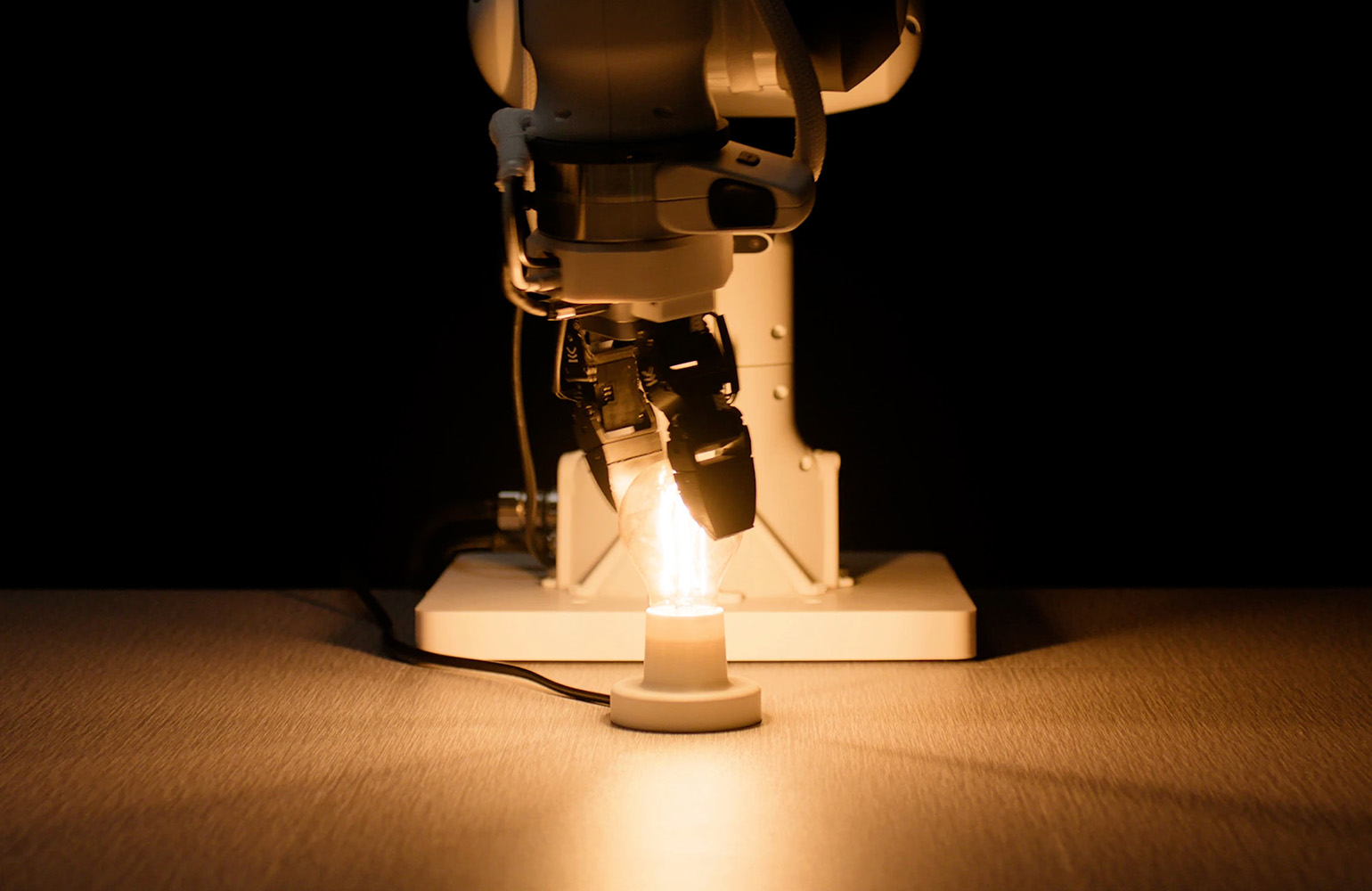
The startup says robots using its AI can pick a broad range of objects outside their training distribution at roughly 1,500 operations per hour. It also says the same systems can perform tasks such as screwing in a light bulb and inserting wires. Those are company assertions, rather than independently reported benchmarks, but they point to the performance measures Eka considers central: success rate and throughput over many repetitions.

Simulation is central to the company’s approach
Eka uses simulation learning to create large volumes of robot experience. The company says it can generate thousands of hours of simulated experience in minutes while varying objects, environments and physical conditions. It contends that this breadth of training is helping to reduce the persistent “sim-to-real” problem—the gap between behavior that works in a virtual world and behavior that survives the messiness of physical deployment.
The potential attraction is scale. Collecting physical robot data can be slow, expensive and constrained by hardware availability. Simulation offers a way to expose systems to many possible configurations before they encounter a real workcell. Eka’s thesis is that reinforcement learning supplies performance while diverse experience supplies generality.
That proposition still has to be proven across customer environments. Simulated contacts, materials and failures can differ from real ones in consequential ways, particularly in fine manipulation. But the funding round signals investor confidence that a model explicitly incorporating force could help move robotic manipulation beyond narrow, pre-programmed use cases.
Capital will be used to push toward deployment
Eka said the new capital will support both technology scaling and customer deployments. That distinction matters: robotics companies must demonstrate not only impressive task videos or laboratory results, but also reliable operation in settings where speed, integration and downtime carry direct costs.
The company is targeting work where dexterity and robustness matter every day. Its investors framed the opportunity in similar terms. In a statement, a16z general partner Raghu Raghuram said Eka’s approach had the generality and throughput needed for deployment. The company, meanwhile, has emphasized that factory-floor value comes down to repeatable success and speed.
What to watch next
The Series A gives Eka substantial resources for a young company, but it also raises the bar for evidence. The most important next indicators will be the range of tasks its systems can perform outside controlled demonstrations, their sustained rate of successful completion, and whether the model transfers across hardware and work environments.
For the broader robotics field, Eka’s financing is another sign that investors see manipulation as a foundational bottleneck. Robots that can reliably handle physical variation could be valuable in manufacturing, logistics and other environments that remain difficult to automate. Whether vision-force-action models become a leading route to that capability will depend on results in the real world, not just the simulation environment where their learning begins.
This article is based on reporting by The Robot Report. Read the original article.
Originally published on therobotreport.com