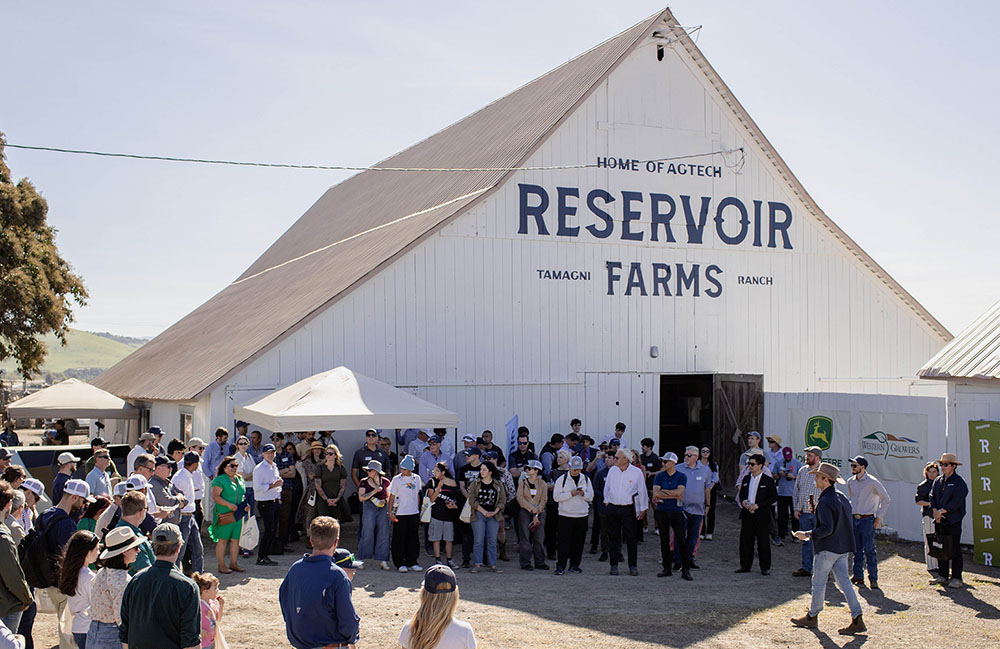
A new agricultural robotics incubator in Washington state aims to move automation out of controlled demonstrations and into the places where growers must decide whether technology actually works: orchards, vineyards and berry fields.
Reservoir announced the initiative with Washington State University’s Prosser Irrigated Agriculture Research and Extension Center, the Washington Tree Fruit Research Commission and the Tri-City Development Council. The program is intended to put agricultural-robotics startups alongside researchers and growers working with high-value crops.
A field-based test for agricultural automation
The announcement comes as Washington growers confront rising labor costs and a shrinking workforce for crops that can be especially difficult to automate. The partners identified apples, cherries, pears, blueberries, wine grapes and hops among the crops in scope.
Those crops illustrate why field validation is important. Agricultural robots do not simply need to operate; they must do so in changing outdoor conditions and within working farming operations. A system that performs well in a controlled setting still needs to fit growers’ real workflows, crop conditions and commercial constraints.
The Washington site is designed around that practical challenge. Startups will work in crop environments with researchers and growers, creating a setting for testing technologies closer to the point where they would eventually be deployed.
Expanding Reservoir’s on-farm model
Reservoir describes itself as an agricultural innovation center and venture-capital fund focused on helping agricultural-technology startups work where agriculture happens: in the field. The Washington announcement follows the organization’s earlier opening of Reservoir Farms – Salinas, an innovation hub in California’s Salinas Valley.
According to Reservoir, the Salinas site includes multiple innovation barns and 24 acres of dedicated commercial test fields for specialty crops. More than 300 growers, agricultural leaders, government officials, community partners, investors and media attended that site’s opening.
The organization has also announced plans to expand its on-farm innovation-center model across California, Arizona and other major growing regions. Each hub is intended to be anchored by academic and research-and-development institutions.
The new Washington incubator adds a regional focus on crops central to the state’s agricultural economy. Rather than positioning a single company’s hardware as the answer, the model creates a shared test environment for startups, growers and researchers.
Why access to working farms matters
Robotics developers frequently face a gap between building a prototype and proving that it can create value in a commercial operation. Access to farms, crop expertise and working feedback can help expose those gaps early.
For growers, the arrangement creates a way to assess emerging technology in the context of the crops and conditions they manage. That is particularly relevant for difficult-to-automate specialty crops, where a labor challenge does not automatically make every automation proposal useful.
Reservoir founder and chief executive Danny Bernstein said the organization developed its innovation-center approach after listening to partners about where agricultural innovation was getting stuck. He said the focus now is on execution and impact, including real-world solutions for growers, upskilled jobs for rural communities and a more secure food supply.

Physical AI meets specialty agriculture
Reservoir says its venture arm backs startups addressing problems in high-value crops and the “rugged physical AI stack.” In this context, the phrase captures a central reality of agricultural robotics: machines and software must operate amid the physical variability of farms.
The Washington initiative does not guarantee that every startup entering the incubator will reach commercial scale. Its significance lies in the infrastructure it creates for evaluation. By bringing technology builders together with growers and research institutions, the incubator can help distinguish systems that are promising in theory from systems that can function in real agricultural work.
That is a meaningful shift for an industry in which the strongest barriers are often operational rather than conceptual. Labor constraints, crop complexity and unpredictable field conditions all make practical testing a key part of development.
For Washington’s orchard, vineyard and berry growers, the new incubator offers a direct route into the testing process. For robotics startups, it provides access to the expertise and field conditions required to demonstrate whether their technology can meet the demands of specialty agriculture.
This article is based on reporting by The Robot Report. Read the original article.
Originally published on therobotreport.com