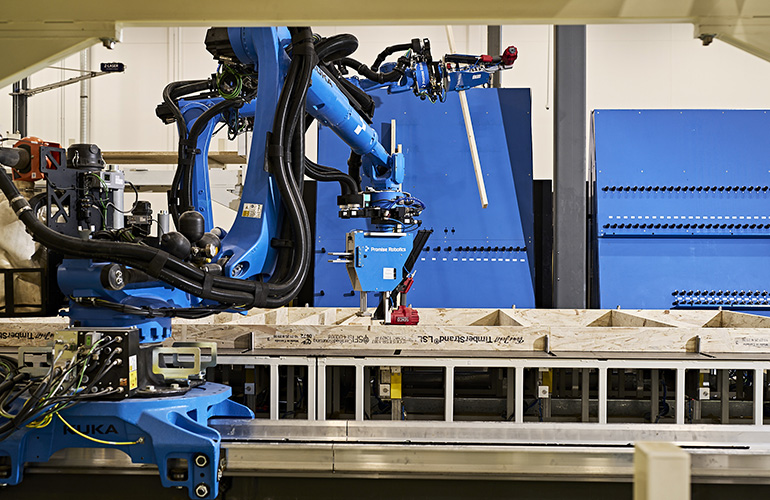
Promise Robotics has signed a multi-year agreement with D.R. Horton that the companies say will bring AI-enabled, automated component manufacturing to the construction of more than 1,250 homes in the United States. The partnership places a fast-growing category of industrial technology—often described as physical AI—into one of the largest and most fragmented parts of the economy: homebuilding.
Promise Robotics, founded in 2021 and based in Toronto, combines robotics, AI, software and manufacturing systems for residential construction. Its stated aim is to connect the workflow from design translation and production planning through automated manufacturing and onsite installation. D.R. Horton, described by Promise as America’s largest homebuilder by volume, will use the company’s Factory-as-a-Service capabilities rather than build and operate equivalent production infrastructure itself.
The agreement arrives as homebuilders face persistent housing demand, labor shortages, rising costs and pressure to increase output. The larger question is whether construction can become more repeatable without ignoring the variation that makes building homes fundamentally different from producing identical goods on an assembly line.
Factory capacity as a service
Promise’s model is designed to give builders access to automated production without requiring each company to create its own robotics operation. The company calls this Factory-as-a-Service, or FaaS. In practice, it is intended to standardize the manufacture of building components while linking factory processes to the needs of onsite installation.
Ramtin Attar, Promise Robotics’ co-founder and chief executive, said physical AI can create a production model that expands capacity within and across markets. He framed the company’s goal as making that capability accessible to homebuilders across North America and supporting the industry’s longer-term growth.
For D.R. Horton, the partnership commits the model to a defined scale: more than 1,250 homes in the U.S. The source material does not specify a timeline, location list or cost savings target for those homes. That makes the agreement more notable as an operational commitment than as a completed demonstration of economic results. The number of planned homes will be an important benchmark for judging whether the model can deliver predictable output at meaningful scale.

Why homebuilding is difficult to automate
Construction is not a conventional manufacturing environment. Attar argues that the sector is both large and fragmented, with separate businesses involved in land, consumer homes and seasonal trades. In his description, the industry does not invest in workforce development in the same way as traditional manufacturing.
There is also a technical problem. Automotive production can make large volumes of the same basic product with relatively small variations. In homebuilding, even rooms within the same home can differ. Floors, walls, clearances, components and layouts are not necessarily identical. That variation is one reason factory-style production cannot simply be copied from an automotive line and placed beside a building site.
Promise says it has built its approach around those constraints. Attar said the company began with mechanical and HVAC work and developed what it calls physical AI infrastructure for building-component manufacturing. The company’s broader pitch is a distributed manufacturing approach: production infrastructure that can be deployed to serve construction rather than relying on a single centralized factory model.
From digital plans to installed components
The company says its systems connect several stages that are often handled separately: translating building designs, planning production, automatically manufacturing components and installing them onsite. That integration is important to its claim that automation can improve homebuilding capacity. A robotically made component only helps if it corresponds to the design, can move through a real construction workflow and arrives when the building process can use it.
This is where the term physical AI is doing practical work. In Promise’s account, it is not merely software used to analyze a building plan. It refers to AI and robotics operating with manufacturing systems that produce physical parts for homes. The intended value is not a generic promise of intelligent construction; it is a more standardized and scalable way to make components for a sector that is otherwise highly variable.
The partnership also reflects an effort to shift risk. Instead of asking homebuilders to pay for, develop and run an advanced factory themselves, FaaS presents that capability as a service. Promise says this reduces the cost, complexity and risk of accessing production infrastructure. Whether that proposition scales will depend on execution, including how reliably components are produced and integrated on construction sites.

A test of scalable construction technology
The D.R. Horton agreement is an example of physical AI moving from a technology pitch toward contracted use in housing production. It does not solve the sector’s labor, cost or supply challenges by itself, and the source provides no independent performance data from the planned deployment. But it identifies a concrete near-term use case for robotics and AI: component manufacturing for more than 1,250 homes.
That scale gives the partnership relevance beyond a pilot project. If the service can make production more repeatable while accommodating the differences among home designs, it could offer builders a model for expanding capacity without creating their own industrial automation stack. If it struggles with those differences, it will underline why construction has resisted straightforward manufacturing analogies.
For now, Promise Robotics and D.R. Horton are betting that a distributed, service-based factory model can help modernize a fragmented building process. Their agreement will be closely watched as a practical test of whether physical AI can make homebuilding faster, more predictable and more scalable.
This article is based on reporting by The Robot Report. Read the original article.
Originally published on therobotreport.com