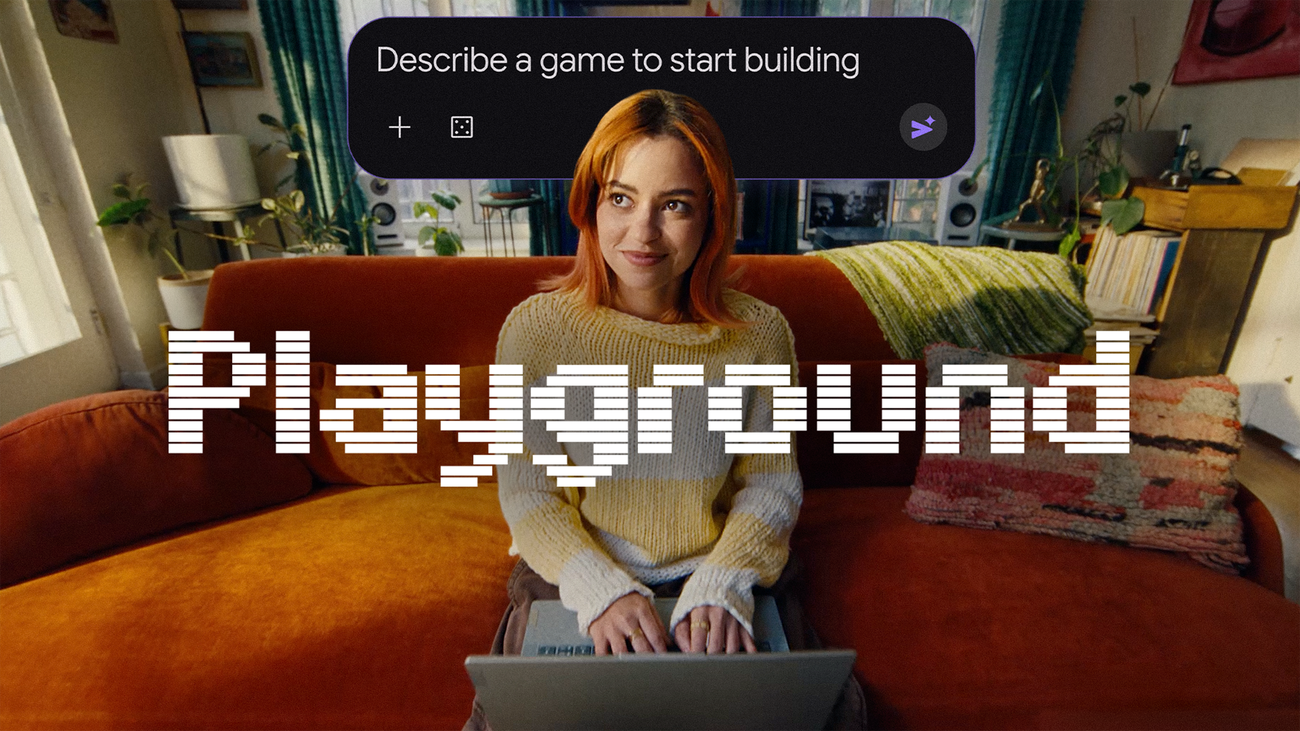
Google has introduced Playground, an experimental platform designed to let people create, play and share custom games by describing their ideas in text. The company says the service is intended to lower the technical barrier that has traditionally separated game ideas from playable prototypes.
Playground uses a conversational interface: a user can start with a blank canvas, remix a starter prompt or use guided support, then direct the creation process by typing what they want to build. Google says users do not need coding experience to create characters, rules or game worlds.
A prompt-based route into game creation
Game development has long relied on specialist tools and skills, from programming and visual design to level creation and testing. Google frames Playground as an attempt to make the earliest stages of that process more accessible. Rather than beginning inside a conventional game engine, creators begin by articulating a concept in ordinary language.
The promise is not simply that a person can make a game more quickly. It is that people who would not normally approach game-development software can experiment with interactive ideas at all. In Google’s description, users can build a game, play it, send it to friends or publish it to a community gallery.
The platform also includes multiplayer games, leaderboards and a growing collection of titles made by users. Those social features matter because they turn creation into an iterative activity: a creator can test an idea with other people rather than treating the result as a private experiment.

What Google is actually launching
Google calls Playground experimental. That label is important. The announcement presents the service as a new venue for prompt-driven game creation, not as a replacement for established professional development environments. The platform is built around accessibility, rapid expression and sharing.
Google says creators can use starter prompts as a foundation and remix them. That can help newcomers understand the kinds of instructions that produce a useful result, while also offering a faster route from a rough concept to a playable variation. Guided support is another way the company is trying to make the system approachable for people who may have an idea but not a vocabulary for conventional game-development workflows.
For players, the result is a library of custom games that can be explored in a browser. For creators, the result is a lightweight publishing path: they can make something, share it with friends or place it in the community gallery for others to try.
Why the launch matters
Generative AI is increasingly being applied to software creation, but games pose a more demanding challenge than producing a static image or a block of text. A game needs rules, player interaction and a coherent experience. Google’s approach is to let users specify those elements conversationally and make the process feel closer to directing an idea than operating a technical toolkit.
That does not eliminate the creative work involved. Someone still has to decide what kind of game they want, how it should work and what they want players to do. But Playground shifts the interface for that work toward prompts. The practical test will be whether the platform helps users refine ideas over multiple rounds and whether the games remain understandable and enjoyable once shared with other people.
Google also positions the release alongside a broader path toward more advanced creation tools. Its announcement points to upcoming professional-grade tools from Unity Spark, suggesting that Playground is aimed at a distinct, more accessible end of the creation spectrum.

An experiment with a social feedback loop
By combining creation, play and sharing in one service, Playground is not treating game generation as a one-time output. A game can be made, played by its creator, challenged by friends and discovered by others. Multiplayer play and leaderboards introduce reasons for people to return after the first prompt.
The community gallery could also become a practical measure of what the platform enables. It gives users examples to explore and potential starting points to remix. At the same time, the usefulness of such a gallery will depend on how easily people can find worthwhile games and understand what makes a particular prompt-created experience work.
What comes next
Google is inviting users to try Playground through its website now. The company’s announcement makes clear that the platform is experimental, so its features and role may evolve as users create and share games. For now, its central proposition is simple: turn a game idea into something playable through a few prompts, without requiring users to write code.
That proposition places Playground within a wider effort to make creative software more conversational. Its significance will depend less on the novelty of generating a first game than on whether people can use the service to iterate, collaborate and make interactive experiences they are genuinely motivated to share.
This article is based on reporting by Google AI Blog. Read the original article.

Originally published on blog.google