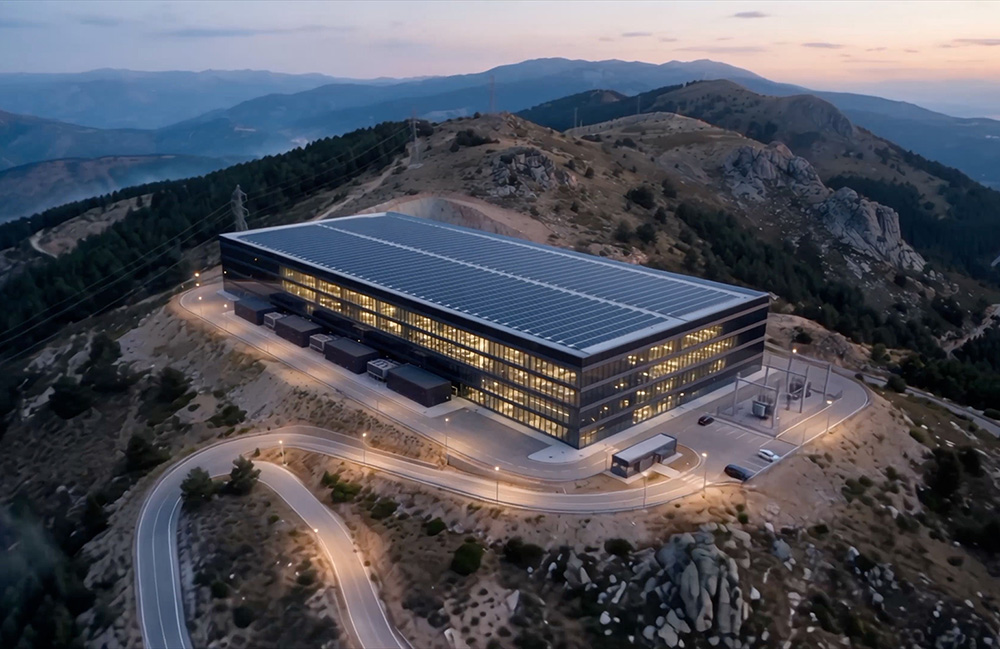
Generative Bionics says it will build a “Physical AI Data Factory” in Italy designed to generate and process data for industrial humanoid robots. The company plans for the first hub, in Genoa, to cover 5,000 square meters and to begin operating in the fourth quarter of 2027.
The facility is intended to connect real robot operation, simulation, and AI model development in a continuous cycle. Generative Bionics says the approach will help move humanoid robots beyond laboratory demonstrations and toward reliable deployment in industrial environments.
Building data around industrial work
Humanoid systems operating in factories and other workplaces need information that reflects the physical conditions of those environments. According to Generative Bionics, that means data covering contact, force, motion, proximity, temperature, task constraints, and human interaction.
For its GENE.01 humanoid robot, the company plans to collect vision and motion data as well as signals from the robot’s full-body multimodal skin. The aim is to create data that can be used to configure and validate the system for a particular industrial setting before customer deployment.
Once robots are deployed, data from those fleets could feed into subsequent training cycles. The company describes this as a real-to-sim-to-real process: operations in real environments inform simulation and model training, while those updated models and simulated scenarios can then support future real-world deployments.
Simulation and physical testing in one network
The planned data-factory network will combine physical industrial environments with large-scale simulation. Generative Bionics said the facilities will reproduce real industrial settings, generate high-fidelity physical data, and connect that information to simulation systems.
This is an important distinction from training approaches that rely principally on visual or language data. The company argues that industrial robotics also requires data about the physical consequences of actions: how a robot contacts a surface, how it moves under constraints, and how it responds to conditions that vary across tasks and workplaces.
Generative Bionics CEO Daniele Pucci framed the effort as an opportunity for Europe to make use of the industrial automation base it has built over decades. He said the company wants physical-AI data needed to train European models to be generated, trained, and validated on the continent.
AMD to provide AI infrastructure
Generative Bionics named Advanced Micro Devices as the AI infrastructure partner for the project. The company said the Physical AI Data Factory network will use AMD Helios, a rack-scale architecture intended to provide computing capacity for processing physical and synthetic data, training physical-AI models, and running thousands of digital-twin scenario variations in parallel.
The compute component is central to the project’s stated design. The facility is not only planned as a place to operate robots and record data; it is also meant to support the processing and simulation needed to turn those inputs into models and deployment configurations.
Generative Bionics did not present the Italian hub as a standalone site. It plans to open a second facility elsewhere in Europe and a third for global markets. Together, the company says, the three locations would form a multi-site proprietary network for industrial humanoid development.

A long-term bet on European robotics capability
The project is scheduled for operation in late 2027, so it remains a plan rather than an operating training center. Still, its scope offers a view of how one robotics company believes industrial humanoids will need to be developed: not from generic demonstrations alone, but through repeated exposure to specific environments, sensory inputs, task constraints, and simulated alternatives.
That proposition also places data at the center of industrial robotics competition. Generative Bionics is positioning the planned factory as a source of data, models, and validation capabilities that are tied to European industry rather than created elsewhere and later adapted for local use.
- The first planned hub is a 5,000-square-meter facility in Genoa, Italy.
- Generative Bionics expects it to be operational in the fourth quarter of 2027.
- The site is intended to link robot operations, simulation, and AI development.
- GENE.01 data is planned to include vision, motion, and full-body multimodal-skin signals.
- AMD Helios is planned to provide infrastructure for data processing, model training, and digital-twin simulations.
- The company ultimately plans additional European and global facilities.
Whether the network achieves its stated goal will depend on execution over the next several years: building realistic industrial test environments, collecting useful multimodal data, integrating simulation with robot behavior, and demonstrating that the resulting systems can work reliably at customer sites. For now, Generative Bionics has set out a 2027 timeline for the first major node in that strategy.
This article is based on reporting by The Robot Report. Read the original article.
Originally published on therobotreport.com