A startup’s case for a shared robot brain
Dream Labs has announced a $90 million seed funding round and the public launch of Dream API, a service the company says can translate a robot’s camera feed and plain-English instructions into motor commands. The San Francisco startup is positioning its technology as an answer to a longstanding robotics problem: machines are often built and programmed around one narrowly defined job, and transferring that learning to another robot can require significant additional work.
The company says its flagship Dream-1 model can work across robots from different manufacturers, including hardware it has not previously encountered. Its central claim is that training from video of people performing everyday tasks allows the model to learn patterns about the physical world that can transfer across machines. Dream Labs says users can connect compatible robots with grippers to the API and have them carry out a task from visual input and a natural-language instruction.
The announcement arrives as industrial robotics is growing, but deployment remains constrained by the effort needed to set up and adapt machines. Dream Labs points to a global installed base of 5 million industrial robots, while arguing that most remain programmed for a single task. The company also says that teaching one robot a task can take specialists months and that a change in task or hardware can mean beginning again.
From camera feed to motor command
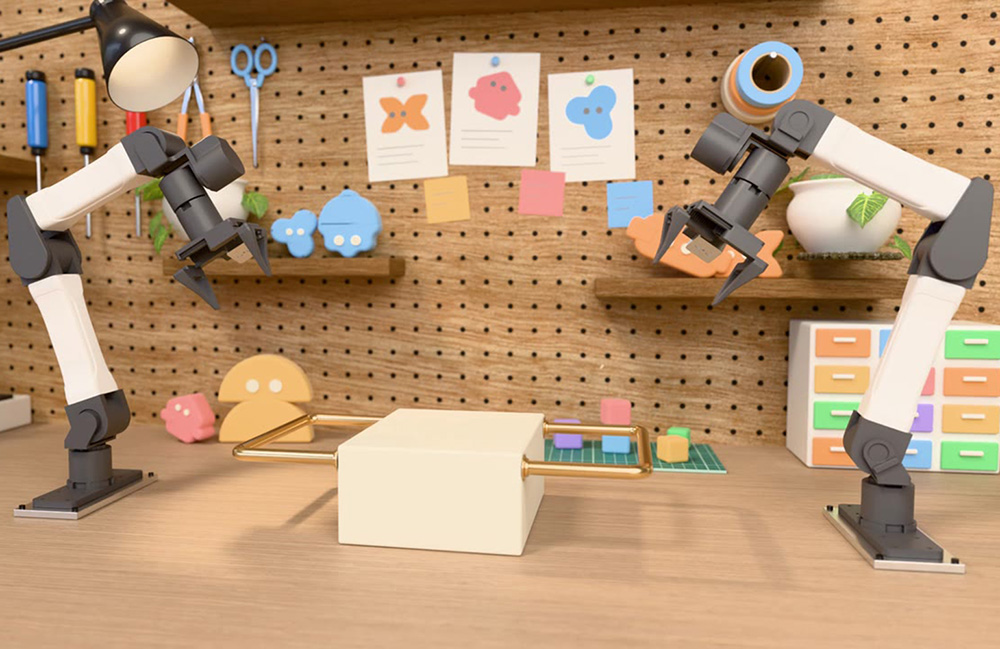
Dream API is intended to be a developer-facing layer between what a robot sees, what a person asks it to do and the actions needed to operate its motors. In the company’s description, a user provides camera input and a written instruction, while Dream-1 produces the resulting robot actions.
That proposition combines several hard robotics challenges. A system has to interpret a scene from images, connect a language instruction to the relevant objects and infer an action sequence that a particular machine can physically carry out. Dream Labs says its approach is designed to transfer capabilities across hardware because the model learns from video rather than from data captured on a single robot.
The company describes this as zero-shot learning for new gripper-equipped robots, meaning it claims a robot can perform useful work without task-specific data for that individual machine. This is an ambitious performance claim from the company, and the supplied announcement does not provide independent benchmarks or comparative test results. Developers will need to evaluate the API on their own hardware, tasks and operating environments.
A public API and a customization path
Making the service publicly available is a notable part of the launch. Dream Labs says developers and robotics enthusiasts can sign up and connect robots with grippers. Its models run in data centers, according to the company, with the aim of providing quick responses across locations.
The startup is also offering fine-tuning as a service. For hardware that is not supported, or for new capabilities, robot makers and developers can submit a small batch of demonstration data for a tailored model. Dream Labs says it can return such a model within hours. This creates two routes into the product: a general model intended to work immediately, and a customization option for cases where a general model is insufficient.
That division reflects a practical tension in robotics. General-purpose models could reduce the effort involved in initial deployment, but real-world systems differ in cameras, grippers, movement limits, workspaces and safety requirements. Fine-tuning is one way to narrow the gap between a broad model and a specific operating context. The announcement does not detail which robots are supported at launch, the types of tasks covered or how performance changes between the base and tailored models.
What the funding signals
B Capital and Kindred Ventures led the $90 million seed round. Participants included A.Capital, Unusual Ventures, SV Angel, Wing VC, Scribble VC and Adrian Aoun, according to Dream Labs. The size of the round underscores investor interest in software that could make existing robot hardware more flexible.
In its statement, Dream Labs frames the market opportunity around a mismatch: low-cost robots are becoming easier to buy, while usable intelligence and rapid task setup remain difficult to obtain. Its pitch is that a software layer capable of transferring learned capabilities could shorten the time from installing hardware to performing useful work.
The company’s own language is deliberately broad. It says Dream-1 can control any robot “out of the box” with grippers and that a new robot can become useful in minutes rather than months. Those statements establish the product ambition, but should not be read as independently verified results. The significance of the launch will depend on whether the system maintains reliable performance outside demonstrations and across the messy, variable conditions of deployed robotics.
The next test is operational
Robotics has repeatedly shown that a task that looks simple in a controlled setting can become much harder amid changes in lighting, object placement, camera viewpoint or hardware behavior. A transferable model is attractive precisely because it could reduce the amount of engineering required for each new setup. But adoption will turn on questions that the launch announcement leaves open: how often the model succeeds, how it handles mistakes, what safety controls developers can use and which tasks it can perform consistently.
Dream Labs has now put a product interface alongside its funding announcement, giving developers an opportunity to test the company’s claims directly. If its video-trained model can transfer effectively between compatible robots, it could help move robot deployment away from one-off programming and toward reusable learned capabilities. If not, the launch will still clarify where the boundary lies between a general robot model and the customization required for real work.
This article is based on reporting by The Robot Report. Read the original article.
Originally published on therobotreport.com