Stryker has invested about $400 million in CMR Surgical and secured an exclusive option to acquire the company’s remaining equity, deepening its move into soft-tissue surgical robotics. The agreement also gives Stryker an exclusive U.S. commercial agency role for CMR Surgical’s Versius robotic-surgery portfolio.
The transaction joins capital, commercialization and a future acquisition option in one arrangement. For CMR Surgical, the investment is intended to support continued innovation and global expansion. For Stryker, it creates a route into a growing robotics segment that it describes as a natural extension of its existing strengths in endoscopy, visualization and enabling technologies.
A commercial alliance built around Versius
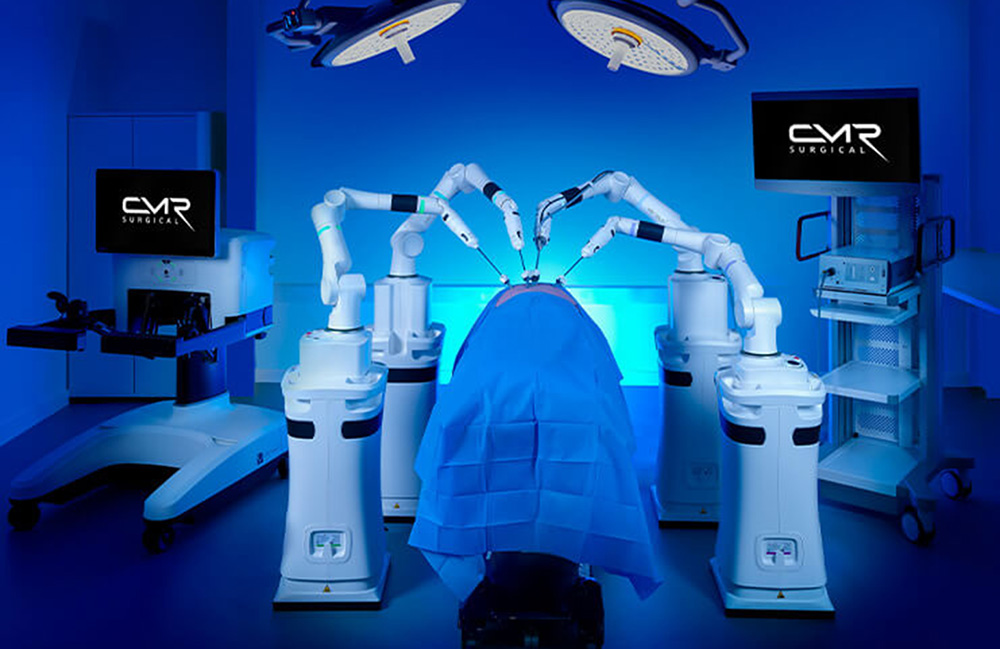
Cambridge, U.K.-based CMR Surgical designed Versius as a compact, modular robotic platform for operating rooms. The company says the system is intended to work in real-world clinical environments without requiring a dedicated operating room.
That modular approach is central to the platform’s commercial proposition. CMR says it can give hospitals flexibility across procedures, surgeon access and sites of care while allowing robotic-assisted surgery to fit into existing workflows. The company also argues that the approach can help health systems expand robotic adoption while maintaining operational flexibility and supporting longer-term program economics.
Under the new agreement, Stryker will serve as the exclusive U.S. commercial agency for the Versius portfolio. That gives CMR access to Stryker’s scale and customer relationships in the United States, while allowing Stryker to bring a soft-tissue robotic system into its broader medical-technology offering.
Where the system is used
According to CMR Surgical, Versius supports procedures in general surgery, colorectal surgery, urology, gynecology and thoracic surgery. The company says the platform has been adopted in hospitals in more than 30 countries and used in 45,000 cases worldwide.
The company also said its Versius Plus system has received FDA 510(k) clearance for cholecystectomy, the surgical removal of the gallbladder. CMR has filed a further 510(k) submission for benign gynecological indications.
Those regulatory and clinical milestones matter because the U.S. agreement is not merely a distribution announcement. It connects Stryker’s commercial reach to a product line that is seeking to broaden its procedure base. The pace and scope of any expansion will depend on regulatory decisions, hospital adoption and clinical demand.
Stryker’s route into soft-tissue robotics
Andy Pierce, Stryker’s group president for MedSurg and Neurotechnology, said the company had evaluated the segment for years. He characterized soft-tissue robotics as a high-growth adjacent market and said the alliance represented a disciplined entry built around the complementary strengths of the two companies.
Stryker selected CMR and the Versius portfolio because it sees an opportunity to help providers expand robotic-assisted surgery across procedures in hospitals and ambulatory surgery centers, Pierce said. The agreement positions Stryker as both an investor and the exclusive U.S. commercial channel for the system.
That structure can reduce the distance between a technology developer and a large commercial network. CMR retains its platform and its global business, while Stryker gains an exclusive role in the U.S. market and an option to purchase the remainder of the company later.
What the deal means for CMR Surgical
CMR Surgical CEO Massimiliano Colella said the alliance was an endorsement of the technology, clinical experience and global business the company has built. He said the investment would strengthen CMR’s ability to accelerate innovation and expand the Versius portfolio globally.
For a surgical-robotics company, investment alone is only part of the equation. Broad deployment requires clinical evidence, procedure clearances, training, service capabilities and hospital confidence that a system can work inside established operating-room processes. CMR’s emphasis on a compact, modular design is aimed at that implementation challenge.
The company says Versius does not require a dedicated operating room, a claim that could be important for providers looking to add robotic capability without building a separate surgical environment. The system’s ability to operate across multiple procedure areas also broadens the potential base of clinicians and facilities that could use it.
A staged acquisition path
Stryker’s exclusive option to acquire CMR’s remaining equity leaves open a larger transaction while immediately establishing a commercial relationship. It is a significant signal of confidence, but it is not the same as a completed acquisition.
The immediate effects are clearer: CMR receives approximately $400 million in investment, Stryker receives exclusive U.S. commercial agency rights for Versius, and the two companies will work to extend the system’s presence in the U.S. market. CMR also said Pierce will join its board of directors.
The alliance illustrates how surgical robotics is increasingly shaped by combinations of platform development, regulatory progress and access to established hospital sales channels. If Versius expands in the United States, the deal could give Stryker a meaningful new position in soft-tissue robotics while supplying CMR with the financial and commercial backing needed for its next stage of growth.
This article is based on reporting by The Robot Report. Read the original article.
Originally published on therobotreport.com