A quadruped robot enters hazardous industrial zones
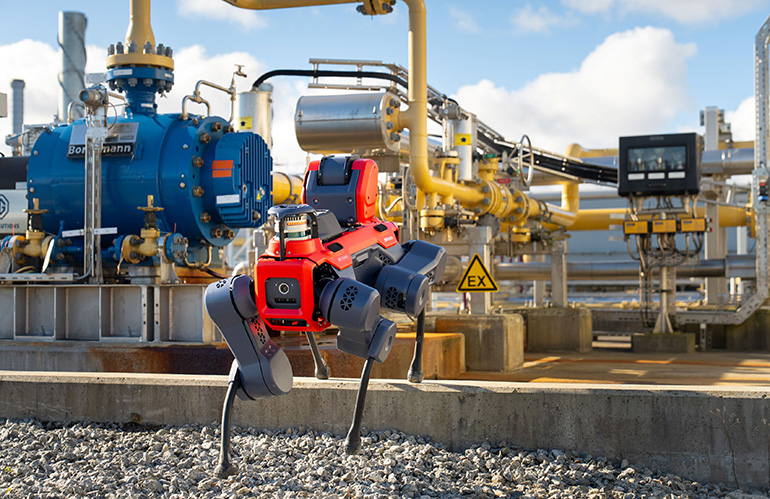
ANYbotics has begun delivering ANYmal X, a legged inspection robot designed to operate in explosive atmospheres at oil, gas and chemical facilities. The company says the system is the world’s first legged inspection robot for such environments and has been built to meet strict safety standards that typically keep standard robots out of hazardous zones.
The launch marks an expansion of a familiar industrial-robotics task into some of the most difficult parts of a plant to automate. Facilities rely on regular checks of equipment such as pumps, compressors, valves and piping, yet many of those assets sit in areas where a worker may need protective equipment, a handheld gas detector and entry permits simply to conduct an inspection on foot.
ANYbotics says ANYmal X uses an industrial AI stack to perform routine autonomous inspections in places that can be dangerous for people. The company positions the machine as a way to keep workers out of harm’s way while collecting continuous, repeatable observations that can support maintenance decisions.
Why explosive atmospheres are a difficult robotics problem
Industrial sites handling combustible gases, vapors or dust demand equipment designed for the conditions in which it operates. That is a higher bar than navigating uneven floors, stairs and mechanical obstacles. A robot must be suitable for the safety requirements of the zone while still carrying out useful inspection work reliably.
ANYbotics chief executive and co-founder Péter Fankhauser said the product required four years of engineering and more than 10 patents. He described the ability to make a legged robot safe for explosive atmospheres as a challenge many experts believed could not be met.
The company argues that oil, gas and chemical plants are a particularly consequential application for physical and industrial AI because of their hazards and operating costs. In these settings, an inspection system has to do more than demonstrate mobility. It has to fit into established safety practices, obtain observations of industrial equipment and produce information that maintenance teams can act on.
Inspection data, safety and downtime
ANYbotics says its ANYmal robots and Shift operations platform are intended to automate routine inspections and turn collected information into maintenance action. For ANYmal X, the stated value proposition is threefold: reduce human exposure to hazardous environments, identify problems earlier, and provide structured data for operating and planning systems such as digital twins.
The financial stakes can be substantial. ANYbotics cites an estimate that preventable downtime costs the world’s 500 largest companies roughly $1.4 trillion annually. It also cites Siemens data indicating that one hour of unplanned downtime in oil and gas can cost as much as $500,000. Those figures illustrate why facility operators are interested in detecting equipment issues before they become outages, though savings from a specific deployment will depend on the site and its operating model.
The company also points to workplace risk. It cites NIOSH findings that U.S. extraction workers face a fatality rate seven times the national average. A robot cannot eliminate the risks of industrial operations, but it can potentially reduce the number of occasions on which people must enter designated hazardous areas for routine observation.
A move beyond conventional mobile inspection
Wheeled mobile robots have already found roles in industrial settings, particularly where floors are predictable and areas are designed for machinery. A legged platform offers a different capability: it can be deployed in facilities where mobility is constrained by complex layouts and terrain. The source material does not specify the inspection routes, sensors or customer sites for ANYmal X, but its purpose is clear: routine autonomous inspection in hazardous industrial environments.
That focus also differentiates the launch from a general-purpose robotics demonstration. The system is aimed at a narrow set of high-value conditions with stringent safety requirements. If it can operate dependably within those constraints, operators could obtain more frequent and consistent observations without placing staff in hazardous areas for every round.
The company was spun out of ETH Zurich in 2016 and has operations in Zurich, San Francisco and Barcelona. It says it has raised more than $150 million from European and Silicon Valley investors and employs about 200 people.

What delivery means—and what remains to be proven
The start of deliveries is an important commercial milestone, but it is not by itself proof of broad industrial adoption. The key test will be whether deployments deliver reliable inspection coverage, integrate with plant workflows and generate information that improves maintenance planning.
For operators, the practical questions will include how often the robot can perform routes, what equipment conditions it can recognize, how it works alongside on-site safety procedures and whether the resulting data changes decisions soon enough to prevent failures. The company’s claims center on its ability to make repeatable inspections and feed structured observations into maintenance action.
The launch nevertheless reflects a wider shift in industrial automation. Robots are increasingly being assigned not only to repetitive production tasks, but also to the monitoring work that helps large facilities understand the condition of their assets. Hazardous zones have remained a difficult frontier because safety certification and reliable mobility must coexist. ANYmal X is an attempt to push a legged robot into that frontier.
- ANYmal X is designed for explosive atmospheres in oil, gas and chemical facilities.
- Its stated role is routine autonomous inspection of equipment in hazardous zones.
- ANYbotics says the robot can provide repeatable, structured observations for maintenance and digital-facility planning.
- The commercial outcome will depend on real-world reliability and integration into industrial operations.
For an industry where downtime can be costly and routine checks may expose workers to danger, a certified mobile inspector could be valuable. The significance of ANYmal X will ultimately rest on the performance of the delivered systems in the environments they were built to enter.
This article is based on reporting by The Robot Report. Read the original article.
Originally published on therobotreport.com