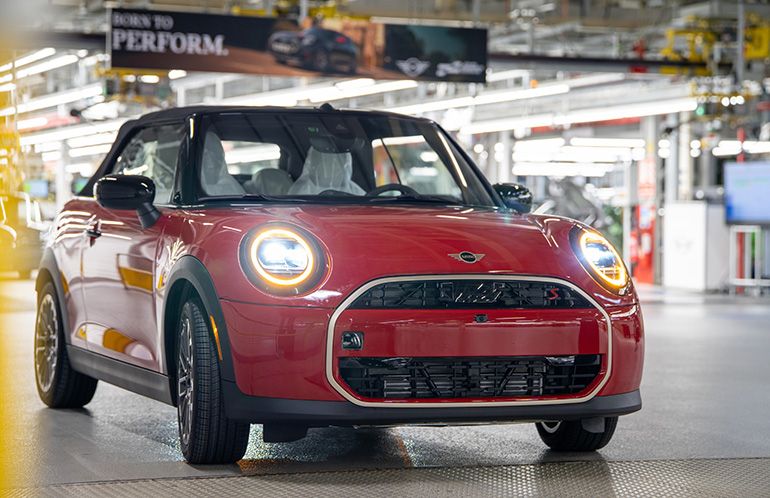
Embotech and BMW have moved 1 million vehicles with automated driving technology across four sites in the United Kingdom and Germany, the companies said. The milestone points to a form of autonomy that is already operating in a tightly defined industrial setting: moving newly built vehicles from production lines to parking areas or truck-loading locations.
The use case is narrower than consumer self-driving, but it addresses a recurring factory and logistics task. Vehicles leaving an assembly line typically need a person to drive them to their next location. Embotech’s automated vehicle marshalling system is intended to handle those movements continuously within a managed site.
According to Embotech, the systems now move 3,500 vehicles a day around the clock across the four BMW locations. The company said its technology is designed for automotive factories, vehicle-distribution centers, ports, and logistics yards.
Autonomy built around the facility
Embotech’s approach places much of the sensing and intelligence in the production environment rather than requiring each vehicle to be equipped with a new autonomous-driving sensor suite. Eva Beck, Embotech’s chief commercial officer, said perception for the company’s automated vehicle marshalling system is infrastructure-based.
Hesai lidars are mounted in the environment, Embotech said, while offboard computers and servers optimize driving trajectories 10 times per second. The system uses a standardized software interface in the factory and connects to existing drive-by-wire capabilities in vehicles. In this model, a newly built car does not need to be independently capable of self-driving in order to make the controlled movement through a facility.
That design matters because automotive plants handle many vehicle models and production configurations. A system that works through infrastructure and a common interface can potentially be applied without extensive hardware changes to each vehicle. Embotech describes its Automated Driving In-Plant offering as vehicle- and OEM-agnostic.
The operating context is also fundamentally different from a public road. An industrial site can define routes, install sensors, control vehicle access, and connect automation to facility systems. Those constraints make it possible to focus on repeatability, traffic coordination, and safe operation in a known environment.
Two layers for driving and safety
Embotech said it supplies AI-based software for perception, prediction, and planning in complex industrial environments. It also described a separate deterministic architecture that defines and enforces safety functions and has been independently certified by TÜV SÜD.
The company says it has multiple TÜV-certified SAE Level 4 solutions. Its two certified systems are Automated Vehicle Marshalling and an Autonomous Tractor Solution, both built on a shared platform. The marshalling application is focused on moving vehicles; the tractor system is intended for logistics operations involving tractors.
Separating the software functions associated with perception and planning from a deterministic safety architecture is notable in an industrial deployment. The driving system must interpret the environment and choose a trajectory, while the safety layer is intended to enforce operational limits. Embotech characterizes the combined approach as one aimed at safety, reliability, and continuous operation.
“Automated vehicle movements only create value when intelligence, safety, and reliability come together,” Andreas Kyrtatos, Embotech’s chief executive, said in the announcement. He said the million-vehicle figure demonstrates what can happen when the technology is integrated into live production and operated around the clock.
From pilot projects to production operations
Automotive manufacturers have long used industrial automation, but Embotech argues that much of the market for autonomous vehicle movement remains at the pilot stage, with only limited numbers of vehicles operating autonomously. The reported BMW milestone is therefore significant less as a demonstration than as evidence of sustained use at multiple sites.
Moving 1 million vehicles requires an operation that can accommodate daily production flow over time. At the reported pace of 3,500 vehicles a day, the task is not an occasional showcase. It is part of the logistical chain between building a vehicle and preparing it for onward movement.
For manufacturers, the value case described by Embotech includes safety, productivity, resilience, and sustainability. The source material does not quantify those outcomes at BMW’s sites, so the announcement should not be read as a measured comparison with human-driven operations. What it does establish is that the technology is being used at scale for an operational factory process.

A specialized path for automated driving
Embotech was spun out of ETH Zurich in 2013 and is based in Zurich. In July, it entered a strategic partnership with HTEC to scale autonomous-driving deployment across vehicles, customer programs, and industrial sites, according to the company.
The BMW deployment illustrates where automated driving can move beyond a concept demonstration: bounded environments with a clear business process, known infrastructure, and repeatable routes. It does not resolve the broader challenges of autonomous driving in unrestricted public traffic. Instead, it shows a different commercial path, one in which automation is deployed around a specific logistics task and supported by the facility itself.
As factories continue to digitize, in-plant movement is likely to remain an attractive target because it links physical operations with scheduling, parking, loading, and production flow. Embotech and BMW’s reported million-vehicle milestone suggests that this particular form of autonomy has reached a meaningful operational scale.
This article is based on reporting by The Robot Report. Read the original article.
Originally published on therobotreport.com