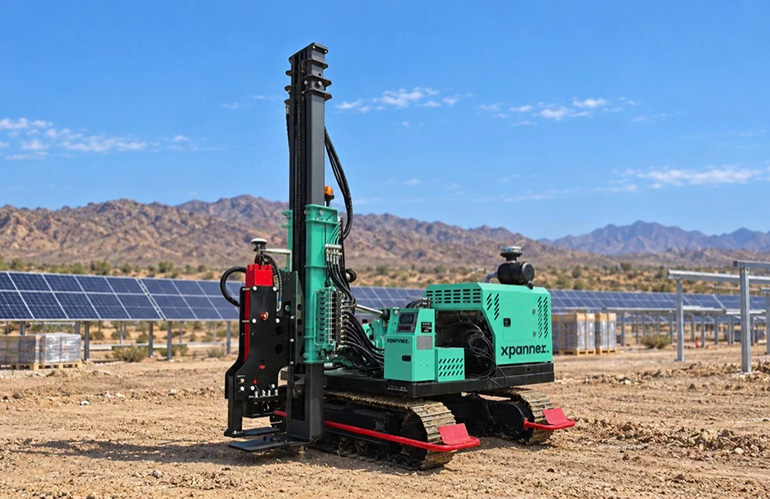
Construction-robotics company Xpanner has introduced an automated pile-driving system intended for utility-scale solar and battery energy storage projects. The X1 Piling R6 is designed to place and drive posts autonomously while a single operator supervises the work.
The launch targets a practical bottleneck in the buildout of large energy projects: installing large numbers of piles accurately while skilled construction crews are in short supply. The company says the machine combines a crawler base with high-precision positioning, onboard sensing and an automation controller to complete the pile-driving process.
Automating a repetitive construction task
Piles provide the foundations or supports used across large solar installations and energy-storage sites. The work is repetitive, but it must be performed to a plan and with sufficient positional accuracy and alignment. Xpanner’s system is built around the company’s Everstar R6 crawler machine and is intended to automate that sequence.
Under the workflow described by Xpanner, an operator first uploads a project plan. The operator uses a remote-control interface to bring the machine to a row, then supervises construction as the machine installs piles. The R6 is designed to navigate between subsequent pile positions using high-precision GNSS antennas and receivers, sensors and Xpanner’s controller.
GNSS, or global navigation satellite system positioning, gives the equipment a way to locate planned coordinates on a project site. In this application, positioning is paired with machine sensors and controls so that the system can move from one planned pile location to the next and record the work completed.

One operator, continuous project data
The company’s central claim is that one operator can remotely manage the installation process. That changes the labor model for a task commonly performed by a larger on-site crew, although the announcement does not provide independently verified productivity figures or comparisons with conventional methods.
Xpanner says the system logs each pile as it is installed. Its Xpanner Connect web dashboard is intended to let project teams upload pile schedules and coordinates, assign machines and configure a site. As the machine operates, it records a pile’s position, depth and plumb, then adds those details to a live project map.
For construction managers, this replaces part of the manual reporting flow with machine-generated records. The company says teams can view machine status, cycle counts and alerts across a fleet without visiting a site. Those functions could provide a more current picture of progress than manual counts, calls, spreadsheets and end-of-day reports.
Aimed at solar and storage buildout
Xpanner is positioning the X1 Piling R6 for utility-scale solar and battery energy storage system, or BESS, sites. The company argues that developers and engineering, procurement and construction firms are trying to add power capacity quickly while facing limited availability of skilled crews.
That connection matters because the foundations stage can affect the schedule for everything that follows. A piling system that can reliably reach prescribed locations and document each placement could reduce handoffs between installation and project tracking. The immediate value proposition is not only autonomous movement; it is a combined workflow of planning, driving, measurement and reporting.
Henri Lee, Xpanner’s co-founder and chief executive, said the new machine uses automation already deployed on the company’s PD10 equipment and moves it to a more powerful and versatile platform. He also said the system is intended to keep people away from the mast while piles are driven.
Equipment sale plus software subscription
Xpanner said it will use a mixed capital-expenditure and software-as-a-service model. Customers can buy or rent the X1 Piling robot and license the automation software on a monthly basis for each active technology.
The subscription is not tied to a particular project, site or number of piles, according to the company. Instead, the customer pays while the technology is actively used; when piling or the applicable work is complete, the equipment can be moved to another task.
That model reflects a wider shift in industrial automation, where contractors may acquire the physical machine but keep paying for software, monitoring and control capabilities. It also makes the availability and reliability of the digital platform part of the product’s operating economics.
What the launch does and does not show
The announcement establishes that Xpanner is bringing a new automated system to the solar-construction market. It describes the operating concept, the data features and the commercial model, but it does not report field performance data, safety outcomes, installation rates or customer deployments.
Those measurements will be important as the product moves from launch to actual project use. Construction equipment must operate across changing ground conditions, site layouts and schedules, and its economic case depends on more than navigation accuracy. Uptime, operator workload, maintenance, pile quality and integration with project crews will all influence adoption.
For now, the X1 Piling R6 is a focused example of autonomy moving beyond warehouses and roads into energy infrastructure. Rather than replacing the construction plan, it places a human supervisor over a machine designed to execute that plan, record the result and repeat the process across a site.
This article is based on reporting by The Robot Report. Read the original article.

Originally published on therobotreport.com