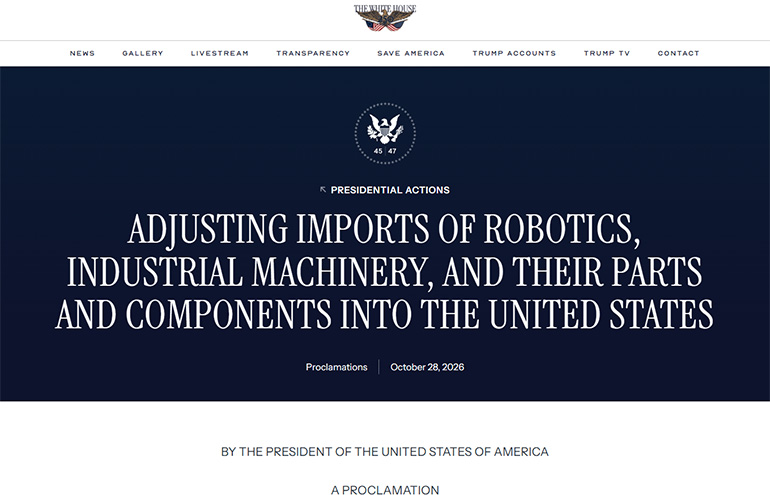
White House acts on robotics import review
The White House has issued a determination following a Section 232 investigation into imports of robotics, industrial machinery, and related components. The finding, submitted by the US secretary of commerce, concludes that the products are being imported in quantities and under circumstances that threaten to impair US national security.
The decision does not itself announce a tariff schedule. Instead, it directs the secretary of commerce and the US trade representative to negotiate with trading partners to adjust imports so they do not pose the stated national-security risk. That leaves the form, timing, and country-specific consequences of any eventual trade measures unresolved.
Why robotics was included
In the proclamation, the administration describes robotics and industrial machinery as foundational to modern manufacturing. It says the systems are important across defense, commercial, and dual-use applications, as well as mission-critical military and law-enforcement activity.
The determination also identifies agriculture, automotive manufacturing, and electronics manufacturing as critical sectors in which robots and related systems matter to US competitiveness. The White House cites approximately $7.1 trillion in shipments of manufactured goods in 2024 and roughly $86 billion worth of equipment production that year as indicators of the economic activity connected to the sector.
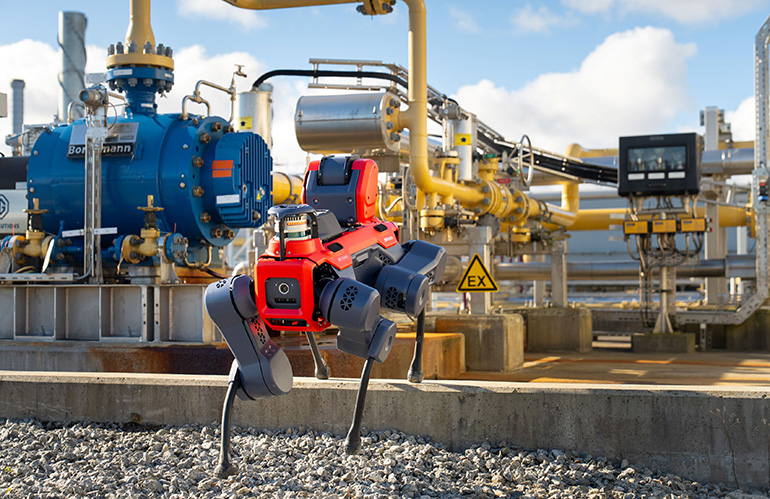
The scope goes beyond conventional factory automation. The Section 232 statement specifically names advanced robots, including autonomous robots, humanoid and quadruped robots, and autonomous ground vehicles. It says such systems can provide direct support to the US military.
Imports, capacity and cybersecurity
The administration’s rationale combines economic dependence and security concerns. It says the value of imported robotics and industrial machinery has increased over the past decade, while cybersecurity risks have also grown.
US investment in domestic robotics production capacity has increased, according to the president’s statement, but the administration says that capacity remains insufficient to meet domestic demand. That gap is central to the finding: the government argues that the country’s reliance on imports can have consequences beyond price or supply availability when equipment is used in manufacturing, infrastructure, defense-linked work, or other sensitive settings.
The article’s source notes that many major industrial-automation providers are headquartered outside the United States. That means negotiations prompted by the determination could affect a broad range of equipment makers and customers, rather than being limited to one narrow class of consumer robots.
What happens next
Section 232 is the US legal process used to assess whether imports affect national security. In this case, the administration has chosen to begin with negotiations with trading partners. The proclamation does not specify an agreement, tariff rate, or implementation date.
For manufacturers and robotics buyers, the immediate significance is policy uncertainty. Companies that depend on imported industrial systems, components, or advanced mobile robots may need to watch for the outcome of those talks and for any subsequent trade actions. Suppliers with US production ambitions may also see the determination as a signal that domestic capacity has become a more prominent policy objective.
The administration frames the move as an effort to protect both security and economic competitiveness. Whether it leads to tariffs, negotiated import arrangements, changes in sourcing, or additional incentives for domestic production will depend on the negotiations now ordered by the White House.
This article is based on reporting by The Robot Report. Read the original article.
Originally published on therobotreport.com