A proposed measure for robots at work
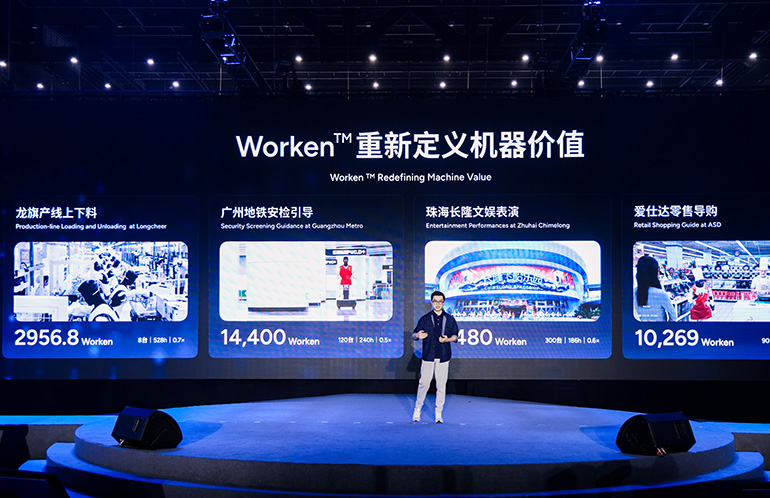
Chinese robotics company AGIBOT has introduced a proposed framework called Worken, intended to measure how much productive work robots deliver after they leave the factory. The announcement came at AGIBOT Innovation Day 2026 in Shanghai, alongside new robot hardware, software and embodied-AI model announcements.
The name combines “work” and “token,” and the concept is meant to shift attention away from familiar industry milestones such as units manufactured, shipments or demonstrations. AGIBOT’s stated question is more operational: once a robot is deployed in a factory, warehouse or service setting, how much useful work can it perform autonomously and consistently?
That distinction matters as robotics companies seek to make the case that machines are moving beyond prototypes and pilots. A robot fleet can be large on paper while still requiring frequent intervention, completing only narrow tasks or producing results that are difficult for an operator to compare across sites. A productivity-oriented measure could make those differences more visible—if companies can define it consistently and validate it in real settings.
From deployment counts to task output
AGIBOT presented Worken as a response to what it sees as a changing benchmark for the industry. The company said manufacturing scale, technical capability and deployment milestones remain important, but argued that sustained autonomous operation and measurable task output are becoming increasingly significant indicators of value.
Peng Zhihui, AGIBOT’s co-founder, president and chief technology officer, framed the proposal around the gap between technical progress and operational results. Hardware, AI models and manufacturing capacity have advanced rapidly, he said, but practical deployments require a clearer answer to how much productive work robots actually deliver.
AGIBOT did not present Worken in the supplied announcement as a broadly adopted industry standard. It is a company proposal, rather than an established external metric. Its significance will therefore depend on whether it develops into a transparent, reproducible way to compare work across different robots, tasks and operating environments.
Even so, the proposal identifies a persistent issue in robotics evaluation. A demonstration can show locomotion, grasping or conversation, but a business customer ultimately needs to know whether a system can keep performing a useful task reliably in a real workflow. Measuring that outcome is harder than counting a robot delivery, because conditions, task definitions and degrees of human supervision vary widely.
A broader deployment-first push
Worken was one part of a larger slate of AGIBOT announcements. The company introduced AHA3, described as an integrated hardware platform bringing together three forms of intelligence, and highlighted developments in its AGILE motion intelligence framework. It also described a new self-evolving agent capability.
On the model side, AGIBOT showed GO-3 Preview, characterized as its next-generation embodied-AI foundation model, and WITA-Omni 1.0, an omni-modal interaction model. The company also launched the G2 Max industrial robot and Link-U OS 1.0, a software framework. According to the announcement, the event included applications in manufacturing and commercial services.
The common thread is a deployment-first strategy: linking robot bodies, motion and task intelligence, interaction, operating software and field applications. That approach reflects an industry reality. A robot’s value is not determined by a foundation model or actuator in isolation. It depends on whether the entire system can operate in the environments where customers need it, integrate with workflows and produce an outcome repeatedly.
AGIBOT’s scale claims
Founded in 2023 as Zhiyuan Xinchuang Technology Co., AGIBOT is based in Shanghai and works across humanoid robots, quadrupeds, dexterous systems and commercial cleaning systems. The company said last month that its 20,000th robot had rolled off the production line. It also cited an IDC report that placed it first in global humanoid robot shipments during the first half of 2026.
Those figures illustrate why AGIBOT is emphasizing a metric beyond shipments. Manufacturing and deployment volumes can show that a company has the capacity to build and place machines, but they do not by themselves reveal how effectively those machines are operating after deployment. In that sense, Worken is an attempt to make performance in the field the next visible layer of competition.
The test is comparability
For Worken to become useful beyond AGIBOT’s own ecosystem, its measurement rules would need to answer difficult questions. What counts as a unit of useful work? How are task complexity, downtime, error rates, safety constraints and human assistance treated? Can one robot’s output in a controlled setting be meaningfully compared with another’s output in a busy warehouse or factory?
The announcement does not provide those technical details, so it is too early to judge how the framework will work in practice. But the focus is notable. As more robots enter commercial environments, customers are likely to demand evidence not only that machines can perform impressive individual capabilities, but that they can deliver dependable task output over time.
AGIBOT’s Worken proposal puts that demand at the centre of its 2026 product message: the consequential measure of robotics progress may increasingly be the work completed after deployment, not simply the number of robots built.
This article is based on reporting by The Robot Report. Read the original article.
Originally published on therobotreport.com