The Navy is expanding its bet on autonomous survey vessels
The U.S. Navy’s selection of Blue Water Autonomy for deep-ocean survey work is a notable signal about where maritime autonomy is moving from concept to mission use. According to the supplied source text, the Boston-based company has been chosen for a multiple-award contract with the Naval Oceanographic Office, or NAVOCEANO, to provide high-resolution ocean-floor mapping using long-endurance uncrewed surface vessels. The arrangement is structured as a multi-year, multiple-award indefinite-quantity contract with a $40 million ceiling, which Blue Water Autonomy will compete for alongside other selected companies.
On its face, the contract is about surveying. In practice, it points to a broader shift in how the Navy wants to gather and refresh data in remote waters. Survey missions are expensive, slow and often conducted far from shore for long periods. Those characteristics make them a strong fit for autonomous systems, particularly vessels designed to stay at sea for months and cover long distances without putting crews on board.
Why ocean-floor mapping matters
Seafloor mapping sounds technical and narrow, but the source material makes clear that the mission has wider military value. Deep open-ocean surveys do more than create a chart of underwater terrain. They characterize the operating environment, including factors such as terrain and acoustics, and help build a picture of the changing conditions that shape how naval forces move and operate far from shore.
That makes survey data relevant to planning, navigation and the broader understanding of maritime conditions across vast areas. The source text specifically notes that the work will support operations across the Indian and Pacific oceans. Those are strategically important regions where distance, cost and endurance all favor systems that can remain deployed far longer than a conventional crewed ship can economically justify.
For the Navy, the appeal is straightforward. Sending crewed survey vessels hundreds or thousands of nautical miles offshore for extended work is costly. The source text says such ships can cost tens of thousands of dollars per day to operate. Uncrewed systems promise a way to lower that operating burden while also reducing personnel risk and increasing total coverage.

What Blue Water Autonomy is offering
Blue Water Autonomy was founded in 2024 and focuses on unmanned ships that can operate autonomously on the open ocean for months at a time. The company says its vessels integrate hardware, software and AI as a single system. That full-stack approach matters in maritime autonomy because endurance missions place demands not only on navigation software, but also on hull design, power management, sensing, communications and fault tolerance.
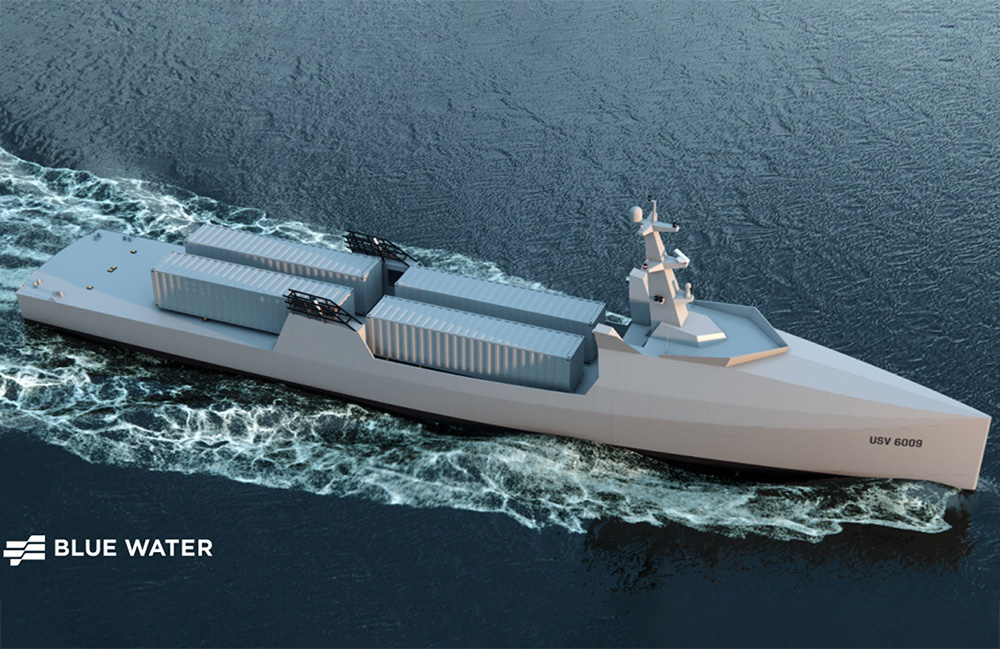
The company unveiled its first vessel, the Liberty Class, in February. According to the source text, it is a 190-foot steel autonomous ship with a range of more than 10,000 nautical miles and payload capacity above 150 metric tons. Those numbers suggest a platform intended for practical deployment rather than a small experimental demonstrator. The company also expects to complete its first vessel for the U.S. Navy this year under a program of record, indicating that the current award sits within a larger pattern of Navy engagement.
The Liberty Class is being built on Damen’s Stan Patrol 6009 hull design. Blue Water Autonomy says using a proven hull reduces technical risk. That is an important detail because one of the hardest parts of defense autonomy is moving beyond prototypes. Reusing a known design can shorten validation cycles and shift attention toward autonomy, mission systems and operational reliability rather than basic naval architecture.
A young company entering a serious market
The company’s pace is also noteworthy. Founded only two years ago, Blue Water Autonomy has already raised substantial capital. The supplied text says it secured $50 million in Series A funding last year, bringing total funding to $64 million. In defense and maritime technology, funding alone does not guarantee adoption, but contract selection by a Navy office responsible for oceanographic missions is more consequential than a financing headline. It suggests the company has crossed an early credibility threshold.
That threshold matters because maritime autonomy is crowded with prototypes, pilots and ambitious claims. Actual government selection for operationally relevant work is rarer. Blue Water Autonomy is still competing within a multi-award framework rather than receiving the full contract value outright, but even that position places it inside a procurement pathway that can lead to recurring mission work if performance holds up.

What this says about naval autonomy
The award reflects a broader evolution in uncrewed defense systems. Much public attention has focused on aerial drones, autonomous aircraft and smaller naval surface systems used near coastlines or in tightly scoped missions. Deep-ocean survey is different. It requires endurance, survivability, dependable autonomy and the ability to operate far from direct human support. If autonomous ships can prove themselves in that environment, they become useful not only for mapping but for a wider set of maritime tasks.
The source material explicitly frames open-ocean survey as the kind of work autonomous vessels are built for. That is a practical way to think about adoption: start with missions where persistence and operating cost matter more than onboard human judgment or immediate tactical complexity. Surveying fits that profile well. The task is valuable, repetitive, geographically dispersed and often detached from crowded near-shore conditions. In other words, it is a plausible beachhead mission for larger autonomous maritime fleets.
NAVOCEANO and the wider Navy have already been expanding their use of uncrewed systems for these missions, according to the source text. The reasons given are cost, personnel risk and coverage. Those are durable drivers, and they suggest this contract is less an isolated experiment than part of a steady institutional trend.
The commercial and strategic implications
For industry, the selection reinforces the idea that maritime autonomy is becoming a serious procurement category rather than a speculative technology theme. Companies that can combine reliable vessels, mission payloads and defensible autonomy stacks may find demand not only in defense but also in commercial ocean mapping, offshore energy support and remote inspection work. The military use case is especially important because it often funds the long development cycles needed to harden these systems.
Strategically, the Navy’s interest in long-endurance mapping platforms reflects a simple reality: ocean knowledge is infrastructure. Better data about the seafloor and the operating environment improves decision-making well beyond the survey mission itself. If autonomous ships can gather that data more cheaply and more often, they can reshape how maritime awareness is built over time.
Blue Water Autonomy’s contract win does not by itself prove that autonomous survey vessels are ready to transform naval operations. But it does show that the Navy is willing to place this class of system inside real mission pipelines. That is usually the moment when an emerging technology stops being a future concept and starts becoming a capability.
This article is based on reporting by The Robot Report. Read the original article.

Originally published on therobotreport.com