Funding a data-intensive approach to general-purpose robotics
Tutor Intelligence has raised $75 million in Series B funding as it seeks to expand the training, deployment and commercial use of its robot systems. The company says its approach combines fleets of internet-connected robots, remote human input, simulation and real-world data to improve AI models for physical work.
The Watertown, Massachusetts-based company spun out of the Massachusetts Institute of Technology’s Computer Science and Artificial Intelligence Laboratory in 2021. It is pursuing what it describes as a full technology stack intended to narrow the gap between tasks robots can perform and tasks people can perform.
The financing arrives as robotics companies face a central challenge that differs from training software-only AI systems: useful physical-world data is comparatively scarce and expensive to gather. Text and image models can learn from large online records. Robots, by contrast, must contend with varied objects, environments, movements and exceptions in the real world.
Robots that produce training data while doing work
Tutor’s model is built around deployments in production environments. Its robots perform customer work while receiving input from remote operators called tutors. The resulting data is used to train improved models, which the company says can then make its robots more capable.
That creates a feedback loop. Better models can support broader deployment; broader deployment can generate more examples of real manipulation tasks; and those examples can be used to improve subsequent models. Tutor refers to this as a data flywheel.
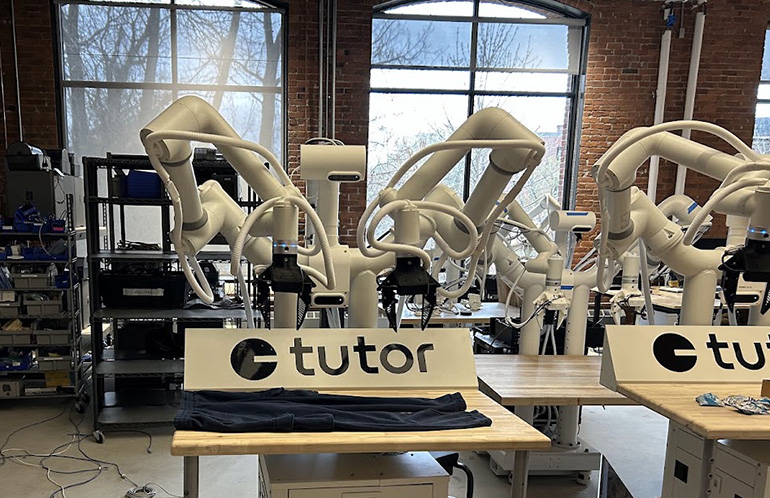
The company also uses simulation and has opened a Data Factory to evaluate policies across 100 physical robots. Physical evaluation is significant because performance in a simulation does not automatically transfer to an operating setting, where handling, positioning and object variation can introduce failure modes that are difficult to anticipate from virtual data alone.

Two systems aimed at warehouse-style tasks
Tutor’s Data Factory includes Sonny, a two-armed, semi-humanoid robot used for each picking. The company also offers Cassie, a mobile manipulator designed for case picking and palletizing.
Those are demanding applications for conventional automation. A fixed robotic system is often most effective when a task is highly repeatable and an environment is tightly controlled. Picking varied items and handling cases or pallets can require more flexibility, perception and recovery from unexpected conditions. Tutor says its platform is intended to bring automation to tasks that have long resisted deterministic robotics.
The company’s claims should be read as statements about its platform and deployment strategy rather than as an independently verified measure of general-purpose robotic capability. Still, the focus on picking, case handling and palletizing places the company in a commercially important part of the robotics market: material movement and fulfillment work.
A different commercial model
Tutor says customers pay by the hour or by the pick, similar to the way they pay for manual labor. According to the company, customers do not make an upfront robot purchase or sign a long-term contract. Tutor handles deployment and maintenance and provides regular software and intelligence upgrades.
That structure differs from a conventional capital-equipment sale and from a standard robots-as-a-service arrangement, according to the company. It may lower the initial barrier for businesses that want automation but are reluctant to invest heavily before seeing operational results. It also places more responsibility on Tutor to operate, maintain and continually improve the systems it deploys.
The approach depends on proving that a robot can perform enough useful work, reliably enough, at a price that makes sense for a customer. The company’s emphasis on hourly or per-pick pricing directly ties the commercial proposition to that operational test.
What the Series B is intended to support
Tutor said the new funding will help it further develop its picking robots, its networked intelligence and its commercial deployments. Chief executive and co-founder Josh Gruenstein said the company sees demand for robots that can perform jobs conventional systems have not been able to do, while lowering the cost of access to automation.
The broader bet is that real-world deployment itself can become a durable advantage. In software AI, large datasets can be gathered from the internet. For robotics, a company that operates machines in working environments can collect examples that are difficult to reproduce from public sources alone. Remote tutors may help robots navigate difficult cases while also producing data for future training.
That does not eliminate the hard problems of safe manipulation, reliability and economic performance. It does make the company’s progress measurable in practical terms: how many tasks its robots can handle, how often they need human intervention, how quickly their performance improves and whether customers continue to use them.
The significance of the raise
The $75 million Series B gives Tutor Intelligence additional resources to pursue this deployment-led path. Rather than presenting robot intelligence as a one-time model release, the company is positioning it as an operating system that learns from an expanding installed fleet.
If that loop works at scale, every deployment could contribute to future capability while customers receive updated software and intelligence. The near-term question is whether that learning cycle can translate into reliable, economically useful automation across more real-world tasks. Tutor’s funding is a vote for testing that proposition in production, where robots must do useful work rather than merely demonstrate potential.
This article is based on reporting by The Robot Report. Read the original article.
Originally published on therobotreport.com