The Arrival of a Microcar
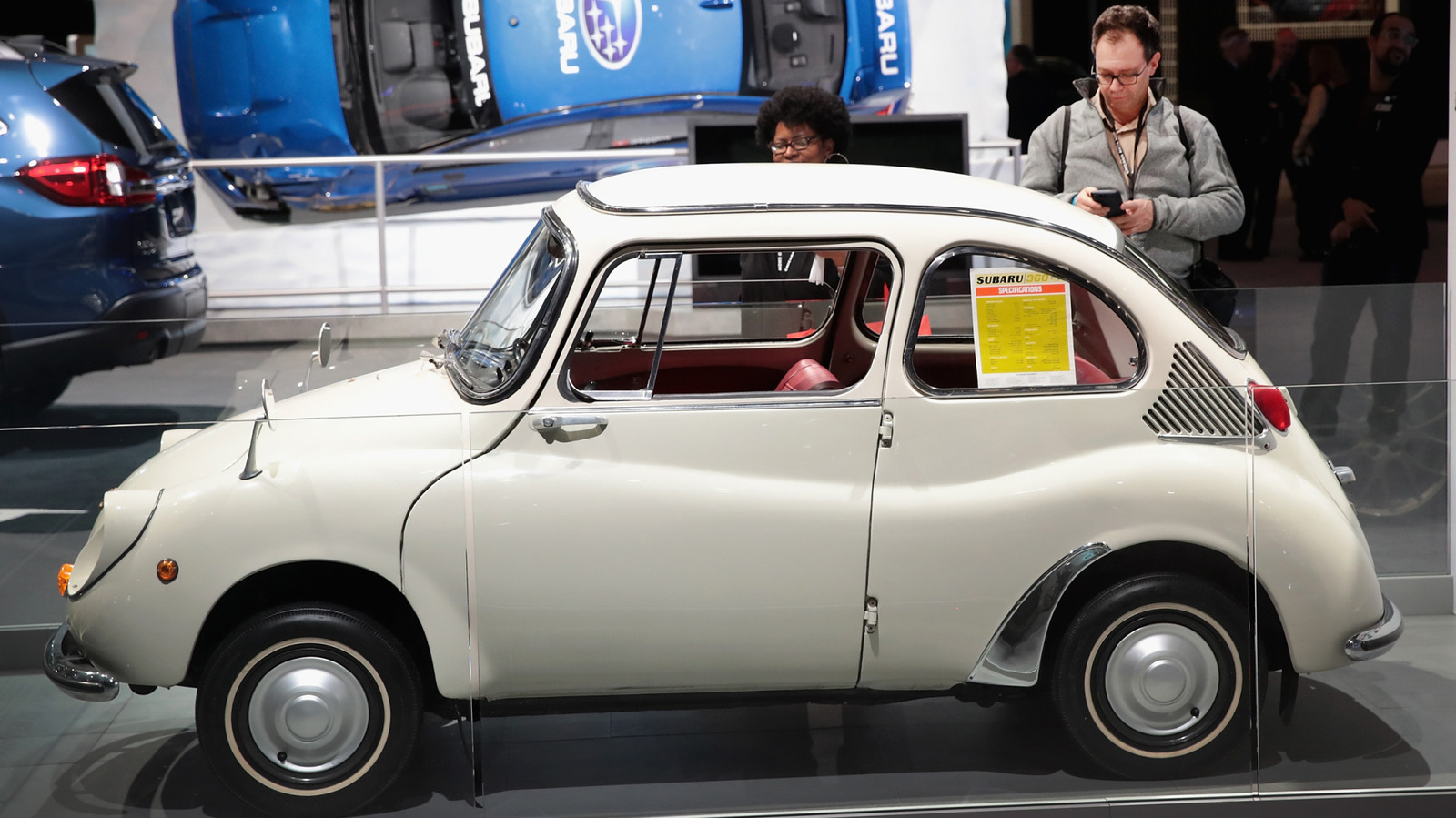
In 1968, Subaru made its first serious attempt to enter the American automobile market with a vehicle that was already a legend in its home country: the Subaru 360. This tiny two-door, with its air-cooled, two-stroke engine displacing just 360 cubic centimeters, represented a bold bet that American buyers would embrace the same kind of microcar that had become a staple of postwar Japanese motoring. The gamble did not pay off. The Subaru 360 was met with harsh criticism, particularly from Consumer Reports, which declared it unsafe and woefully underpowered. Within a few short years, the car disappeared from U.S. showrooms, leaving behind a cautionary tale about the risks of bringing a kei car to a market that was not ready for it.
The Subaru 360 was not just any small car; it was the smallest production car Subaru ever built, and it held that distinction for decades. Weighing in at just 993 pounds without a driver, it was barely more than a motorcycle with a roof. Its engine, a two-stroke twin producing a meager 16 horsepower, was designed to exploit Japan's kei car regulations, which capped engine displacement at 360cc. In Japan, where roads were narrow, fuel was expensive, and parking was scarce, the 360 made perfect sense. It was economical, nimble, and affordable. But America in the late 1960s was a different world, one dominated by big-block V8s, sprawling freeways, and a growing obsession with safety.
Underpowered and Overmatched
Consumer Reports' testing of the 1968 Subaru 360 was nothing short of damning. The magazine had a reputation for rigorous, no-nonsense evaluations, and the little Subaru failed on nearly every measure. The most glaring issue was performance. With only 16 horsepower to move 993 pounds, the car had a power-to-weight ratio that was almost absurdly poor. Consumer Reports calculated that it took a staggering 37.5 seconds for the 360 to accelerate from 0 to 50 miles per hour. In an era when even modest economy cars could reach highway speeds in under 20 seconds, this was embarrassingly slow. To put it in perspective, a contemporary Kawasaki motorcycle with a smaller engine could produce far more horsepower relative to its weight. The Subaru 360 was simply not equipped to keep up with even the slowest traffic on American Interstates.
Subaru of America had hoped that the 360's low price and tiny footprint would appeal to budget-conscious buyers. But the reality was that American drivers expected a certain level of performance, and the 360 was unable to deliver it. Consumer Reports noted that even the car's fuel economy, which should have been a selling point, was offset by the need to mix oil with gasoline, a quirk of two-stroke engines that many American buyers found inconvenient and messy. The engine was also noisy and prone to vibration, making long drives uncomfortable.
A Safety Disaster
If the 360's acceleration was disappointing, its handling was downright dangerous. Consumer Reports conducted an emergency swerve test to simulate avoiding an obstacle, and the results were frightening. The magazine reported that during the maneuver, the car's outside rear wheel tucked under as the rear end hiked up, causing sudden and violent oversteer. Simultaneously, the front wheels lost their cornering bite, making the car nearly impossible to control. Consumer Reports concluded that if a driver needed to steer around a potential accident, the result would very likely be an accident.
The cause of this instability was attributed to the car's suspension design. Despite featuring fully independent suspension, the 360's geometry and tuning were not suited for the demands of American driving conditions. The drum brakes, while capable of stopping the car efficiently, suffered from severe front-end dive during hard braking. The soft front dampers allowed the nose to pitch alarmingly forward, which could destabilize the car and reduce steering effectiveness. In an era when safety regulations were tightening and consumers were becoming more aware of crashworthiness, the 360's poor dynamic behavior was a dealbreaker.
Unfair Comparison: The VW Beetle
Consumer Reports explicitly compared the Subaru 360 to its most obvious rival in the American microcar segment: the Volkswagen Beetle. The comparison was not flattering. The 1968 Beetle, with its air-cooled 1.5-liter engine, produced 53 horsepower, more than three times the output of the Subaru. At 1,742 pounds, the Beetle was heavier but still had a far better power-to-weight ratio. It could accelerate from 0 to Interstate speeds in a respectable 14.5 seconds, less than half the time needed by the Subaru 360. The Beetle was also considered safe enough to pass the standards of the day, even if it wasn't perfect. The Subaru, by contrast, was seen as dangerously unstable.
The Beetle had been sold in the United States since the 1950s and had built a reputation for reliability, simplicity, and durability. It was a known quantity. The Subaru 360 was an unknown, and Consumer Reports' negative review effectively killed any chance it had of gaining a foothold. The magazine's influence over American car buyers was enormous, and its verdict that the 360 was unsafe and slow was a death sentence.

A Star in Japan, a Flop in the US
To understand the Subaru 360's failure, one must appreciate its origins. In Japan, kei cars were a category of small vehicles that enjoyed tax and insurance advantages. When legislation capped kei car engine displacement at 360cc in 1958, Subaru was quick to capitalize. The company launched its first model that very year and quickly became the dominant player in the kei car segment. Between 1958 and 1971, Subaru led the market, producing millions of these tiny vehicles for domestic consumers.
In Japan, the 360 was a practical and beloved solution to the challenges of dense urban living. Its small size made it easy to park, its engine was cheap to run, and its design was charming. But the American market was fundamentally different. U.S. roads were wider, speed limits were higher, and consumers were used to larger, more powerful cars. The 360's virtues in Japan were irrelevant, and its vices were magnified. Subaru of America, the importing arm led by Malcolm Bricklin, had hoped to introduced the 360 as a low-cost alternative to the Beetle. Bricklin, who would later gain fame for his own gull-winged sports car, was enthusiastic about the 360's potential. But the Consumer Reports review, which specifically targeted the car's safety flaws, made it clear that Americans would not tolerate such a machine.
Legacy of a Failure
The Subaru 360's failure in the United States was a setback for Subaru, but it also provided valuable lessons. Subaru would later return to America with conventional vehicles, and the company eventually found success with cars like the Subaru Outback and WRX. The 360 itself has become a collector's item, a quirky reminder of an era when microcars were a hopeful experiment. Its failure was not just about speed or safety, but about cultural mismatch. What works in one market may not work in another, and the 360 showed that a car must be designed for the conditions and expectations of its target buyers.
Today, the Subaru 360 is remembered as an interesting footnote in automotive history. It was Subaru's smallest production car, and it holds the dubious honor of being the company's first vehicle sold in the U.S. Its brief and unsuccessful run in America is a classic example of how a good idea can go wrong when it is transplanted without adaptation. For those who study automotive history, the Subaru 360 is a reminder that even the most promising products can fail if they don't meet the needs of the market.
Key Specifications of the 1968 Subaru 360
- Engine: 360cc two-stroke, air-cooled, two-cylinder
- Power: 16 horsepower
- Curb weight: 993 pounds (without driver)
- 0-50 mph time (Consumer Reports test): 37.5 seconds
- Transmission: manual, rear-engine layout
- Brakes: drum brakes with excessive front dive
- Positive attributes: low cost, good fuel economy in ideal conditions, unique design
The story of the Subaru 360 is one of ambition meeting reality. It was a car that made perfect sense in one part of the world and absolutely none in another. Consumer Reports' role in exposing its flaws cannot be overstated. Without that negative review, the 360 might have sold to a niche of curious buyers, but it likely still would have struggled. The American public had spoken: they wanted more, not less. And so the 360 slipped away, leaving behind a legacy that is both cautionary and fascinating.
This article is based on reporting by Jalopnik. Read the original article.
Originally published on jalopnik.com